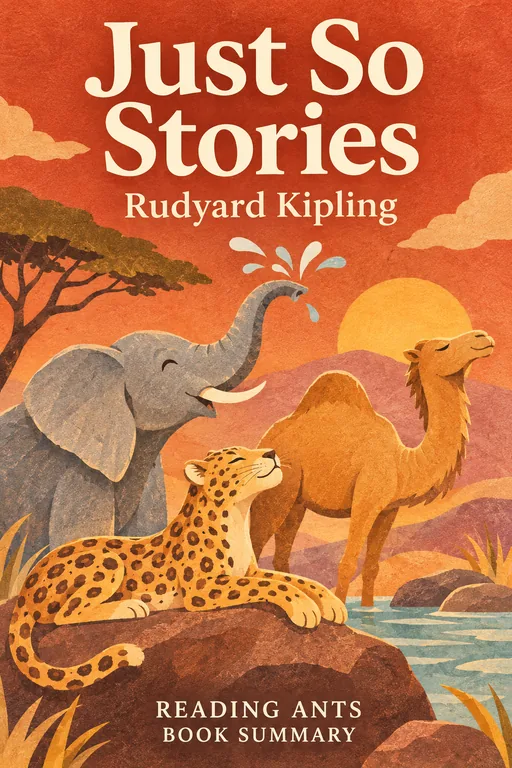
Just So Stories
In a collection of playful origin tales told to a child called Best Beloved, Rudyard Kipling imagines how animals got their well-known features, such as the camel's hump, the leopard's spots and the elephant's long trunk.
Overview
Just So Stories for Little Children is a collection of tales by Rudyard Kipling, published in 1902. They were first told to his own young daughter at bedtime, and they keep the rhythm of spoken storytelling, with repeated phrases, funny names and a warm narrator who addresses the child as “Best Beloved.” Each story explains in a comic way how an animal came to look or behave as it does. Kipling also drew the original illustrations. The tales are short, playful and meant to be read aloud, though a few contain attitudes of their time.
Main Characters
- Best Beloved: the listening child to whom the narrator tells every tale.
- The Elephant’s Child: a young, curious elephant who asks too many questions.
- The Crocodile: a sly river creature who pulls the elephant’s nose long.
- The Camel: a lazy animal who refuses to work and says “humph.”
- The Parsee: a man in a hot country whose cake is stolen by a rhinoceros.
- The Rhinoceros: a greedy animal who takes off his skin to bathe.
- The Cat: a wild creature who keeps to himself in a famous tale.
Full Summary
How the Whale got his throat
In the early days, a hungry whale eats all the fish in the sea, until a small, clever fish tells him that he should try a shipwrecked sailor floating on a raft. The whale swallows the man whole, along with his raft, but the sailor, who has a pair of suspenders and a knife, jumps and dances inside the whale until the whale gets the hiccoughs and asks him to come out. The sailor insists on being taken home first. While the whale swims, the sailor cuts the raft into a criss-cross grating and ties it with his suspenders, and when he steps out onto the beach he wedges it into the whale’s throat. To stop the whale from swallowing people again, the grating stays there, so that now whales can eat only very small fish.
How the Camel got his hump
When the world was new, the Camel lives in the desert and refuses to work, answering every request with “humph.” The Horse, the Dog and the Ox complain, until a magical Djinn, who is in charge of all deserts, grows tired of the idleness and gives the Camel a large lump on his back. Because he missed three days of work, the Djinn says, he will now be able to work for three days without food, living on the hump, and so he must go and join the others. Ever since, the Camel has had a hump, and he has never caught up with the three days that he missed.
How the Rhinoceros got his skin
On an uninhabited island by the Red Sea, a Parsee man bakes a cake, and a rhinoceros, who has a smooth skin fastened by buttons, upsets the stove and eats the cake. Later, the Rhinoceros takes off his skin and goes for a swim. The Parsee finds the skin and fills it with stale cake crumbs, which makes it tickly inside. When the Rhinoceros puts on the skin again, it itches terribly, and he rolls on the sand and rubs against a palm tree to relieve it. The skin is now full of folds, and the Rhinoceros is bad-tempered forever.
The Elephant’s Child
The Elephant’s Child is full of curiosity and asks endless questions, for which his relatives spank him. When he asks what the Crocodile has for dinner, everyone hushes and spanks him, and the Kolokolo Bird tells him to go to the Limpopo River and find out for himself. On the way he meets a Python, who spanks him too, and then he meets the Crocodile, who seizes his short nose and pulls. The Python helps him tug free, but his nose has been stretched into a trunk. At first he is upset, but the Python shows him how useful a trunk is. He returns home and uses it to spank the relatives who once spanked him, and soon the whole family goes to the Limpopo to borrow new noses, which is why every elephant has a trunk.
The Cat that Walked by Himself
In the dawn of time, a woman makes a home in a cave and uses her magic to draw the wild animals in one by one. The Dog, the Horse and the Cow each make a bargain and become the woman’s helpers in return for food. The Cat, who insists that he walks by himself, bargains cleverly. The woman promises that if she ever praises him, he may enter the cave, sit by the fire and drink milk. He earns his place by amusing her baby and by catching a mouse, and each time he repeats that all places are alike to him. The Man and the Dog then make their own bargains, and ever since, the Dog chases cats and men throw things at them. Even so, the Cat catches mice and is kind to the baby, and at night he still walks by himself.
Why It Matters
Just So Stories is one of the best-loved collections of children’s tales in English, and it is often chosen for reading aloud. It combines humor, rhythm, invented words and affectionate fun, giving even simple explanations a feeling of magic. The stories show that curiosity, laziness, greed and cleverness can all shape a creature’s fate, and they invite children to imagine their own explanations of the world. Many phrases, such as “Best Beloved” and the name of the Limpopo River, are still known. The tales also influenced later writers of fables and nature stories.
Key Takeaways
- Curiosity has a price and a reward. The Elephant’s Child gets his trunk by asking questions.
- Laziness has consequences. The Camel’s hump follows from his refusal to work.
- Greed can backfire. The Rhinoceros loses comfort because he stole a cake.
- Cleverness helps the small. A tiny fish outwits the huge whale.
- Stories are meant to be heard. Rhythm and repetition make them memorable.
What We Can Learn
You can use these tales to encourage a child’s curiosity, and to invent new origin stories together, such as how a zebra got his stripes. They show how a story can teach through humor, not through lectures. Notice how Kipling uses repetition and sound to hold attention, and try reading them aloud with a lively voice. Adults can also talk with children about the old-fashioned attitudes in a few tales, and about why the explanations are not scientific, but are pleasures of imagination.
Criticism and Counterpoints
Some modern readers object to a few passages that reflect the colonial period in which Kipling wrote, such as the way in which some people and places are described and named, and editors have sometimes changed or removed them. Others find that the long, formal sentences and invented words are hard for young children without an adult reading aloud. Some teachers note that the stories are not accurate science and should not be mistaken for it. Kipling’s reputation is also debated because of his views on empire. Still, the stories are admired for their charm.
Who Should Read It
This book is for children from about four to ten as bedtime stories, and for adults who enjoy language and humor. It works best read aloud. Parents may want to preview the stories, and to explain the old-fashioned parts, or choose editions that are carefully prepared.
Want the whole book?
A summary is a taste, not the meal. Here is where to find the full book.
You reached the end 🎉
Nicely done. Mark this one as read, and we will suggest what to read next.
Read this next
The Jungle Book
Rudyard Kipling
A human boy raised by wolves in the Indian jungle learns the Law of the Jungle from a wise bear and a panther, and must outwit a man-eating tiger, in a collection of classic animal stories.
🧸 Children's Books
Charlotte's Web
E. B. White
A lonely pig named Wilbur learns he is going to be killed, and his clever friend Charlotte, a spider, comes up with an amazing plan to save his life.
🧸 Children's Books
The Wind in the Willows
Kenneth Grahame
A shy Mole, a kindly Water Rat, a gruff Badger and a boastful Toad share riverside adventures in the English countryside, in a story about friendship, home and the madness of Mr. Toad's passion for motorcars.
🧸 Children's Books
Aesop's Fables
Aesop
A collection of very short stories, mostly about talking animals, each teaching a simple lesson about life, such as slow and steady wins the race, and don't cry wolf.
🧸 Children's Books
Black Beauty
Anna Sewell
A gentle black horse tells the story of his life, from a happy childhood to hard years pulling cabs, and shows how kindness or cruelty can change an animal's whole life.
🧸 Children's BooksHarry Potter and the Philosopher's Stone
J. K. Rowling
An unloved orphan boy discovers on his eleventh birthday that he is a famous wizard, and during his first year at a magical school he makes true friends and faces the dark wizard who killed his parents.
🧸 Children's BooksWant something different?
Pick another topic and we will show you three books to start with.