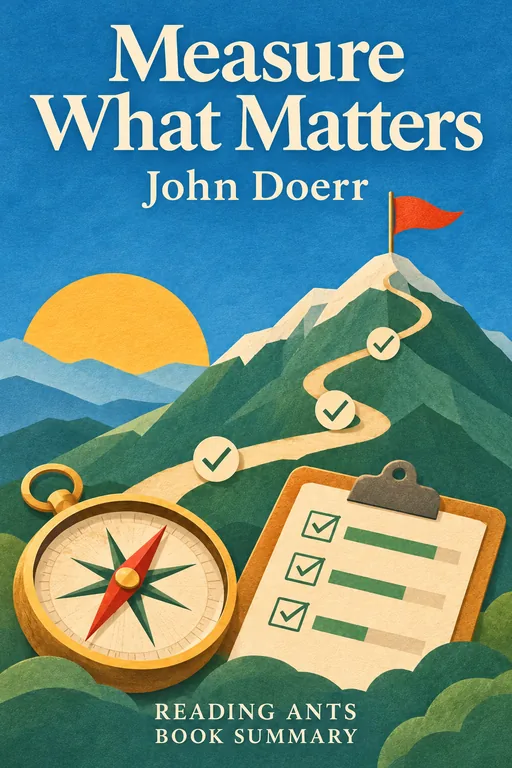
John Doerr explains the goal-setting system called OKRs, which stands for Objectives and Key Results, and shows through stories from companies and charities how clear, measurable goals help teams focus and aim high.
Overview
Measure What Matters was published in 2018 by John Doerr, a well-known investor in technology companies. Doerr learned the OKR method from Andy Grove, the leader of Intel, and later taught it to many young firms, including Google. The book explains how the system works and tells stories of organizations that used it. An objective is what you want to achieve. Key results are the specific, measurable results that show whether you are getting there. The book is written for managers, but the ideas can help students, families and anyone with a big goal.
Full Summary
1. Objectives and key results
The idea: An objective is a clear, motivating description of what you want to achieve. Key results are a small number of measurable results that tell you whether you have reached it. A good objective says what to do and why it matters, and a good key result is something you can check with a number, so that no one has to argue about whether it was met.
From the book: Doerr says that he first saw this system at Intel, where Andy Grove used it to keep a large company pointed in the same direction.
In real life: For a school year, an objective might be “become a confident reader.” The key results might be finishing twelve books and giving three short book talks.
2. Focus and commit to priorities
The idea: The first strength of OKRs is focus. Because only a few objectives are allowed, people must choose what is most important and say no to the rest. Doerr argues that this stops teams from doing many things in a half-hearted way.
From the book: He describes an Intel campaign, which the company pursued against a rival’s chip, to show how a clear and urgent goal can unite a whole company behind a single effort.
In real life: If you try to improve your grades, learn guitar, start a business and get fit all at once, you may do none of them well. Picking two for this term gives you a chance.
3. Align and connect for teamwork
The idea: In a company that uses OKRs, goals are shared openly, so that everyone can see what the company, the team and their colleagues are working on. Workers can then link their daily work to the larger mission. Doerr says that openness builds trust and helps people to help one another.
From the book: He explains that at Google, goals are visible to everyone in the company, and that this has helped people across teams to see how their work fits together.
In real life: When a class project has a posted plan and each student can see who is doing what, people are less likely to repeat work or to be surprised.
4. Track for accountability
The idea: OKRs are checked regularly, not just set once a year. People look at their progress, change their plans and learn from what is not working. Doerr says that an OKR is not a trap for punishing people. It is a way to see what is happening, and to take action sooner.
From the book: He suggests that goals can be scored simply, on a scale from zero to one, and that a team should end each cycle by reflecting on what it learned. He also shows the Gates Foundation using OKRs to track progress on ambitious goals, such as its work against malaria.
In real life: A runner who writes down times each week can see whether a training plan is working, and adjust it, instead of guessing.
5. Stretch for amazing
The idea: The fourth and last of the four “superpowers” is to aim higher than seems comfortable. At some companies, a “stretch” or “moonshot” goal is set so high that reaching about seventy percent counts as a good result. Doerr says that this can lead to bold ideas and breakthrough work, as long as people know the difference between a stretch and a commitment that must be met.
From the book: He tells how Google encouraged very ambitious goals, and he explains that such stretch goals are expected to be only partly reached, with an average score of around seventy percent, while goals that are real commitments are expected to be met in full.
In real life: A student who aims to write a 5,000-word story, and ends up with 3,500 good words, has done more than one who aimed for 1,000 and stopped.
6. Conversations, feedback and recognition
The idea: In the later part of the book, Doerr adds three ideas that go with OKRs: regular conversations between managers and staff, honest feedback, and recognition of good work. He says that goals can feel cold if they are not paired with real human contact, and that people stay motivated when they are noticed.
From the book: He presents this as continuous performance management, an alternative to relying only on a yearly review, and the book as a whole uses stories from nonprofits as well as companies to show that the system is not only for businesses.
In real life: Telling a teammate “you handled that call well” costs nothing, and makes people keep trying.
Why It Matters
Measure What Matters helped to spread OKRs from a few Silicon Valley firms to teams around the world. Many start-ups, charities and large companies now use some version of the method. The book matters because it shows a simple structure that works in different places, and it is open about its roots in the thinking of Andy Grove. It also encourages a particular attitude: that goals should be public, measurable and a little scary. The method has also been criticized and adapted, and the book is a starting point for people who want to try it. By including stories from non-business groups, Doerr also made the point that clear goals can help with social causes, and not only with profits. For many readers, this is an accessible first book on the topic of goals and results.
Key Takeaways
- Few goals, clearly stated. Choosing a small number of priorities is more powerful than a long list.
- Make results measurable. A key result should be something you can check with a number or a clear yes or no.
- Share goals openly. When people can see how their work connects, they cooperate better.
- Check progress often. Short, regular reviews help teams learn and change course.
- Aim high, and treat goals as a guide. Stretch targets bring bold ideas, as long as people are not punished for honest effort.
What We Can Learn
You can use OKRs on a personal scale. Write one objective for the next three months, such as getting stronger at math, and add two or three key results that you can count. Look at them every week and ask what is working. Share the goal with a friend or parent, since saying it aloud makes you more likely to act. When a goal is missed, ask what you learned, not who to blame. Finally, remember that a measure is a tool. If a number drives you to do something that is not truly useful, change the measure, not the purpose.
Criticism and Counterpoints
Critics say that OKRs can turn into a form-filling exercise that creates more paperwork than results. Measuring only what is easy to count can also lead people to ignore important things that are hard to count, such as creativity or kindness. If goals are tied to bonuses or promotions, people may set safe targets, or try to game the numbers. Some also point out that Doerr is an enthusiastic investor in the firms he writes about, so the stories are largely success stories, and failures receive less attention. The method works best when leaders use it to learn, not to punish.
Who Should Read It
This book is for managers, start-up founders, teachers, team leaders and students who want a practical way to set and track goals. It is short on theory and rich in stories. Readers who already know OKRs may find it repeats familiar ideas, and those who prefer research and data may want to look beyond its success stories.
Want the whole book?
A summary is a taste, not the meal. Here is where to find the full book.
You reached the end 🎉
Nicely done. Mark this one as read, and we will suggest what to read next.
Read this next
High Output Management
Andrew S. Grove
Andy Grove, a longtime leader of the chip maker Intel, explains that a manager's real output is the output of the team, and he shows how to raise it with leverage, good meetings, honest measures and one-to-one talks.
💼 Business
Atomic Habits
James Clear
Big changes in life come not from huge leaps but from tiny habits repeated every day, and you can build good habits (and break bad ones) by designing your life so the right choices are obvious, attractive, easy and satisfying.
🌱 Self-Improvement
Radical Candor
Kim Scott
Kim Scott argues that the best bosses and colleagues combine two habits, caring personally about people and challenging them directly, and she shows how to give honest feedback without being cruel or being fake.
💼 Business
The Lean Startup
Eric Ries
Startups succeed not by following a detailed plan but by quickly testing their ideas with real customers, learning from the results and changing direction when needed.
💼 Business
Good to Great
Jim Collins
Collins argues that sustained corporate improvement comes from disciplined leaders, carefully chosen people, a focused economic concept and cumulative execution rather than dramatic transformation programs.
💼 Business
Built to Last: Successful Habits of Visionary Companies
Jim Collins and Jerry I. Porras
A six-year study of long-lasting, successful companies, which finds that what sets them apart is a strong core purpose, combined with a constant drive to change and improve.
💼 BusinessWant something different?
Pick another topic and we will show you three books to start with.