 Reading Ants

Moon Over Manifest
In 1936 a girl sent to a run-down Kansas town for the summer uncovers the town's hidden history from 1918, and learns why her father left.
Overview
Moon Over Manifest is a 2010 novel by Clare Vanderpool, and it won the Newbery Medal in 2011. It is set in 1936, in the middle of the Great Depression. Twelve-year-old Abilene Tucker has been riding the rails with her father, Gideon, but now he sends her to Manifest, Kansas, his old hometown, to stay with a friend while he works a railroad job. Manifest is poor and worn down, but under a floorboard in her new home Abilene finds a box of letters and keepsakes, and a mystery begins. The story moves between 1936 and 1917 and 1918, when Manifest was a mining town full of immigrants, and a boy named Jinx and his friend Ned lived there. The two timelines slowly come together.
Main Characters
- Abilene Tucker: the twelve-year-old narrator, a curious girl who has traveled all her life.
- Gideon Tucker: her father, who sends her to Manifest.
- Jinx: a young con artist in 1918, who turns out to be her father as a boy.
- Ned Gillen: Jinx’s friend, who goes to war and writes the letters in the box.
- Shady Howard: the pastor (and saloon keeper) whose house is Abilene’s home for the summer.
- Miss Sadie: a Hungarian fortune-teller, or diviner, who tells Abilene the story of 1918.
- Lettie and Ruthanne: Abilene’s new friends.
- Hattie Mae Harper: the town newspaper reporter.
- Mr. Underhill: the town undertaker.
- Sister Redempta: the schoolteacher nun.
- The Rattler: a mysterious figure in the old letters.
Full Summary
Sent to Manifest
In 1936, Abilene’s father puts her on the train to Manifest, Kansas, the town where he grew up, while he takes a job on the railroad. She stays with Shady Howard, an old friend of his, who is the town’s pastor and also runs a saloon. Manifest is poor and run-down, hit hard by the Depression, and Abilene feels lonely and misses her father. Under a floorboard she finds a cigar box of letters and keepsakes written long ago by a boy named Ned to a boy named Jinx.
The Rattler
With two new friends, Lettie and Ruthanne, Abilene starts to read the letters. One of them mentions a figure called the Rattler, and the girls decide that he was a German spy in 1918 and set out to find him. Then a warning note arrives, telling them to stop, which only makes them more curious. While searching for the truth, Abilene loses her father’s compass.
Miss Sadie’s Story
To get the compass back, Abilene goes to the home of Miss Sadie, the diviner. After she breaks a pot, she has to work off the debt with odd jobs, and in return Miss Sadie tells her stories of two boys in Manifest in 1918. Jinx is a young con artist who has drifted into town. Ned is a boy who wants to join the army, and Jinx’s cleverness helps him enlist while he is too young. Ned goes off to war and writes letters from the front.
The Quarantine
In those days the mine owners controlled Manifest and paid the workers, who came from many countries, very little. When land came up for sale, the townspeople wanted to buy it before the owners could. To raise the money, they pretended that a sickness had hit the town and put themselves in quarantine, then sold a “healing” tonic. Someone betrayed the plan to the owners, who sent the workers back to the mine. In the end, the town managed to win the land it wanted. Then came word that Ned had been killed in the war in France, and Jinx blamed himself and left Manifest. A deadly flu later struck the town.
The Secret
Abilene realizes that the letters and Miss Sadie’s tale fit together, and that Jinx grew up to be her father, Gideon. He left Manifest because he blamed himself for Ned’s death, and in the same way he blamed himself for something painful that had happened to Abilene, and so he sent her away. She also learns that Ned was Miss Sadie’s son, whom she had watched over from a distance. The Rattler turns out to be a tale that grew from someone seeing a nun with a rattling rosary in the woods at night. The “spy” is the undertaker, Mr. Underhill, who had betrayed the town’s plan to the mine owners and wrote the warning note to scare the children off.
Coming Home
Abilene sends her father a telegram that makes him think she is sick. He rushes back, and she tells him that she knows who he is and why he ran away. She asks him to stay, and he understands. The two of them choose to make Manifest their home. It is a quiet and moving reunion, in which a father learns that his daughter forgives him.
Two Times, One Story
The book is built from two stories that run side by side: Abilene’s summer of 1936 and the town’s story of 1917 and 1918, which also comes through newspaper columns by Hattie Mae. Each one explains the other. The box under the floorboard holds the evidence of the past, and Miss Sadie’s tale gives it meaning. Abilene sees that Manifest was once a place where people from many countries worked, struggled and helped one another. She also sees that her father, whom she thought of only as a man who moved on, was once a boy who belonged here. Knowing where he came from helps her to understand where he is going.
Why It Matters
Moon Over Manifest was Clare Vanderpool’s first novel, and it won the 2011 Newbery Medal. It was praised for weaving two time periods into one mystery, and critics described it as richly detailed. The author has said that the fictional town of Manifest is based on the real Kansas town of Frontenac. It gives a rich picture of a small American town during the Depression and the First World War, with its immigrants, its miners and its secrets.
The book is also a story about how the past shapes the present, and about the way a child can heal a family by understanding what happened before she was born. Its mix of history and mystery has made it a favorite for classroom reading.
Key Takeaways
- The past explains the present. Abilene’s father’s behavior has roots in 1918.
- Guilt can make people run. Jinx blames himself and leaves.
- Small towns hold stories. Every object in the box has a history.
- Understanding brings forgiveness. Abilene can forgive because she knows why.
- Communities can band together. Manifest’s people work to save their town.
What We Can Learn
If a family member has a habit of running from problems, the book suggests that it helps to understand what is behind it. Abilene’s patience gives her father a reason to stay.
It also shows the value of listening to older people’s stories. Miss Sadie holds the key to the mystery, and Abilene learns by doing odd jobs and listening.
Finally, it reminds us that a place, such as a town or house, remembers the people who lived there. Listening to those memories can heal a family.
Criticism and Counterpoints
Some readers find the double time frame confusing, and the stories within stories slow to come together. One review says that several of the mystery’s threads, such as the question of the spy, fray at the end, and others find the reunion a little quick. The book’s picture of immigrant workers and the prejudice they faced is told in outline. Because the story has many characters and keeps moving between 1936 and 1918, some young readers may need to read slowly to keep track. But critics praised its warmth and its rich detail.
Who Should Read It
This book suits readers from about ten to fourteen who like mysteries, history and stories that unfold in layers. It is a good choice for classes studying the 1930s or small-town America. Readers who prefer a single storyline may find the shifts in time hard at first. Parents may want to know that the book includes a young soldier’s death, a flu epidemic, and a few scenes of violence.
Want the whole book?
A summary is a taste, not the meal. Here is where to find the full book.
You reached the end 🎉
Nicely done. Mark this one as read, and we will suggest what to read next.
Read this next

The Watsons Go to Birmingham - 1963
Christopher Paul Curtis
A funny family from Flint, Michigan, drives south to Alabama in the summer of 1963 to straighten out their troublemaking oldest son, and finds themselves close to one of the worst crimes of the civil rights era.
🧸 Children's Books
When You Reach Me
Rebecca Stead
A sixth-grade girl in 1970s New York gets mysterious notes that predict the future, and slowly realizes they are tied to a homeless man on her corner and to a boy she hardly knows.
🧸 Children's Books
Kira-Kira
Cynthia Kadohata
A Japanese American girl in the 1950s idolizes her older sister, who teaches her to see the world as glittering, and has to hold on to that vision when her sister becomes ill.
🧸 Children's Books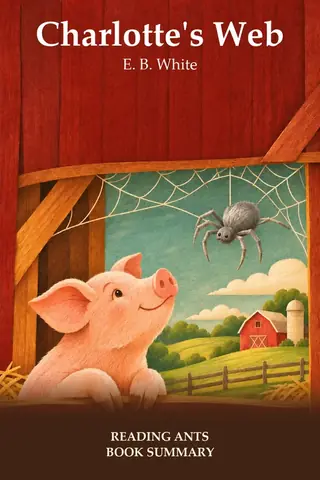
Charlotte's Web
E. B. White
A lonely pig named Wilbur learns he is going to be killed, and his clever friend Charlotte, a spider, comes up with an amazing plan to save his life.
🧸 Children's Books
Harry Potter and the Philosopher's Stone
J. K. Rowling
An unloved orphan boy discovers on his eleventh birthday that he is a famous wizard, and during his first year at a magical school he makes true friends and faces the dark wizard who killed his parents.
🧸 Children's Books
The Hobbit
J. R. R. Tolkien
A comfortable, home-loving hobbit is swept into a dangerous quest with thirteen dwarves to win back their treasure from a dragon, and discovers along the way that he is far braver and cleverer than he ever imagined.
🧸 Children's BooksWant something different?
Pick another topic and we will show you three books to start with.