 Reading Ants
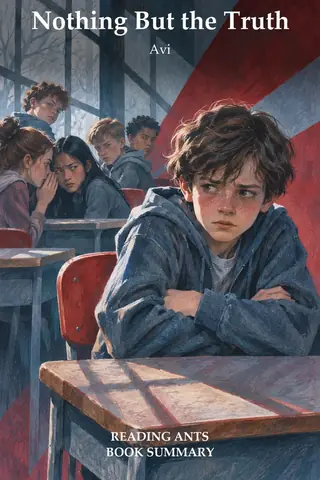
Nothing But the Truth
A ninth grader's complaint that he is not allowed to sing the national anthem in homeroom turns, through diaries, memos and news reports, into a national story in which nobody tells the whole truth.
Overview
Nothing But the Truth is a 1991 novel by Avi, subtitled A Documentary Novel. It was a Newbery Honor book. It has no narrator. Instead the story is told through documents: Philip’s diary, a teacher’s letters to her sister, school memos, phone calls, newspaper articles, a radio show and telegrams. It takes place from March 13 to April 9 at a high school in Harrison, New Hampshire. Philip Malloy, a ninth grader who wants to make the track team, gets into a dispute with his English teacher, who becomes his homeroom teacher, about humming along to the national anthem. By the end, a small quarrel has grown into a public scandal, and everyone involved has told the truth, but only some of it.
Main Characters
- Philip Malloy: a fourteen-year-old ninth grader, runner and paper carrier, who jokes his way through class and hates English.
- Miss Margaret Narwin: his English teacher of twenty-one years, who loves literature and writes to her sister.
- Mr. and Mrs. Malloy: Philip’s parents, who back him up when they hear his story.
- Dr. Gertrude Doane: the principal, who was once Miss Narwin’s student.
- Dr. Joseph Palleni: the assistant principal in charge of discipline.
- Dr. Albert Seymour: the superintendent, worried about a school budget vote.
- Ted Griffen: the Malloys’ neighbor across the street, who is running for the school board.
- Coach Jamison: the track coach.
- Allison Doresett: a classmate who likes Philip at first.
- Jennifer Stewart and Robert Duval: reporters for two different papers, one in New Hampshire and one in Missouri.
Full Summary
A Runner and a Teacher
Philip Malloy is a ninth grader at Harrison High. Coach Jamison wants him for the track team, and Philip dreams of winning races, as his father once did. He does not care for English, and he writes sarcastic diary entries about his teacher, Miss Narwin, and the book she assigns, The Call of the Wild. Miss Narwin writes to her sister in Florida that she has taught for twenty-one years and fears that students no longer love books. She thinks Philip is intelligent but restless and unambitious.
The Grade
On the winter exam, Philip answers a question about the novel with a silly joke, claiming the dog is really a cat, and Miss Narwin writes that this is unacceptable. His English grade for the term falls to a D. Then Coach Jamison tells him that a rule bars any student from a team unless every grade is passing. Philip never knew about the rule, and he realizes that he will not be able to try out. He blames his English teacher, and he decides that the best way out is to get moved into another class.
The Homeroom Change
At the start of spring, homerooms are changed, and on March 28 Philip lands in Miss Narwin’s. During the morning announcements, a tape of the national anthem plays, and the school’s rule is that students must stand in respectful, silent attention. Philip hums along. Miss Narwin tells him to stop, and he tells her that his old homeroom teacher did not mind. At dinner, Philip tells his parents that a teacher will not let him sing the national anthem. They are shocked, and that night his father tells him to stick up for his rights. Philip does not mention the grade or the track rule.
Sent Out, Suspended
The next morning Philip sings, and Miss Narwin sends him to the assistant principal, Dr. Palleni, who points out the rule. On the third morning, March 30, Philip insists that he has a right to sing, and he is sent out again. Palleni offers him a chance to apologize, Philip refuses, and he is suspended for the rest of that day and the next school day. Palleni also moves him back to his old homeroom. His mother is called from work to take him home. That evening his father takes him across the street to their neighbor, Ted Griffen, who is running for the school board, and who introduces him to a newspaper reporter, Jennifer Stewart. Philip tells her only about the anthem.
The Story Grows
The Manchester Record runs the story under the headline “Suspended for Patriotism,” and it wrongly calls Philip a tenth grader. A news service sends a shorter version across the country, and a radio host reads it on the air and invites callers. Telegrams and letters arrive at the school, most of them angry at Miss Narwin. Griffen uses the story in his campaign speeches. The principal, Dr. Doane, the assistant principal and the superintendent, Dr. Seymour, who is worried about a school budget vote, agree that they must all tell the same story, and the memos they write describe Philip’s singing as louder and more deliberate each time. Doane questions students, and what they say depends on how she asks.
Everyone Loses
Almost two hundred telegrams pile up at the school, and Miss Narwin receives a sack of letters, many from strangers who hate her. Dr. Doane tells her to take the rest of the term off with pay and to take the summer course the school had refused to fund, and Miss Narwin feels she is being pushed out. Philip is moved out of her English class too, and his classmates tease him and shun him. The school budget is defeated, and Ted Griffen is elected to the school board. Miss Narwin tells a reporter, Robert Duval, her side of the story, but he warns her that other big news has crowded it out, so his article about her may never be printed. She goes to Florida to stay with her sister. Philip transfers to a private school, where the teacher begins the day with the anthem and asks him to lead. He cries and says he does not know the words.
Why It Matters
Nothing But the Truth was a Newbery Honor book and a Boston Globe–Horn Book Honor book, and it remains a popular book in classrooms. Its documentary form is unusual in children’s books, and it makes the reader work out what really happened by comparing the documents. Avi says in a preface that many teachers have said that it sounds like their own school.
It is also a lesson about how stories spread. The book shows how a news story can be built from a single account and passed along, and how adults with their own worries, such as budgets, elections and reputations, bend the truth for their purposes.
Key Takeaways
- The truth has many sides. Each person in the story reports true facts but leaves out important ones.
- Leaving things out can mislead. Philip’s complaint is about the anthem, but he never mentions the grade that drives it.
- Adults protect themselves. The school leaders and the candidate focus on their own interests.
- Media can flatten a story. A news item turns a small dispute into a national issue.
- Patriotism is more than a gesture. Philip ends not knowing the words he wanted so much to sing.
What We Can Learn
When you hear a dramatic story, ask what might be missing. Who is telling it, and what do they want? Before taking sides, it helps to listen to everyone involved.
The book also teaches us to be honest with ourselves about why we do things. Philip says that he is standing up for his rights, but he is really angry about a grade. Admitting the real reason might have solved the problem on the first day.
Finally, it shows that small acts of disrespect or stubbornness, on any side, can grow into serious harm. A calm conversation early on might have saved everyone a great deal of trouble.
Criticism and Counterpoints
Some readers find the form hard to follow at first, because there is no narrator to explain things, and some wish for more of Philip’s thoughts. Others say that Philip is not very likable, and that the adults, from the principal to the candidate, are drawn as rather simple types. A few critics think that the events, such as a national newspaper story over a homeroom dispute, are exaggerated. Some readers also wish that the book said more about what finally happens to Miss Narwin. Many still praise its sharp humor and its message.
Who Should Read It
This book suits readers from about ten to fourteen, especially those who enjoy puzzles and arguments about what is fair. It is a good choice for classroom discussion on truth, media and school life. Readers who like action may find a story told in memos slow, but short chapters keep it moving.
Want the whole book?
A summary is a taste, not the meal. Here is where to find the full book.
You reached the end 🎉
Nicely done. Mark this one as read, and we will suggest what to read next.
Read this next
The Wednesday Wars
Gary D. Schmidt
A seventh grader in 1967 who is stuck alone with his teacher every Wednesday afternoon finds, through Shakespeare, a way to grow up in a year of war and family trouble.
🧸 Children's Books
Hoot
Carl Hiaasen
A new kid in Florida teams up with a barefoot runaway and a tough classmate to save a nest of tiny burrowing owls from a pancake restaurant being built on top of them.
🧸 Children's Books
Holes
Louis Sachar
A boy with a family curse is wrongly sent to a desert detention camp where boys must dig holes all day, and he uncovers a buried secret that connects his family's past to the camp's cruel warden.
🧸 Children's Books
Charlotte's Web
E. B. White
A lonely pig named Wilbur learns he is going to be killed, and his clever friend Charlotte, a spider, comes up with an amazing plan to save his life.
🧸 Children's Books
Harry Potter and the Philosopher's Stone
J. K. Rowling
An unloved orphan boy discovers on his eleventh birthday that he is a famous wizard, and during his first year at a magical school he makes true friends and faces the dark wizard who killed his parents.
🧸 Children's Books
The Hobbit
J. R. R. Tolkien
A comfortable, home-loving hobbit is swept into a dangerous quest with thirteen dwarves to win back their treasure from a dragon, and discovers along the way that he is far braver and cleverer than he ever imagined.
🧸 Children's BooksWant something different?
Pick another topic and we will show you three books to start with.