 Reading Ants
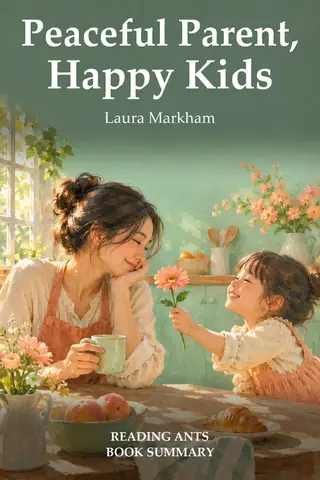
Peaceful Parent, Happy Kids
A parenting writer and clinical psychologist argues that peaceful, cooperative children grow best when parents first regulate themselves, then build connection, and then coach their children's feelings and behavior without punishment.
Overview
Peaceful Parent, Happy Kids: How to Stop Yelling and Start Connecting was published by Perigee in December 2012 by Laura Markham, a clinical psychologist and parenting writer who runs the site Aha! Parenting. It has a foreword by Jack Canfield and is built around what she calls the Three Big Ideas: Regulating Yourself, Fostering Connection, and Coaching, Not Controlling. Advice is given for each stage from babies to elementary schoolers, with practical guides and short quotes from parents throughout. Her premise is that most books focus on changing the child’s behavior, while she asks parents to manage their own triggers first.
Full Summary
Start with yourself
The idea: Markham begins from a different place than most parenting books, which aim at changing a child’s behavior. She says the first job is the parent’s own inner state, because a parent who is triggered cannot connect or coach. Mindfulness is the opposite of losing your temper, she argues, and parents who want to stop yelling should work on healing the wounds of their own childhood. She gives ways to calm the body’s fight-or-flight response before reacting, and she says a do-over with the child later is fine. She also urges parents to look after themselves, because having to summon patience is a sign that the cup is empty. Change is possible, she says, and it starts with small steps.
In real life: A mother who wants to yell steps away, breathes and returns later to try again with her son.
Connection first
The idea: Connection, in Markham’s view, is the essential ingredient, because a close bond gives parents access to their natural know-how and makes children more open to influence. She follows its importance through the stages from babies, whose brains are being wired, to toddlers who need secure attachment, preschoolers who are building independence and school-age children who are laying the foundation for the teen years. Defiance, she says, is the clearest sign that a relationship needs repair. Her daily habits include regular one-on-one time, which she calls Special Time, frequent hugs, easier bedtimes and learning to listen without jumping in with solutions. She also stresses play and laughter, which help children release anxiety.
In real life: A parent takes fifteen minutes of Special Time with a child who is allowed to choose and lead the play.
Coaching feelings
The idea: Markham asks parents to coach their children’s emotions instead of controlling them. Empathy, she says, is not probing: asking a child to tell you how he feels is not the same as understanding him. Children carry an emotional backpack of old feelings, and anger usually hides more threatening feelings underneath, such as fear or sadness. In her view all misbehavior is an SOS about an unmet need. To help a child through a meltdown she suggests staying close, holding a safe space and letting the feelings pass without lectures. She also offers playful ways to work through fears, such as separation anxiety, and says that acknowledged feelings pass more quickly and teach emotional skill.
In real life: A child melts down over a toy, and her mother kneels, holds out her arms and lets her cry.
Guidance, not punishment
The idea: A large part of the book argues against punishment. Markham defines punishment as an action meant to hurt in order to teach a lesson, and says it works only as far as it is painful, while teaching children to avoid getting caught. She rejects spanking, citing research linking it to less long-term compliance, and asks whether yelling is the new spanking. She suggests time-ins instead of time-outs, which can erode a parent’s empathy, and argues that imposed consequences are punishment under another name, though truly natural consequences can teach. In their place she offers empathic limits and ways of making amends, in which the child reflects, repairs the harm and takes responsibility. Guidance, she says, builds a child who wants to behave.
In real life: A parent starts a limit by joining the child, saying it looks like fun, and then explains that someone might get hurt.
Mastery and the long view
The idea: The last stretch of the book turns to helping children achieve with joy. Markham defines self-esteem as the knowledge that we are more than enough as we are, and says it grows from mastery. Parents can scaffold mastery at each age, from babies who are budding scientists to toddlers who want to do it themselves and school-age children exploring their passions. She prefers constructive feedback to conventional praise, which she argues is not truly unconditional, and she warns against helicopter parenting. The afterword says parents should consider professional help when a child’s struggles go beyond what they can handle at home, and that even with a diagnosis a parent offers something no expert can: love and knowledge of the child as a person.
In real life: A toddler tries to pour his own water, and his father helps by showing and then stepping back.
Why It Matters
Peaceful Parent, Happy Kids is one of the best-known guides to what is often called gentle or peaceful parenting. Its main contribution is practical: it takes the common goal of not yelling and breaks it into steps, starting with the parent’s own emotions. It helps parents who feel guilty about their anger by showing that change is possible, and it connects behavior with relationship.
It sits in the same family as books such as Raising Good Humans and How to Talk So Kids Will Listen. Many readers value its steady, encouraging tone, built on a structure of stage-by-stage advice, action guides and short quotes from other parents, which reminds them that change happens by small steps and that a bad day does not undo a good relationship.
Key Takeaways
- Regulate yourself first. A calm parent can think clearly and respond, not react.
- Connect before you correct. Close, warm relationships make cooperation more likely.
- Welcome feelings. Acknowledged feelings pass more quickly and teach emotional skill.
- Guide, do not punish. Warm limits with follow-through teach more than threats.
- Build mastery. Let children do what they can, and give feedback that describes, not just praises.
What We Can Learn
Next time you feel anger rising, stop and take a few slow breaths before you speak. Give yourself a short time-out if you need one, and come back when you are calm. Remind yourself that your child is acting like a child because he is one. Then respond in a quiet voice.
Add a small habit of connection, such as fifteen minutes of Special Time in which your child chooses the activity. When your child is upset, say what you see, stay close and hold off on lessons until the feeling has passed. When you set a limit, start with connection, join your child and say it kindly. If you lose your temper, apologize and move on.
Criticism and Counterpoints
Critics say that the book can set a high bar for calm that tired and stressed parents cannot meet, and that its tone can add to guilt on bad days. Some readers think it does too little about firm consequences or about children with serious behavior challenges, though several sections take up difficult children and the afterword urges professional help when needed. Others note that it shares ideas found in many gentle-parenting books, and that its strong claims, such as that punishment always worsens behavior, go further than some parents or researchers would.
The advice assumes a degree of time and emotional energy that not every family has, and the many parent quotes are testimonials, not evidence. Its focus on empathy may also frustrate parents who want quick fixes for immediate problems.
Who Should Read It
This book is for parents who want to stop yelling and punishing and who are ready to look at their own reactions. It suits parents of babies through school-age children. It is encouraging and practical. Parents of teenagers may find parts too young, and families in crisis should look for professional help as well.
Want the whole book?
A summary is a taste, not the meal. Here is where to find the full book.
You reached the end 🎉
Nicely done. Mark this one as read, and we will suggest what to read next.
Read this next

Raising Good Humans
Hunter Clarke-Fields
A mindfulness teacher argues that kind, cooperative children grow best from calmer parents, and she teaches eight skills for easing reactivity, listening, speaking without blame, solving conflicts without punishment and building a peaceful home.
🎓 Parenting & Education
The Whole-Brain Child
Daniel J. Siegel and Tina Payne Bryson
Understanding how a child's brain develops helps parents respond to tantrums, fears and conflicts in ways that connect, calm and teach, so that different parts of the brain work together.
🎓 Parenting & Education
No-Drama Discipline
Daniel J. Siegel and Tina Payne Bryson
Two brain-science authors argue that discipline means teaching rather than punishing, and that a parent who first calms and connects with an upset child can then guide the child toward better choices without screaming, threats or drama.
🎓 Parenting & Education
Good Inside
Becky Kennedy
A clinical psychologist argues that every child and every parent is good inside even when behavior is hard, and she teaches parents sturdy leadership, connection and repair instead of rewards, punishment and shame.
🎓 Parenting & Education
How to Talk So Kids Will Listen and Listen So Kids Will Talk
Adele Faber and Elaine Mazlish
Parents can get better cooperation and closer relationships by acknowledging children's feelings, describing problems instead of blaming, and using simple, respectful communication skills.
🎓 Parenting & Education
Siblings Without Rivalry
Adele Faber and Elaine Mazlish
Two parent-group leaders argue that sibling fights are normal but not hopeless, and show how listening to feelings, refusing to compare, and teaching children to settle their own disputes can make home calmer.
🎓 Parenting & EducationWant something different?
Pick another topic and we will show you three books to start with.