 Reading Ants
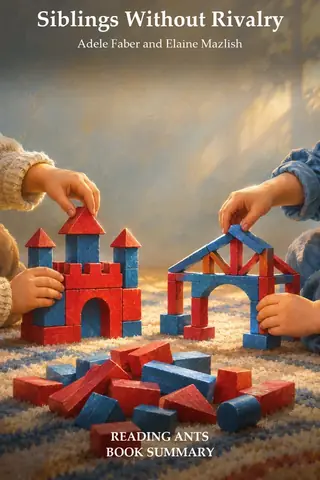
Siblings Without Rivalry
Two parent-group leaders argue that sibling fights are normal but not hopeless, and show how listening to feelings, refusing to compare, and teaching children to settle their own disputes can make home calmer.
Overview
Siblings Without Rivalry: How to Help Your Children Live Together So You Can Live Too was published in 1987 by Adele Faber and Elaine Mazlish. The two women ran workshops for parents and had trained under the child psychologist Haim Ginott. The book grew out of those groups and out of their earlier book on talking with children. Each chapter takes one topic, such as comparisons or fighting, and gives short stories from parents, cartoons that show a poor response and a better one, and a summary. The central question is simple: if fights between brothers and sisters are unavoidable, what can a parent do so that they hurt less and teach more?
Full Summary
1. Rivalry is normal, and it is not a verdict on you
The idea: The authors begin by saying that rivalry shows up even in loving families. A child who feels that a brother or sister is taking attention, space or love can feel threatened, and that threat produces screaming matches and complaints. The authors do not treat this as proof that parents have failed or that the children will dislike each other for life. They also do not promise that siblings will become best friends. They aim for something more modest and more useful: a home where hurting is not allowed and where children learn how to live with another person.
In real life: A mother of two hears her daughters shouting about a borrowed sweater and worries that she has raised enemies. The book’s view would be that this is an ordinary clash, and that her job is to guide it.
2. Let the bad feelings out
The idea: The authors say that children may feel any emotion about a sibling, including rage, jealousy and resentment, but they may not hurt each other. Parents often try to end a quarrel by scolding the angry child or by insisting that children should love each other. The authors argue that this pushes the feelings underground, where they come out in other ways. Instead, a parent can say what the child seems to feel, accept it without judging, and give safe ways to express it. Good feelings, the book suggests, only have room to grow after the bad ones have been heard.
In real life: A boy says he wishes the new baby would go away. A parent who answers that it sounds hard to share the house with a baby, and does not scold, leaves the boy less alone with his anger.
3. The trouble with comparisons
The idea: Comparing children, even in praise, makes trouble. Telling one child that he is neater than his brother makes the brother feel small and makes the first child feel he must keep winning. Reviews of the book stress a different habit: describe what you see and what you need, about this child only, and leave the sibling out of it. Parents are also advised to keep big celebrations of one child’s success for a private moment, because loud praise in front of a brother or sister can feel like a put-down to the one who is listening.
In real life: Instead of telling a slow dresser to hurry because his sister is already ready, a father says that shoes still need to go on and the bus comes in ten minutes.
4. Equal is less: loving each child for who they are
The idea: Many parents try to treat their children exactly alike, with the same amount of time, the same gifts and the same slice of cake. The authors say this backfires, because children do not want to be loved equally. They want to be loved for their own particular selves, and being measured against a sibling can feel like being loved less. A fairer rule is to meet each child’s needs, even when that means unequal treatment, and to explain it kindly. The book also points toward time alone with each child, so that each one feels like the center of attention sometimes.
In real life: One child needs help with homework this week and the other needs a ride to practice. Each gets what he needs, and a parent can promise the second child a turn when his need comes.
5. Do not lock a child into a role
The idea: In many families children slide into roles: the smart one, the clown, the responsible one, the troublemaker, the helpless one. Parents, brothers and sisters, and the children themselves all feed these labels. The authors warn that a role limits a child. The child who is always the bully is never given a chance to be gentle, and the one who is always the baby never has to try. They suggest ways to free a child, such as describing what he did without calling him a name, and noticing the moments when he steps outside the label. Even a flattering role can become a weight.
In real life: A family that calls the oldest girl the reliable one might notice the day she forgets a chore, and let her be ordinary without comment.
6. When the kids fight
The idea: The book separates roughing around, which is acceptable when both children agree, from fighting where someone gains pleasure from another’s pain, which is not. A blog review lays out the approach. If someone is being hurt, the parent names it, says that hurting is not allowed, and separates the children to cool off. If no one is in danger, the parent asks each child to describe the problem, repeats each side back, says that it is a hard problem but that the children can find an answer, and then leaves the room, saying where he will be. The parent does not take sides, uses a vote only as a last resort and avoids punishment, which can make a child want revenge on the sibling blamed for it.
In real life: Two brothers argue over one controller. Their mother states each complaint calmly, says she trusts them to work out a schedule, and goes to the kitchen.
7. Making peace: the past, and the home you are building
The idea: The last section pulls the lessons together into a picture of family life in which anger is handled safely, each child is valued individually, cooperation takes the place of competition, and children practice solving differences day by day. Other summaries also note that the authors invite adults to look back at their own childhood rivalries, since old family roles and grievances can shape how a parent reacts today. Readers are encouraged to build goodwill between siblings through one-to-one time, shared celebrations, regular family meetings and room for children to be apart.
In real life: A father who always took the blame as a boy may find himself siding with the younger child automatically, and noticing it is the first step to changing it.
Why It Matters
Siblings Without Rivalry is one of the best-known books on a problem almost every family with more than one child knows. It applies to brothers and sisters the same respectful way of speaking that the authors’ earlier book on parent-child communication applies to everyday family life, and the authors credit their training under the child psychologist Haim Ginott.
Its format helps explain why it is still read. Because it grew out of real workshops, each topic arrives with a scene, a poor response, a better response and a short summary, so a tired parent can find one idea and try it tonight. Decades after it first appeared, it is still available in several formats, and a later edition adds a review and addendum. Its main points are now familiar in much of the advice written for parents: name feelings, avoid labels, avoid comparisons and let children solve what they can.
Key Takeaways
- Feelings are allowed, hurting is not. Children can be angry at a brother or sister, and a parent’s job is to accept the feeling while stopping the harm.
- Comparisons backfire. Even praise that measures one child against another can make both feel worse, so describe each child’s own behavior.
- Fair is not the same as identical. Children want to feel valued for who they are, so meet each child’s needs and give each some one-to-one time.
- Labels become cages. Roles such as the smart one or the troublemaker limit how children see themselves, even when the role sounds flattering.
- Hand the problem back. When no one is in danger, hear both sides, say you trust them to find a solution and step away, without taking sides.
What We Can Learn
For a parent, the most useful lesson is to catch the sentence that begins with a comparison. Try replacing it with a plain description of the one child in front of you: what you see, what bothers you and what you would like to happen. Notice also when you use a label, even a kind one, and try describing the action instead.
A second lesson is to treat anger as information. When a child says something harsh about a brother or sister, the first reply can be to name the feeling and show that you heard it. Many children calm down once they feel understood, and the conversation about behavior can come afterward.
You do not need to be a parent to use this. Anyone who grew up with brothers and sisters, or who manages a team, can see how rivalry turns on attention, fairness and fixed roles. Understanding that can make adult sibling relationships a little easier, too.
Criticism and Counterpoints
The book rests on the authors’ workshop experience and on parents’ own stories, not on controlled studies, so its claims about what works are persuasive rather than proven. Some readers find the sample dialogues stiff or hard to say aloud in a real fight, and some also find the scenes dated or drawn mostly from a certain kind of family: two parents at home, with plenty of time and patience.
The advice to hand problems back to children assumes that the siblings are of similar strength and age and that the parent is calm enough to stay out. It may not fit a household with a much older child, a child with special needs, or a pattern of bullying that needs firm adult action. Reviewers also point out that no technique removes all rivalry. The supporters’ reply is that the book never promises that: it aims to make rivalry less damaging.
Who Should Read It
This book is for parents of two or more children, grandparents, teachers and anyone who works with groups of brothers and sisters. It is quick to read, practical and full of short examples. If one child is hurting another repeatedly or the fighting feels unsafe, a parent should also seek help from a counselor or pediatrician.
Want the whole book?
A summary is a taste, not the meal. Here is where to find the full book.
You reached the end 🎉
Nicely done. Mark this one as read, and we will suggest what to read next.
Read this next
How to Talk So Kids Will Listen and Listen So Kids Will Talk
Adele Faber and Elaine Mazlish
Parents can get better cooperation and closer relationships by acknowledging children's feelings, describing problems instead of blaming, and using simple, respectful communication skills.
🎓 Parenting & Education
Positive Discipline
Jane Nelsen
Jane Nelsen argues that children behave better when they are treated with both kindness and firmness, and she offers practical tools, such as family meetings and logical consequences, to teach them responsibility without punishment or pampering.
🎓 Parenting & Education
The Whole-Brain Child
Daniel J. Siegel and Tina Payne Bryson
Understanding how a child's brain develops helps parents respond to tantrums, fears and conflicts in ways that connect, calm and teach, so that different parts of the brain work together.
🎓 Parenting & Education
Raising Good Humans
Hunter Clarke-Fields
A mindfulness teacher argues that kind, cooperative children grow best from calmer parents, and she teaches eight skills for easing reactivity, listening, speaking without blame, solving conflicts without punishment and building a peaceful home.
🎓 Parenting & Education
How to Raise an Adult
Julie Lythcott-Haims
A former dean at Stanford University argues that modern parents who do too much for their children, from homework to college applications, are leaving them anxious and unprepared, and she urges them to step back and let young people learn to stand on their own.
🎓 Parenting & Education
No-Drama Discipline
Daniel J. Siegel and Tina Payne Bryson
Two brain-science authors argue that discipline means teaching rather than punishing, and that a parent who first calms and connects with an upset child can then guide the child toward better choices without screaming, threats or drama.
🎓 Parenting & EducationWant something different?
Pick another topic and we will show you three books to start with.