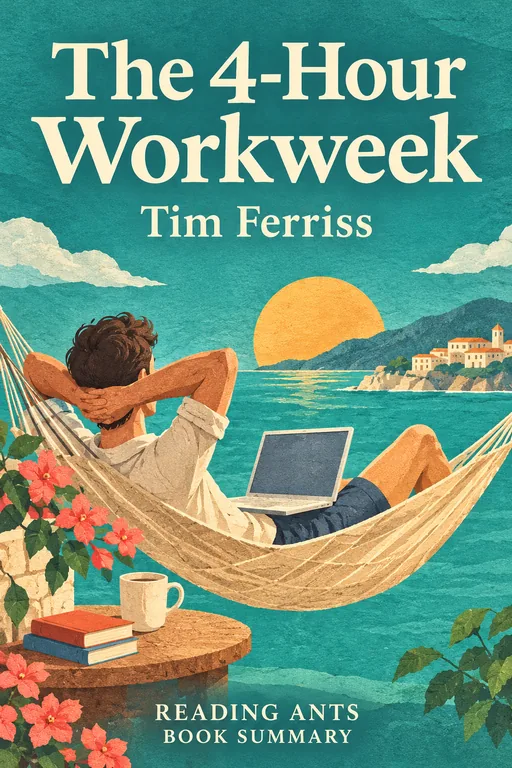
Tim Ferriss argues that you can escape the traditional "deferred life plan" of working until retirement, by eliminating wasteful tasks, automating income and using outsourcing, in order to live well now and spend time on what you value.
Overview
The 4-Hour Workweek: Escape 9-5, Live Anywhere, and Join the New Rich was published in 2007 by Tim Ferriss, a young American entrepreneur who ran a supplement company, and later became an investor, author and podcaster. It became a huge bestseller, spending years on the New York Times list. The book is a manual for creating a “lifestyle business” that gives income without requiring constant work, so that one can travel and pursue interests. It is organized into four steps, D, E, A and L: Definition, Elimination, Automation and Liberation.
Full Summary
1. Definition: rethinking what you want
The idea: Ferriss begins by challenging the standard path of working hard for forty years and retiring. He calls it the deferred life plan, and argues that people can enjoy “mini-retirements” throughout life. He introduces the “new rich,” people who value time and mobility as much as money. Step one is to define your goals, and he suggests a practice of “fear-setting,” in which you write down the worst that could happen if you took a risk, how you could repair the damage, and the cost of doing nothing.
In real life: Imagining the worst outcome of a bold choice often shows that it is less scary than it seemed.
2. Elimination: focus on what matters
The idea: The second step is to cut out the unproductive. Ferriss draws on the Pareto principle, the idea that about eighty percent of results come from twenty percent of the efforts. He recommends identifying the twenty percent of activities that produce most of the results, and stopping the rest. He pairs this with Parkinson’s law, the idea that a task expands to fill the time allotted, and so urges shortening your working time. He also advocates a “low-information diet,” limiting email and news, and setting aside specific times to check messages. His point is to be productive, not just busy.
In real life: Checking your email twice a day instead of constantly can free up hours.
3. Automation: build a business that runs itself
The idea: Ferriss’s third step is to automate income, by creating a product or business that does not rely on your time. He describes a method he calls the muse: identify a niche market and its customers first, then develop a product for them, test demand cheaply, and rely on outside providers so that the business needs little of your time. He suggests using virtual assistants to handle routine tasks, often hired from other countries at lower cost, and advises eliminating a task before you delegate it.
In real life: A small online shop that ships orders automatically can earn money while the owner is away.
4. Testing demand before you build
The idea: The author advises validating an idea before investing. For example, you can run a small online ad that sends visitors to a simple page, to see whether people will actually buy or pre-order before you make the product. If there is interest, you can then make it. He stresses starting with a niche, and finding a product that can be sold at a high markup, with information products aimed at a niche among his favorites. He warns against spending heavily without evidence of demand, and suggests learning from small experiments.
In real life: Before opening a shop, you might sell a few items online to see if people want them.
5. Liberation: escape and travel
The idea: The last step is to break free from the geographic limits of the office, and to live where you want. Ferriss describes how to free yourself from a fixed location, whether by working remotely or by taking “mini-retirements” of a month or several months in one place abroad, where living can cost less. He argues that mobility can multiply the value of money, since a dollar goes further in some places. He also suggests that time freed from work should not be wasted but spent on learning, adventure and relationships, and that the aim is to make life richer, not just easier.
In real life: A person who can work online might spend a winter in a cheaper, warmer country.
6. Life beyond: purpose and giving back
The idea: In the closing sections, Ferriss addresses the question of what to do with free time. He suggests that, after the initial rush of travel and leisure, people will need purpose, and recommends filling the gap with continual learning and service to others. He also argues that the timing for important things never feels right, so waiting for the perfect moment is a mistake. The final advice is to take action, since reading alone changes nothing.
In real life: Freedom from a job is most rewarding when it leads to meaningful projects.
Why It Matters
The 4-Hour Workweek became a cultural phenomenon, selling millions of copies, and launched Ferriss’s career. It popularized ideas such as lifestyle design, remote work, outsourcing to virtual assistants and the “digital nomad” lifestyle, long before the pandemic made remote work common. It encouraged many readers to question the assumptions of a traditional career, and to experiment with side businesses. The book has been controversial, and criticized, but few would deny that it changed attitudes toward work, time and freedom for a generation, and many of its ideas, such as remote work and outsourcing routine tasks, are now ordinary parts of working life.
Key Takeaways
- Question the deferred life plan. Do not wait until retirement to live.
- Focus on the vital few. Use the 80/20 principle.
- Automate and outsource. Build income that does not depend on your hours.
- Test before you invest. Validate demand cheaply.
- Use freedom well. Time is valuable when it has purpose.
What We Can Learn
You can apply some of the book’s ideas without quitting anything. Look at your week and find the activities that give most of the value, and consider reducing the rest. Limit the time you spend on email and messages. Try writing a fear-setting list before a hard decision. Be open to learning about remote and flexible work. At the same time, be realistic: building a business takes effort and luck, and not everyone can or should do so. Ask what a good life means to you.
Criticism and Counterpoints
Many critics say that the title is misleading, since Ferriss himself worked long hours, and that the lifestyle is only possible for a few people with the right skills, capital and circumstances. Others point out that some of the advice, such as exploiting low-cost labor abroad, raises ethical questions, and that the examples of success are drawn from a small sample. Some say that parts of the book are formulaic or pushed to extremes, and that some of the tactics are dated. Others claim that it encourages a focus on money and convenience. Even so, many find it motivating.
Who Should Read It
This book is for readers who want to rethink work and who like practical, bold ideas, including young adults. It is energetic and sometimes brash. Those who are skeptical of get-rich-quick claims should read it critically and with realistic expectations.
Want the whole book?
A summary is a taste, not the meal. Here is where to find the full book.
You reached the end 🎉
Nicely done. Mark this one as read, and we will suggest what to read next.
Read this next
Essentialism
Greg McKeown
Greg McKeown argues that we should do fewer things, but do them better, by deciding what is truly essential, saying no to the rest, and building simple routines that protect our time and energy.
🌱 Self-Improvement
The Almanack of Naval Ravikant
Eric Jorgenson
Eric Jorgenson gathers the thoughts of the investor and entrepreneur Naval Ravikant on how to build wealth and how to be happy, and presents them as a guide to creating a good life by your own effort and judgment.
💰 Money & Economics
The E-Myth Revisited
Michael E. Gerber
Michael Gerber argues that most small businesses fail because their owners are skilled workers who never learned to build a business, and he says the cure is to work on the business with systems and not only in it.
💼 Business
The Personal MBA
Josh Kaufman
Josh Kaufman argues that you can learn the essentials of business on your own, and he explains the key ideas of how businesses create value, sell, deliver and manage money, along with the mental skills that help people work well.
💼 Business
Digital Minimalism
Cal Newport
Computer scientist Cal Newport argues that we should use technology intentionally, by clearing out low-value digital habits, and building a life of high-quality leisure, solitude and real conversation, a philosophy he calls digital minimalism.
🌱 Self-Improvement
Atomic Habits
James Clear
Big changes in life come not from huge leaps but from tiny habits repeated every day, and you can build good habits (and break bad ones) by designing your life so the right choices are obvious, attractive, easy and satisfying.
🌱 Self-ImprovementWant something different?
Pick another topic and we will show you three books to start with.