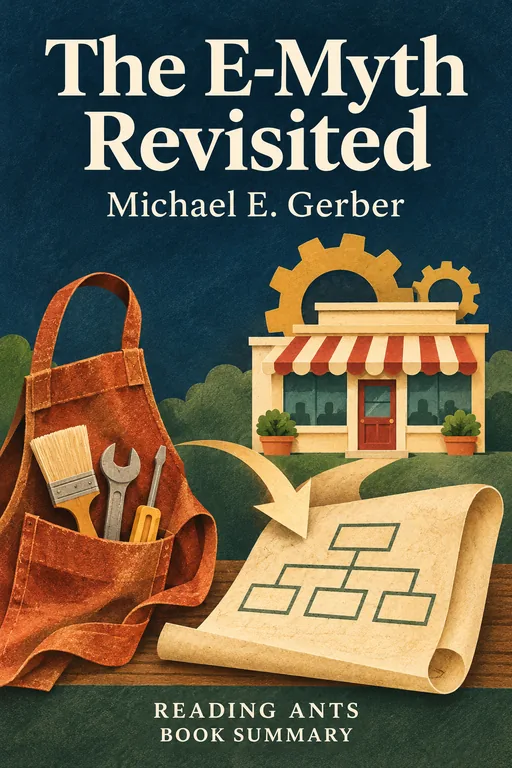
Michael Gerber argues that most small businesses fail because their owners are skilled workers who never learned to build a business, and he says the cure is to work on the business with systems and not only in it.
Overview
The E-Myth Revisited was published in 1995 and is a revised version of an earlier book by Michael E. Gerber, a small-business consultant. The “E-Myth” is the “entrepreneurial myth,” the belief that people who start a business are entrepreneurs. Gerber says that most are really skilled workers, whom he calls technicians, who have an idea to do their own work for themselves, and who then become overwhelmed. The book is written as a series of conversations and stories. Its aim is to help small business owners create a company that can run without depending on them every minute.
Full Summary
1. The entrepreneurial myth
The idea: Gerber says the central error is the belief that someone who is good at a craft will be good at running a business that sells it. A fine baker does not automatically understand pricing, hiring or planning. Most new owners are in fact skilled workers who had “an entrepreneurial seizure,” a sudden urge to be independent, and who then find that they have bought themselves a demanding job.
From the book: Gerber uses a running example, a pie shop owner named Sarah, who is struggling to keep up with her shop and who believes the answer is simply to make better pies, when the real problem lies in how the business is run.
In real life: A talented hair stylist who opens a salon may spend the day cutting hair and never have time to plan the business.
2. The three personalities inside you
The idea: Gerber says that every owner has three people inside them. The technician enjoys doing the actual work. The manager likes order, planning and keeping things running. The entrepreneur is the dreamer who sees opportunities and wants to change things. In most small business owners, the technician is far stronger than the others, and this imbalance causes trouble.
In real life: A student who loves drawing, but dislikes deadlines and does not look at the next project, will feel the imbalance in a freelance art job.
3. The three stages of a business
The idea: Gerber describes a business as moving through three stages, which he names infancy, adolescence and maturity. In infancy, the owner does all the work. In adolescence, the owner decides the business needs help and hires some, but often struggles to manage or to let go of the work, and the business grows in a messy way. Maturity is a deliberate, entrepreneurial point of view, in which the owner sees the business from the outside and builds a structure that works with or without them. Gerber says this view can guide a business even from its first day.
In real life: A family that starts a food stall may at first do everything, and later need rules to keep the stall running in the same way when they hire a helper.
4. Work on your business, not only in it
The idea: The key advice of the book is to step back and look at the business as a product in its own right. Gerber says that the owner should design the business so that it could be copied many times, much as a franchise is. That means writing down how things are done, so the quality is the same whoever does the job.
From the book: He uses the idea of the franchise prototype, a business built so that it works in the same way in every location, as a model for any small business.
In real life: A tutoring center that has a written guide for every lesson can hire new teachers without losing quality.
5. Build systems and a clear structure
The idea: Gerber says that people should be organized around the work that needs doing, not around the personalities in the company. He asks owners to draw an organization chart, even for a very small business, with a position for every role, so that tasks are assigned to positions, not to people. Systems should be clear and written down, so that workers can follow them without constant supervision.
In real life: A small bike repair shop could keep a checklist for each repair, so that any mechanic follows the same steps.
6. A business development process
The idea: The last part of the book gives a series of steps to follow in order to improve a business. Gerber describes a continual process of innovation, quantification and orchestration: coming up with ideas for improvement, measuring what happens, and then organizing the new way of working, so that it becomes a system. This is separate from his seven-part Business Development Program, whose steps are a primary aim, a strategic objective, and organizational, management, people, marketing and systems strategies. He also says that the owner needs a clear purpose, a vision of what the business should be, and a plan for how to reach it.
In real life: A shop that tries a new way of greeting customers, counts how many return, and then keeps the version that works, is following this method.
Why It Matters
The E-Myth Revisited has sold widely and is one of the best-known books on small business. Its main message, that you should build a business that can work without you, has been repeated by many coaches, consultants and business owners. The book helped to popularize the idea of systems and procedures for small firms, and the distinction between working “in” and “on” your business is now a common phrase. It matters because it speaks to a very common situation, in which a talented person starts a business out of passion and then burns out. By explaining why this happens, it gives owners a way to see their problem more clearly, and to begin to change it before it is too late.
Key Takeaways
- Skill is not the same as business sense. Being good at a craft does not make you good at running a company.
- Three roles matter. A healthy business needs a technician, a manager and a dreamer, and most owners lean heavily on one.
- Work on the business. Step back and design how the business should work, so that it does not depend on you alone.
- Write down the system. Clear procedures give customers the same quality every time.
- Think like a franchise. Build a model that could be copied, even if you never plan to copy it.
What We Can Learn
If you want to start a small business, or already have one, ask yourself which tasks only you can do and which could be written down and given to someone else. Try writing a simple step-by-step guide for something you do often. Even outside business, the idea applies: if you run a club or a family project, a clear plan helps others take over when you are away. It also reminds us to look at our own strengths and gaps. If you are a dreamer, find a partner who likes planning. If you love the work itself, find time to look at the big picture.
Criticism and Counterpoints
Critics point out that the book is written in a simple, story-driven style, with a running example character, and that it offers little evidence from research. Its strong preference for systems and franchise-style standards may not suit creative or personal businesses, where a personal touch is the main value. Some readers find the categories of technician, manager and entrepreneur too neat, and the claim that most small businesses fail because of their owners too broad. Other factors, such as luck, funding and the market, also matter. The book is best seen as a helpful way of thinking, not as a law.
Who Should Read It
This book is for people who run or plan to start a small business, such as shops, studios, restaurants and consultancies. It is a quick, accessible read. Readers who work in a large company or who want detailed financial or technical advice may find it less relevant.
Want the whole book?
A summary is a taste, not the meal. Here is where to find the full book.
You reached the end 🎉
Nicely done. Mark this one as read, and we will suggest what to read next.
Read this next
The Lean Startup
Eric Ries
Startups succeed not by following a detailed plan but by quickly testing their ideas with real customers, learning from the results and changing direction when needed.
💼 Business
Zero to One
Peter Thiel with Blake Masters
The most valuable companies create something new from nothing, and Peter Thiel argues that this means aiming for a monopoly in a small, specific market rather than competing with everyone in a crowded one.
💼 Business
The Personal MBA
Josh Kaufman
Josh Kaufman argues that you can learn the essentials of business on your own, and he explains the key ideas of how businesses create value, sell, deliver and manage money, along with the mental skills that help people work well.
💼 Business
Crossing the Chasm
Geoffrey A. Moore
Geoffrey Moore argues that new technology companies often fail when they try to move from a small group of enthusiasts to the mainstream, and that they can cross this "chasm" by focusing on one narrow market and offering a complete solution.
💼 Business
Good to Great
Jim Collins
Collins argues that sustained corporate improvement comes from disciplined leaders, carefully chosen people, a focused economic concept and cumulative execution rather than dramatic transformation programs.
💼 Business
Built to Last: Successful Habits of Visionary Companies
Jim Collins and Jerry I. Porras
A six-year study of long-lasting, successful companies, which finds that what sets them apart is a strong core purpose, combined with a constant drive to change and improve.
💼 BusinessWant something different?
Pick another topic and we will show you three books to start with.