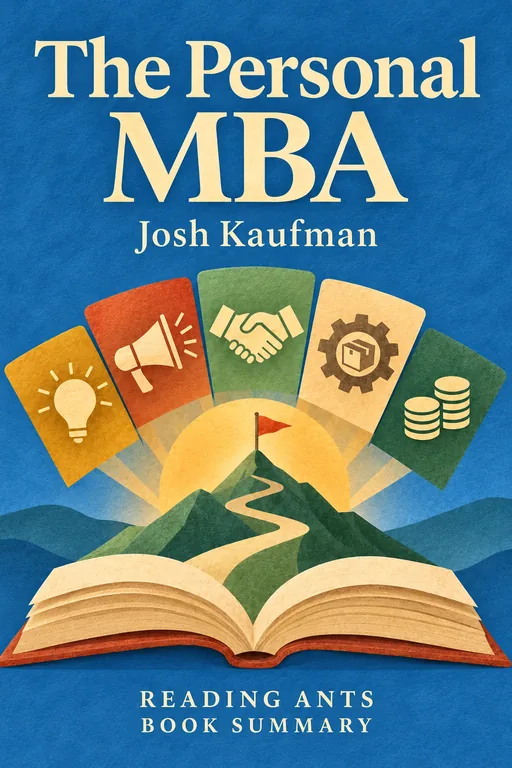
Josh Kaufman argues that you can learn the essentials of business on your own, and he explains the key ideas of how businesses create value, sell, deliver and manage money, along with the mental skills that help people work well.
Overview
The Personal MBA was published in 2010 by Josh Kaufman, an author and entrepreneur. It grew out of a reading list that Kaufman first put together in 2005 for people who wanted to learn business without paying for a business-school degree. The book is a collection of more than two hundred short explanations of core concepts, one or two pages each, grouped into chapters on value creation, marketing, sales, value delivery and finance, followed by chapters on the human mind, working with yourself, working with others, and systems. The tone is practical, and every concept can be read separately.
Full Summary
1. The five parts of every business
The idea: Kaufman says that every business, however large or small, does five things. It creates something of value that people want. It markets to get attention, sells to turn interest into purchases, delivers the value to the customer, and finances the work so that it earns more than it spends. If any of the five parts fails, the business will struggle, so a clear view of how they fit together is the foundation of everything else.
In real life: A lemonade stand needs a drink that people like, a sign, a way to ask for money, a cup to serve and enough profit to buy more lemons.
2. Value creation: make something people want
The idea: Kaufman begins with value creation, because there is no business without a product or service that people truly need or want. He recommends studying real needs and checking whether an idea is likely to be profitable before developing it. He also says that a business should look for a market that is large enough to support it, and that products and services are only two of twelve forms of value a business can offer.
In real life: Before building an app, a student can ask ten classmates if they would use it, and listen to what they say.
3. Marketing and sales
The idea: Marketing is about getting the right people to notice and care about what you offer, and sales is about helping them to decide. Kaufman discusses how to explain benefits clearly, and why a business must understand what its customers want before telling them what it makes. He also points out that busy people quickly filter out messages that do not seem relevant to them, so a clear, targeted message works better than a loud one.
In real life: A bakery that puts a sample tray at the door is marketing, and the staff who help a customer choose a cake are selling.
4. Value delivery and finance
The idea: Delivering value means that a business must be able to provide its product to customers well and consistently, and at a reasonable cost. Kaufman explains concepts such as using resources well, improving processes and meeting customers’ expectations so that they come back. In finance, he says that a business must earn more than it spends, and must understand profit and the relationship between price and cost.
In real life: A food stall may sell many meals, but if each one costs more to make than the price paid, it will lose money with every sale.
5. The human mind and working with yourself
The idea: Kaufman gives space to the way our minds work. He discusses how people make decisions, why we are influenced by biases and what motivates us. He also gives advice on working with yourself, such as setting priorities and managing your attention. He argues that success depends not just on knowledge of business, but on how you manage your own behavior.
In real life: If you notice that you work best in the morning, you can plan the hardest tasks for then, instead of fighting your own rhythm.
6. Working with others
The idea: Businesses are made of people, and Kaufman describes ideas about communication, leadership and management. He suggests that you aim for good relationships and a clear understanding of what each person wants, and he touches on the importance of listening and helping others to succeed.
In real life: When a group of friends organizes an event, the one who clarifies who is doing what, and checks in with everyone, often makes the project run smoothly.
7. Understanding systems
The idea: The last major part is about systems, which are sets of parts that work together. It has three chapters, on understanding, analyzing and improving systems. Kaufman says that businesses and the world are made of connected parts, and that understanding how they fit together helps you to make better decisions. He encourages readers to look for the whole picture and to keep improving in steps.
In real life: If you change one thing in a schedule, such as starting school earlier, it may affect sleep, meals and homework, so the effects go beyond the first change.
Why It Matters
The Personal MBA became popular as an affordable alternative to a business degree, and it is part of a larger movement of self-education. Kaufman’s argument, that you can learn the key ideas of business from books and practice, appealed to many who could not or did not want to attend business school. The book provides a broad map of the subject, which makes it a useful starting point for further reading. It has been read by students, founders and people in many careers. It also reflects a trend of people using libraries, websites and books to build their own education. While it cannot replace experience, its clear short sections help beginners to know the basic ideas and vocabulary.
Key Takeaways
- Every business has five parts. Value creation, marketing, sales, delivery and finance must all work.
- Start with real needs. A product that nobody wants is not a business.
- Understand money simply. A business must earn more than it spends.
- Know your mind. Biases and habits shape decisions, so knowing them helps.
- Think in systems. Changes in one part of a system affect others.
What We Can Learn
You can use the book as a map for learning. Pick one concept a week, such as pricing or negotiation, and try it in a small way: a school fundraiser, a hobby shop or a project with friends. Keep a notebook of what you learn. Notice the five parts in the businesses you visit, and ask where each is strong or weak. Reading the book is only the first step; the real learning comes from trying ideas, seeing what happens and adjusting. You can also find other books on the subjects that interest you, and treat Kaufman’s list as a guide for further study.
Criticism and Counterpoints
Critics point out that the book is a collection of summaries and can feel shallow, and that real skill in business comes from experience and not from reading. A degree also offers a network, feedback and credentials that a book cannot. Others note that the book is a large reference rather than a story, so it is not meant to be read straight through, and that it is not a workbook, with only a few exercises. Some of the ideas are drawn from other authors, and readers may want to explore the original sources. It is best seen as an introduction, not a substitute for study and practice.
Who Should Read It
This book is for beginners in business, self-taught learners, students, and people thinking about starting a small business. It can be read in small pieces. Those who already have a business background may find much of it familiar, and readers who want in-depth technical material will need more specialized books.
Want the whole book?
A summary is a taste, not the meal. Here is where to find the full book.
You reached the end 🎉
Nicely done. Mark this one as read, and we will suggest what to read next.
Read this next

The E-Myth Revisited
Michael E. Gerber
Michael Gerber argues that most small businesses fail because their owners are skilled workers who never learned to build a business, and he says the cure is to work on the business with systems and not only in it.
💼 Business
Zero to One
Peter Thiel with Blake Masters
The most valuable companies create something new from nothing, and Peter Thiel argues that this means aiming for a monopoly in a small, specific market rather than competing with everyone in a crowded one.
💼 Business
The Lean Startup
Eric Ries
Startups succeed not by following a detailed plan but by quickly testing their ideas with real customers, learning from the results and changing direction when needed.
💼 Business
Positioning: The Battle for Your Mind
Al Ries and Jack Trout
Al Ries and Jack Trout argue that in a world crowded with messages, the key to marketing is to claim a clear and different place in the minds of customers, not just to improve the product.
💼 Business
High Output Management
Andrew S. Grove
Andy Grove, a longtime leader of the chip maker Intel, explains that a manager's real output is the output of the team, and he shows how to raise it with leverage, good meetings, honest measures and one-to-one talks.
💼 Business
Good to Great
Jim Collins
Collins argues that sustained corporate improvement comes from disciplined leaders, carefully chosen people, a focused economic concept and cumulative execution rather than dramatic transformation programs.
💼 BusinessWant something different?
Pick another topic and we will show you three books to start with.