 Reading Ants
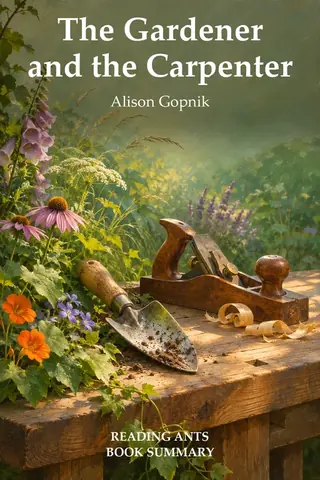
The Gardener and the Carpenter
A developmental psychologist and grandmother argues that "parenting," as a craft aimed at producing a certain kind of adult, is the wrong model, and that being a parent is a loving relationship more like tending a garden than carving a table.
Overview
The Gardener and the Carpenter: What the New Science of Child Development Tells Us About the Relationship Between Parents and Children was published in 2016 by Alison Gopnik, a professor of psychology and affiliate professor of philosophy at the University of California, Berkeley, who studies how babies and young children learn. She writes as scientist, philosopher and grandmother, and she begins with a puzzle: why do parents find caring for children so demanding and so satisfying? The book has nine chapters, each drawing on evolution, brain science, experiments and stories from daily life. It is longer and more scientific than most parenting books, but its tone is warm and its argument is simple.
Full Summary
Introduction: the parent paradoxes and the garden
The idea: Gopnik says that the word “parenting” has come to mean working toward a goal, like a carpenter shaping wood, with expertise leading to success. She thinks this model fuels anxiety and the “mommy wars,” and she doubts that anyone’s expert knowledge, her own included, can deliver such outcomes. In its place she offers “being a parent,” a kind of love that has a purpose but no blueprint: to give children a rich, safe environment in which they can become themselves. She names paradoxes of love, such as dependence against independence, and of learning, such as play against work and tradition against innovation. A gardener sets up a protected space and welcomes surprises.
In real life: A gardener’s greatest joys come when something escapes her control, such as a weedy white flower that turns out to be lovely.
Chapters 1 and 2: against parenting, and the evolution of childhood
The idea: Gopnik compares the rise of “parenting” to what happened to food in America, when people moved from learning cooking traditions to following experts and rules. She argues that the details of caregiving do not determine how children turn out. Human beings produce varied children, and that variety helps a species cope with a changing world. Young brains are designed to explore, while older ones exploit what they know, and humans have an unusually long childhood, a period of protected immaturity, in which learning can happen. The caregiver’s job is to protect that space and to guide the child’s move from exploring to control.
In real life: At a farmers’ market, a one-year-old grandson explores fruit and spoons, and she sees the long childhood at work.
Chapter 3: the evolution of love
The idea: The third chapter asks how human caregiving evolved. Gopnik looks at pair-bonding, which is complicated in people, and at biological work on voles. She describes the grandmother hypothesis from the anthropologist Kristen Hawkes, which says grandmothers helped raise early human children, and she explains alloparents, the other adults who help care for children. The commitment puzzle is that people love a particular child, not just children in general, and she writes about her own love for this grandchild. She notes that religious traditions hold up the ideal of extending such committed love beyond one’s own family.
In real life: A grandmother realizes she is not crazy about “a grandchild” but about this particular blue-eyed boy.
Chapters 4 and 5: learning through looking and listening
The idea: Children learn from caregivers by watching, says Gopnik, and they notice more than parents realize. She debunks the myth of mirror neurons and explains that young children can tell whether a person acted on purpose or by accident. Younger children are often better than adults at spotting unlikely solutions, and they overimitate, copying even needless steps when an adult seems to be an expert. They also learn by listening: toddlers trust familiar caregivers, and children track how reliable speakers are, though they are slow to discount an overconfident one. Stories and a special “pretend” voice help them sort fact from fiction, and their questions seek explanations, not only facts. She ends by saying that love in practice means doing things together.
In real life: A child copies every step a demonstrator takes, even pointless ones, but copies only the useful steps when the demonstrator says she does not know how the toy works.
Chapter 6: the work of play
The idea: Gopnik asks what play is and why it matters. She describes rats whose brains stay flexible as adults if they played when young, and young New Caledonian crows that play with sticks and palm leaves, clumsily imitating how adults use them. She discusses rough-and-tumble play, exploring objects and pretend play, which she thinks is quite possibly uniquely human and gives children the power to imagine other possibilities and work out what would happen if things were different. Imaginary companions fit here. Adults can enrich the world children play in, and she asks when teaching helps and when it gets in the way.
In real life: A six-year-old who believes a balance beam always balances at its center plays longest with a trick beam that tips, because the result contradicts the child’s theory.
Chapter 7: growing up
The idea: The seventh chapter follows children as school becomes their main caregiver. Gopnik says learning shifts toward mastery, with apprenticeship as the natural way to learn, and she contrasts it with scholastic skills that are necessary but meaningless in themselves, which schools teach without discovery or apprenticeship. She is skeptical of the rising focus on testing and points to evidence that school testing policies led to more ADHD diagnoses, and argues for changing schools instead of drugging children. In adolescence, a reward and emotion system, especially for social rewards, arrives before the system that controls it, so teens are drawn to risk and strong feeling. She warns against treating childhood as just a way station to adulthood.
In real life: A Berkeley undergraduate who is excellent at test-taking is baffled when asked to work like an apprentice and explore an open problem.
Chapter 8: the future and the past
The idea: Chapter eight takes on technology. Gopnik treats today’s screens as the latest of many changes, like reading, which also reshaped the brain. She says that adults misjudge change because children grow up inside it, and she describes a ratchet effect, in which each generation takes the last one’s changes for granted and builds on them. She is cautious about the digital pessimists and compares the web to a city, with both bewildering and rich possibilities. Childhood, she argues, is the crucible of cultural change, not a period of innocence apart from it.
In real life: A parent feels that the Internet has changed her own life, while her child simply grows up inside it.
Chapter 9 and conclusion: the value of children
The idea: In the final chapter Gopnik argues that children are valuable for their own sake and that the care of the young and old is a public matter. Many societies once gave children extended families, but modern families, especially poor ones, often lack that support. She wants preschool treated as a child’s garden for rich and poor alike, not as the first step in shaping a successful adult. She adds that adult play, in sports, art, drama and science, keeps exploration going. Being a parent, she concludes, is worthwhile because of the love, not because of the adult it produces.
In real life: A poor family without the aunts and grandparents who once helped finds that good public preschool fills part of the gap.
Why It Matters
The book came out when parenting advice was a huge industry, and it offered something different: a scientist’s argument that the whole idea of parenting as technique deserves a second look. It helped many readers question the pressure to optimize every moment of a child’s life, and it brought research on play, learning, apprenticeship and brain development into a conversation that is often driven by fear.
Gopnik’s metaphor has become a handy shorthand for a real debate about education and family life: do we shape children toward set goals, or do we create conditions in which they can grow? Because she is also a developmental researcher, her warm tone carries scientific weight. The book also pushes beyond the home, arguing that how a society treats children is a matter for voters and lawmakers as well as parents.
Key Takeaways
- Parenting is a relationship, not a craft. Love and care matter for their own sake, not only for the adult the child becomes.
- Be a gardener. Provide safety, resources and affection, and expect children to grow in surprising directions.
- Children learn by joining real life. Watching, listening, helping and asking questions teach more than lessons built for them.
- Play is serious. Free, child-led play and pretending build imagination, flexibility and thinking about what might be.
- Caring for children is a public job. Families cannot do it alone, and society should support all children, not only those with lucky parents.
What We Can Learn
For a parent, the book gives permission to relax a little. If the main job is to provide a loving, stable and safe place, many of the daily worries about the perfect school, schedule or technique matter less than we think. Time spent together, answering questions and reading aloud counts.
For teachers and other adults, it suggests making room for different kinds of minds and for play, instead of pushing everyone toward the same test results. Children are not material to be molded, and a classroom can feel more like a garden.
For anyone, it widens the circle. If children do best with stable care, then neighbors, schools and lawmakers share the work of tending them. Even a small step, like volunteering or backing local child-care support, puts that idea into practice.
Criticism and Counterpoints
Not every reader is convinced. One reviewer found the book padded for its length, thought the technology chapter tried to forecast the future without enough support, and disliked some slogan-like lines. Others note that the garden image is attractive but may be too gentle: gardeners do prune and protect, and parents of children with serious difficulties often need active guidance and expert help, not only patience.
The claim that parents’ everyday choices matter little for outcomes can be misread as saying that nothing parents do matters, which is not what the author means, since she stresses stable love and care. Her policy proposals reflect her own values and will draw disagreement, particularly over cost. The book also leans on the author’s wide-ranging scientific field, so readers who want detailed evidence for each claim will need to follow the research behind it.
Who Should Read It
This book suits parents, grandparents, teachers and teenagers who are curious about how children learn and why modern parenting feels so tense. It is thoughtful and mostly gentle. Readers who want a step-by-step toolkit for daily problems may find it too big-picture and may prefer a practical guide.
Want the whole book?
A summary is a taste, not the meal. Here is where to find the full book.
You reached the end 🎉
Nicely done. Mark this one as read, and we will suggest what to read next.
Read this next
How to Raise an Adult
Julie Lythcott-Haims
A former dean at Stanford University argues that modern parents who do too much for their children, from homework to college applications, are leaving them anxious and unprepared, and she urges them to step back and let young people learn to stand on their own.
🎓 Parenting & Education
NurtureShock
Po Bronson and Ashley Merryman
Two journalists collect surprising research on how children really develop, and show that several common beliefs about praise, sleep, honesty, race and play are wrong or too simple.
🎓 Parenting & Education
The Whole-Brain Child
Daniel J. Siegel and Tina Payne Bryson
Understanding how a child's brain develops helps parents respond to tantrums, fears and conflicts in ways that connect, calm and teach, so that different parts of the brain work together.
🎓 Parenting & Education
Simplicity Parenting
Kim John Payne with Lisa M. Ross
A Waldorf-trained family counselor argues that children are overloaded by too much stuff, too many choices, too much information and too much speed, and he shows parents how to reduce that load through toys, rhythm, schedules and a filtered adult world.
🎓 Parenting & Education
The Gift of Failure
Jessica Lahey
A middle school teacher and mother argues that fear of failure, in parents and children alike, has led us to rescue, reward and hover, and she shows how stepping back with clear expectations builds motivation, competence and independence.
🎓 Parenting & Education
How to Talk So Kids Will Listen and Listen So Kids Will Talk
Adele Faber and Elaine Mazlish
Parents can get better cooperation and closer relationships by acknowledging children's feelings, describing problems instead of blaming, and using simple, respectful communication skills.
🎓 Parenting & EducationWant something different?
Pick another topic and we will show you three books to start with.