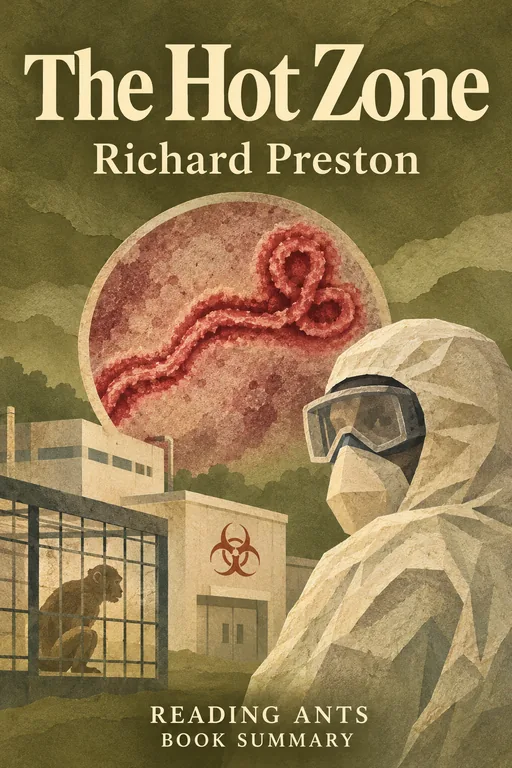
The Hot Zone
Richard Preston tells, in the style of a thriller, the true story of the Ebola virus, from its appearance in Africa to a frightening outbreak among monkeys at a laboratory facility in Virginia, and the scientists and soldiers who fought to contain it.
Overview
The Hot Zone: A Terrifying True Story was published in 1994 by Richard Preston, a writer who developed it from an article in The New Yorker. It tells of the emergence of filoviruses, a family that includes Ebola and Marburg, which cause a severe and often fatal disease. Preston interviewed scientists, army experts and doctors, and reconstructed scenes in vivid detail. The book became a bestseller and helped to alarm the public about emerging diseases, and inspired a film project and a television series. It is a mixture of reporting and dramatization.
Full Summary
The book is divided into four parts: the story of a Marburg case in Kenya, an account of Army virologists, the Reston monkey house and the Army operation, and a closing visit by the author to Kitum Cave.
1. Marburg and Kitum Cave
The idea: The book begins in January 1980, when a Frenchman called Charles Monet (a pseudonym) explored Kitum Cave on Mount Elgon in western Kenya, a place where elephants and bats were found. About a week later he fell ill with fever and vomiting, and he was flown to Nairobi Hospital, where he began to hemorrhage and died, having vomited and bled on the physician Dr. Shem Musoke. Musoke fell ill but recovered, and no one else became sick. The disease was identified as Marburg virus, named after the German town where laboratory workers had been infected by imported monkeys in 1967. Preston describes the illness in graphic terms, which shows how quickly a virus can destroy the body and why such viruses are feared.
In real life: A single visit to an isolated place can bring a person into contact with a dangerous organism.
2. Ebola emerges
The idea: Preston describes the first outbreaks of Ebola in 1976, when two outbreaks arose at the same time, one of the Sudan strain in Nzara, in what is now South Sudan, and one of the Zaire strain around Yambuku, in what is now the Democratic Republic of the Congo. The disease was named after a river near Yambuku. Unsterilized needles used on patients helped the viruses to spread. Among the dead from the Zaire strain was a nurse named Mayinga, and the book treats Ebola Zaire as the most deadly of the filoviruses, with a death rate of about nine in ten. The natural reservoir of these viruses was unknown when the book was written.
In real life: Reusing medical equipment without cleaning can spread an infection quickly.
3. Life inside a biosafety lab
The idea: The story moves to the US Army Medical Research Institute of Infectious Diseases, known as USAMRIID or “the Institute,” at Fort Detrick, Maryland. Here the army veterinarian Nancy Jaax, and her husband Jerry Jaax, also an Army veterinarian, are introduced. Nancy works in the Level 4 laboratory, the highest level of containment, where a spacesuit protects scientists from diseases that have no vaccine or cure. Preston describes the research on Ebola led by Gene Johnson, in which monkeys infected with the Zaire strain could not be cured. He describes a moment when blood reached the innermost glove of Nancy Jaax, without touching her hand, as an example of the constant risk of accidents.
In real life: Working with dangerous germs requires layers of protection and strict habits.
4. The monkeys of Reston
The idea: In October 1989, the veterinarian Dan Dalgard noticed that monkeys at a quarantine facility in Reston, Virginia, a suburb of Washington, D.C., were dying in unusual numbers. The monkeys were macaques imported from the Philippines. In November, samples were sent to Fort Detrick, where an electron microscope showed that cells had been destroyed. At first the scientists suspected simian hemorrhagic fever, a disease harmless to humans, but then Thomas Geisbert found a filovirus, and Peter Jahrling judged that it was Ebola or a close relative. The news passed up the chain of command, and the Army, the CDC and local authorities were brought in.
In real life: A discovery that something dangerous is nearby calls for a quick but careful response.
5. The operation: containing the outbreak
The idea: After friction between the Army and the CDC, the Army took charge of the operation. Jerry Jaax and Gene Johnson planned it, and soldiers in protective suits euthanized and dissected hundreds of monkeys in the building, which was then decontaminated. The work was kept quiet to avoid press attention and panic. Several workers were later found to have the virus in their blood without ever becoming ill, which showed that this strain, now called Reston virus, did not harm humans, though that was not known when the operation began. Preston dramatizes the fear, and the sense that disaster was narrowly avoided. Some scientists have said that the book overstates the danger of such viruses.
In real life: Acting on the worst-case assumption can protect people, even if the threat turns out to be smaller.
6. Kitum Cave and the lessons
The idea: In the final part, Preston describes his own trip in 1993 to Mount Elgon and Kitum Cave, along the road known as the Kinshasa Highway, which he links to the spread of AIDS. He enters the cave in a protective suit, and fears afterward that he may have been exposed. He reflects that tropical viruses such as Ebola and HIV may be a kind of immune reaction of nature to the destruction of the tropics by humans, and that a deadlier virus might one day threaten humanity. He ends with a visit to the abandoned Reston monkey house, where plants and insects are returning, and warns that Ebola will return.
In real life: Jet travel means that a disease in one place can reach another within a day.
Why It Matters
The Hot Zone was a bestseller and a major influence on public awareness of emerging infectious diseases. It brought Ebola to a wide audience. A film based on it, with Ridley Scott as director and Robert Redford and Jodie Foster cast, was abandoned in 1994, and a television series followed in 2019. It shaped public views of emerging viruses. In the years since, real outbreaks, such as the Ebola epidemic in West Africa in 2014, SARS and COVID-19, made its warnings seem prescient. It also became a case study in the benefits and risks of dramatizing science.
Key Takeaways
- New viruses can emerge. Human contact with wildlife increases the risk.
- Biosafety matters. Strict protocols protect researchers and the public.
- Early detection is vital. Quick action can contain outbreaks.
- Travel spreads disease fast. A local problem can become global.
- Preparedness is essential. Public health needs investment before a crisis.
What We Can Learn
You can use the book to understand why public health systems, vaccination, hand washing and quick reporting of unusual diseases matter. Support funding for health research and for surveillance. Be wary of panic, and look for reliable information from health authorities. At the same time, appreciate the work of the people who study dangerous germs. And remember that the book is a dramatized account, so read it alongside more neutral sources. If you are easily frightened by descriptions of disease, be aware that some parts are graphic.
Criticism and Counterpoints
Critics say that Preston sensationalized Ebola. In their 1996 book Level 4, the former CDC scientists Joseph McCormick and Susan Fisher-Hoch disputed his claim that Ebola dissolves organs, and they disputed his account of the CDC’s actions at Reston. The writer David Quammen later said that the gruesome detail created an exaggerated, almost supernatural picture of Ebola. The Reston strain, which fills much of the book’s tension, turned out to be harmless to humans. Some scenes and the thoughts of the characters were reconstructed. Public health experts note that Ebola spreads through contact with bodily fluids, and not casually. Still, the book raised awareness.
Who Should Read It
This book is for adult readers who enjoy thrillers and science, and can handle graphic medical descriptions. It is fast-paced. Those who want a measured account of Ebola and public health should also consult more recent and sober sources.
Want the whole book?
A summary is a taste, not the meal. Here is where to find the full book.
You reached the end 🎉
Nicely done. Mark this one as read, and we will suggest what to read next.
Read this next
The Body: A Guide for Occupants
Bill Bryson
Bill Bryson takes a funny and amazed tour of the human body, from the skin to the brain, and the history of those who have studied it, to show how remarkable, complicated and fragile our bodies are.
🔬 Science
Mountains Beyond Mountains
Tracy Kidder
Tracy Kidder follows the American doctor Paul Farmer, who devoted his life to bringing high-quality medical care to the poorest people in Haiti and elsewhere, and who challenged the world to treat poor patients as worthy of the best.
🍎 Health
The Checklist Manifesto
Atul Gawande
Surgeon Atul Gawande shows that in a world too complex for any expert to remember everything, a simple checklist can prevent mistakes in hospitals, airplanes and building sites.
🍎 Health
The Demon-Haunted World
Carl Sagan
Carl Sagan defends science as a candle in the dark against superstition and pseudoscience, and offers a "baloney detection kit" of tools for thinking critically and for testing claims.
🔬 Science
Gut: The Inside Story of Our Body's Most Underrated Organ
Giulia Enders
A young German medical student explains in a funny and friendly way how the digestive system works, how it talks to the brain and why the tiny organisms living inside us matter more than we once thought.
🍎 Health
A Brief History of Time
Stephen Hawking
One of the world's greatest physicists explains, with almost no math, what we know about the origin, structure and fate of the universe, from the Big Bang to black holes and the nature of time itself.
🔬 ScienceWant something different?
Pick another topic and we will show you three books to start with.