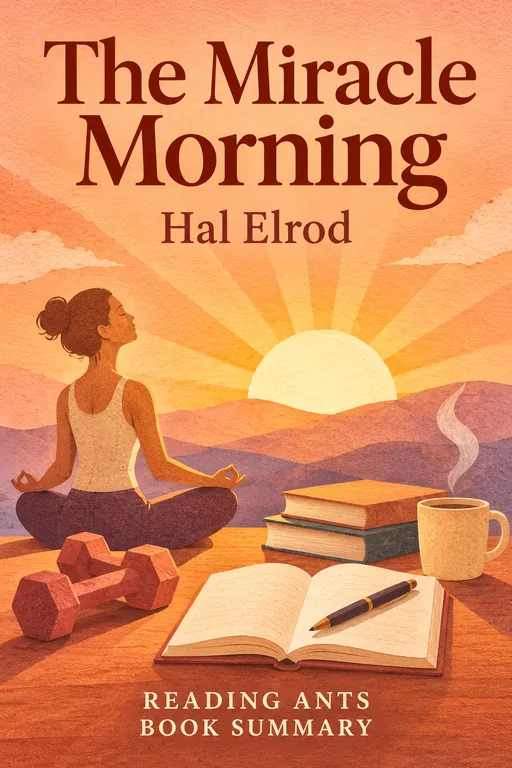
The Miracle Morning
Hal Elrod proposes that spending the first hour of each day on six simple practices, summed up as Silence, Affirmations, Visualization, Exercise, Reading and Scribing, can transform your life, and he describes a thirty-day plan to build the habit.
Overview
The Miracle Morning: The Not-So-Obvious Secret Guaranteed to Transform Your Life (Before 8AM) was published in 2012 by Hal Elrod, an American speaker and author who had earlier worked as a top salesperson. Elrod tells how, at the age of twenty, he was hit by a drunk driver in a car accident in which he died briefly, and was left with brain damage and told that he might never walk again. He recovered, and later, during a low point in his career in the financial crisis of 2008, developed a morning routine that turned his life around. Later printings add new chapters, including one on an evening routine. The book combines his story with a simple method, and has become a popular guide to morning routines.
Full Summary
1. The story and the premise
The idea: Elrod begins with his story: a crash with a drunk driver left him dead for several minutes, then in a coma, and doctors told him that he would probably not walk again, yet he did. He calls this his first rock bottom. His second came in 2008, when the financial crisis hit his business and he sank into a deep depression that, he says, was harder than his recovery from the accident. Desperate for a change, he went for a run, came across the idea that your level of success will seldom exceed your level of personal development, and decided to make time for his own growth. He chose to wake early, looked into the most effective practices, and combined six of them into a routine. He says that the way you wake up sets the tone for your day, and so your life. He proposes that you should wake up with purpose, not just in a rush.
In real life: A person who starts the day with a plan may feel more in control than one who hits the snooze button.
2. Why mornings
The idea: Elrod argues that the first ritual of the day is the most powerful one, since it sets the mind and the context for everything that follows, and that hitting the snooze button is a way of resisting the life you say you want. He wants readers to aim for a “Level 10” life in every area, and he warns against settling for mediocrity, citing statistics about how few people reach financial security as a reality check. He says that your level of success depends on your level of personal development, which comes from daily habits. By dedicating the first hour to yourself, you invest in becoming the person you need to be to reach your goals. Even people who call themselves night owls, as he did, can learn it.
In real life: A quiet hour before the family wakes can be a rare time of peace.
3. The six practices: SAVERS
The idea: The method is built on six practices, which spell the word SAVERS. Silence: meditation, prayer or deep breathing, to calm the mind. Affirmations: reading statements that reinforce your goals and beliefs. Visualization: imagining success in detail. Exercise: a short burst of movement, such as stretching or a workout. Reading: nonfiction that helps you learn from people who have done what you want to do. Scribing: writing in a journal about gratitude, insights and progress. Each can be done in as little as a minute, for a six-minute version, or up to an hour.
In real life: A short mix of stretching, reading and writing can be done before breakfast.
4. Making it easy: the flexible time frame
The idea: Elrod stresses that you can adapt the routine to your time. The full version takes sixty minutes, but there is a six-minute version, one minute for each practice, for busy days. He says that consistency matters more than length, and that you should not fall into an all-or-nothing mentality. He offers a five-step plan for waking up without snoozing: set a positive intention before bed, put the alarm across the room, brush your teeth, drink a glass of water, and put on workout clothes. The aim is to remove excuses. He adds that the routine can be moved to another time of day if mornings do not suit your work or family.
In real life: Putting your alarm clock across the room forces you to get up to turn it off.
5. The thirty-day challenge
The idea: The book presents a thirty-day plan to establish the habit, divided into three phases. In the first ten days, Elrod says, it is “unbearable,” as you face resistance and discomfort; in the second ten, it is “uncomfortable,” as you adapt but still need commitment; and in the last ten, it becomes “unstoppable,” a part of your identity. He argues against the popular idea that twenty-one days is enough. He points readers to the Miracle Morning community and an app for accountability. He encourages commitment to the full thirty days, since results come from persistence.
In real life: The first week of a new routine often feels hardest, and then it gets easier.
6. Beyond the morning: goals and life areas
The idea: In the last part, Elrod links the routine with larger goals. He offers a thirty-day transformation kit and advises people to identify what they want in key areas of life, and to use the morning to work on them. He tells the story of a reader, Keith Minick, who moved from depression to a more fulfilled life with the routine. The expanded edition adds a Miracle Evening, a routine for better sleep, and a final section about inner freedom, the idea that you can choose how you experience each moment. The central message is that daily personal growth can change everything.
In real life: A student who spends ten minutes each morning reviewing a goal may stay focused.
Why It Matters
The Miracle Morning was a bestseller, and started a community of followers, who share their routines online. It joined a wave of books and interest in morning routines among entrepreneurs and others, and encouraged many people to try waking earlier and to adopt habits of reflection and exercise. The book is simple and practical, and its story of recovery gives it emotional weight. It also led to a series of follow-up books for specific audiences, such as parents, salespeople and writers. Whether or not one believes in its promises, it has helped many readers to build a routine.
Key Takeaways
- Start the day on purpose. How you begin shapes the day.
- Use six simple practices. Silence, affirmations, visualization, exercise, reading and writing.
- Make it flexible. Use the six-minute version on hectic days.
- Commit for thirty days. Habits take time to form.
- Link it to goals. Use the time to move toward what matters to you.
What We Can Learn
You can try a short version of the routine for a week, choosing two or three practices that appeal to you, such as a few minutes of quiet, stretching and reading. Prepare the night before, and go to bed early enough to get adequate sleep, which is more important than waking early. Write down one thing you are thankful for. If mornings do not suit you, choose another time of day. Be patient with yourself, and adapt the plan to your life. Remember that habits are personal.
Criticism and Counterpoints
Critics may say that the book’s claims are exaggerated, with “miracle” and “guaranteed” promising more than a simple routine can deliver, and that it relies on personal stories and not on research. Others note that waking earlier is not good for everyone, since people have different body clocks, and that cutting sleep to fit the routine can be counterproductive. A morning routine may also be easier for people with flexible schedules, and no routine can solve every problem that a person faces. Still, many readers say that it has helped them.
Who Should Read It
This book is for readers who want a simple, structured way to start a morning routine, including students and professionals. It is easy to read, and motivational. Those who are skeptical of self-help hype might take its practical parts and leave the rest.
Want the whole book?
A summary is a taste, not the meal. Here is where to find the full book.
You reached the end 🎉
Nicely done. Mark this one as read, and we will suggest what to read next.
Read this next

Atomic Habits
James Clear
Big changes in life come not from huge leaps but from tiny habits repeated every day, and you can build good habits (and break bad ones) by designing your life so the right choices are obvious, attractive, easy and satisfying.
🌱 Self-Improvement
Tiny Habits
BJ Fogg
Stanford behavior scientist BJ Fogg teaches that lasting change comes not from willpower but from starting with very small behaviors, attaching them to existing routines and celebrating each success to make them stick.
🌱 Self-Improvement
Awaken the Giant Within
Tony Robbins
Motivational speaker Tony Robbins argues that anyone can take immediate control of their emotions, habits and destiny by changing what they focus on, the meanings they give to events, and the beliefs and standards that guide their choices.
🌱 Self-Improvement
The Compound Effect
Darren Hardy
Success magazine publisher Darren Hardy argues that big results come from small, smart choices repeated consistently over time, in the way that money grows by compound interest, and gives practical steps for building the right habits.
🌱 Self-Improvement
The 5 Second Rule
Mel Robbins
Mel Robbins offers a simple tool, counting backward from five and then moving, to push yourself into action before your mind talks you out of it, and shows how it can be used to beat procrastination, fear and doubt.
🌱 Self-Improvement
The 7 Habits of Highly Effective People
Stephen R. Covey
Lasting success in life and work comes not from quick tricks or a charming personality but from good character, built through seven habits that move us from depending on others, to standing on our own, to working well with others.
🌱 Self-ImprovementWant something different?
Pick another topic and we will show you three books to start with.