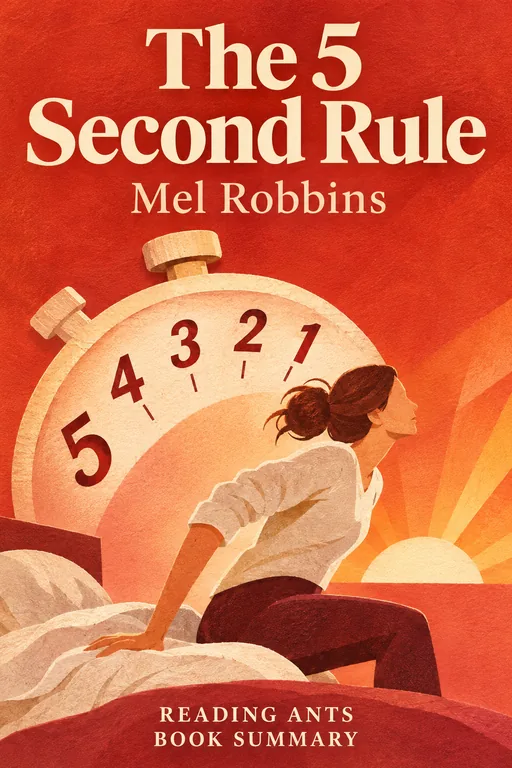
The 5 Second Rule
Mel Robbins offers a simple tool, counting backward from five and then moving, to push yourself into action before your mind talks you out of it, and shows how it can be used to beat procrastination, fear and doubt.
Overview
The 5 Second Rule: Transform Your Life, Work, and Confidence with Everyday Courage was published in 2017 by Mel Robbins, an American lawyer who became a television host, speaker and author. She says that she invented the rule in 2009, at the age of 41, when her marriage, finances and career were all falling apart and she could barely get out of bed, hitting the snooze button again and again. One night she saw a rocket launch in a television commercial, and the next morning she counted down, five, four, three, two, one, and stood up. She found that it worked, and then applied it to exercise, work, drinking and worry. The book has five parts and seventeen chapters, and it describes the method, the research she says supports it, and many stories and social media posts from readers.
Full Summary
1. The origin of the rule
The idea: Robbins tells how, in 2009, she was unemployed after a reality show for FOX was shelved, her husband’s restaurant business was failing, liens had hit their house, checks bounced, and she was drinking too much. Every morning she hit the snooze button two, three or four times, which she calls the one moment when she felt in control. Then one night a television commercial showed a rocket launch, with the countdown from five, and she thought that she could launch herself out of bed. The next morning she counted backward and stood up. She named it the 5 Second Rule because the name came to her that morning, and she started at five for no special reason. She later learned that counting interrupts your default thinking, and she calls the rule a metacognition tool and a starting ritual.
In real life: Counting down from five before getting up gives your mind something else to do than argue.
2. The rule: count and move
The idea: The rule itself is that, when you have an instinct to act toward a goal, you must count 5-4-3-2-1 and physically move, or your brain will stop you. Robbins says that there is a window of about five seconds between the instinct and the moment that your mind kills it with doubts and excuses. The count must go backward, she says, because with counting forward you can keep going, while after one there is nothing left to do except move. She calls motivation a myth, and says that you will never feel like it, because feelings, not logic, decide most of our choices; she cites the neuroscientist Antonio Damasio for this. You cannot control how you feel, she says, but you can choose how you act.
In real life: If you have a thought of doing homework, count down and open the book at once.
3. Why we hesitate
The idea: The author explains that the brain is designed to protect us, so it resists anything uncertain, scary or new, and that hesitation sends a stress signal that puts it in protection mode. Hesitating, worrying and doubting are habits, she says, and habits can be replaced. She tells of Christine, who has an idea in a meeting in Plano, Texas, and uses the countdown to speak up. She also tells of Rosa Parks, who she says did not hesitate or plan her act in 1955, and of Martin Luther King Jr., who said that he would probably have declined to lead the Montgomery bus boycott if he had thought it through. She calls this everyday courage, the courage of the subtitle.
In real life: Dreading a phone call often makes it harder than the call itself.
4. Using the rule for habits and tasks
The idea: Part 3 applies the rule to behavior. Robbins suggests a Wake Up Challenge: set your alarm thirty minutes earlier, and count down and get up the moment that it rings, so that you feel the “activation energy” needed to start. For health, she says that no diet or workout plan matters if you do not do it, and that you will never feel like it. For productivity, she advises removing distractions, never hitting snooze, and planning your day in the first part of the morning, in a routine that she calls “30 before 7:30.” For procrastination, she draws on the psychologist Timothy Pychyl, who she says finds that people put things off to escape stress. Her three steps are to forgive yourself, to ask what your future self would do, and to use the rule to get started.
In real life: Saying “five, four, three, two, one” and raising your hand in class can build your confidence.
5. Using the rule for anxiety, fear and thoughts
The idea: Part 4 turns to the mind. Robbins says that she had anxiety and panic attacks for many years, took the drug Zoloft for nearly two decades, and later came off it and says that she cured herself. For worry, you catch yourself, count, and point your mind to a positive thought or to what you are grateful for. For anxiety, she suggests counting and then telling yourself that you are excited, since she says the two states feel the same in the body, and she cites research by Alison Wood Brooks. For fear, she describes “anchor thoughts,” a pleasant image of your destination, which she used to overcome her fear of flying. She also says that people in a deep hole should get professional help.
In real life: Counting backward when worried can pull your attention to the present for a moment.
6. A life of everyday courage
The idea: In the last part, Robbins argues that confidence is a skill that you build through small acts of courage, not a matter of personality. She tells of an engineer at Cisco who used the countdown to introduce himself to the company’s chief executive on a jogging path. For passion, she advises you to explore your curiosity and act on it, and tells of a student, Todd, who left a dual law and business degree to study physical education. For relationships, her advice is to say it: leave nothing important unsaid, as she did when she asked her father if he was scared before his brain surgery. She ends by saying that the time to reveal your greatness is now.
In real life: Sending a message that you have been postponing can be easier if you do it right away.
Why It Matters
The 5 Second Rule became a bestseller, and its simple idea spread widely, in part through the author’s viral 2011 TEDx talk and her social media following; she says that more than 100,000 people in more than 80 countries wrote to her about it. It has been used by many people as a quick tool to start tasks, and the book describes sales teams and managers at companies using it. The book is part of a movement in self-help that emphasizes small, immediate actions over long-term planning and willpower. Robbins says that she became one of the most-booked speakers in the world, and she later launched a podcast. For readers who struggle with procrastination, it gives an easy tool.
Key Takeaways
- Do not wait for motivation. Action comes first.
- Count down and move. Use five seconds to cut off hesitation.
- Hesitation is a habit. It can be broken with practice.
- Small acts build confidence. Everyday courage adds up.
- It can help with feelings. Counting can shift attention away from worry.
What We Can Learn
You can try the technique the next time you hesitate over something small, like getting up in the morning, starting homework or sending a message. Count down from five, and then do the first step. Notice how it feels. Use it to speak up when you have an idea, and to try new things. Combine it with other habits, such as making a plan, and do not rely on it for everything. If you struggle with persistent anxiety or depression, speak to a professional, since a counting trick is not a treatment, and the book itself says that people in serious trouble should seek professional help. The book’s own first exercise is simple: set the alarm thirty minutes early and get up on the count.
Criticism and Counterpoints
Critics say that the book makes grand claims for a simple trick. The author calls the rule research-backed, but the book does not cite a study that tests the countdown itself; it borrows findings from research on habits, feelings, procrastination and anxiety, and its explanations of the brain, such as the role of the prefrontal cortex, are simplified. Others note that the book is repetitive and long for its main idea, and that it is largely built on anecdotes and social media posts, which cannot show that the rule caused the changes. The method also draws on existing ideas, such as starting rituals, activation energy and if-then planning, so it is a new packaging of familiar tools. Robbins herself says that serious anxiety may need professional help. Still, many find the rule useful.
Who Should Read It
This book is for readers who struggle with procrastination or hesitation, and like short, energetic motivational advice. It is easy to read, though it has some strong language and mentions addiction and suicidal thoughts in reader stories. Those who prefer evidence-based books on behavior change may also read Tiny Habits.
Want the whole book?
A summary is a taste, not the meal. Here is where to find the full book.
You reached the end 🎉
Nicely done. Mark this one as read, and we will suggest what to read next.
Read this next

Tiny Habits
BJ Fogg
Stanford behavior scientist BJ Fogg teaches that lasting change comes not from willpower but from starting with very small behaviors, attaching them to existing routines and celebrating each success to make them stick.
🌱 Self-Improvement
Atomic Habits
James Clear
Big changes in life come not from huge leaps but from tiny habits repeated every day, and you can build good habits (and break bad ones) by designing your life so the right choices are obvious, attractive, easy and satisfying.
🌱 Self-Improvement
The Miracle Morning
Hal Elrod
Hal Elrod proposes that spending the first hour of each day on six simple practices, summed up as Silence, Affirmations, Visualization, Exercise, Reading and Scribing, can transform your life, and he describes a thirty-day plan to build the habit.
🌱 Self-Improvement
Awaken the Giant Within
Tony Robbins
Motivational speaker Tony Robbins argues that anyone can take immediate control of their emotions, habits and destiny by changing what they focus on, the meanings they give to events, and the beliefs and standards that guide their choices.
🌱 Self-Improvement
The Compound Effect
Darren Hardy
Success magazine publisher Darren Hardy argues that big results come from small, smart choices repeated consistently over time, in the way that money grows by compound interest, and gives practical steps for building the right habits.
🌱 Self-Improvement
The 7 Habits of Highly Effective People
Stephen R. Covey
Lasting success in life and work comes not from quick tricks or a charming personality but from good character, built through seven habits that move us from depending on others, to standing on our own, to working well with others.
🌱 Self-ImprovementWant something different?
Pick another topic and we will show you three books to start with.