 Reading Ants
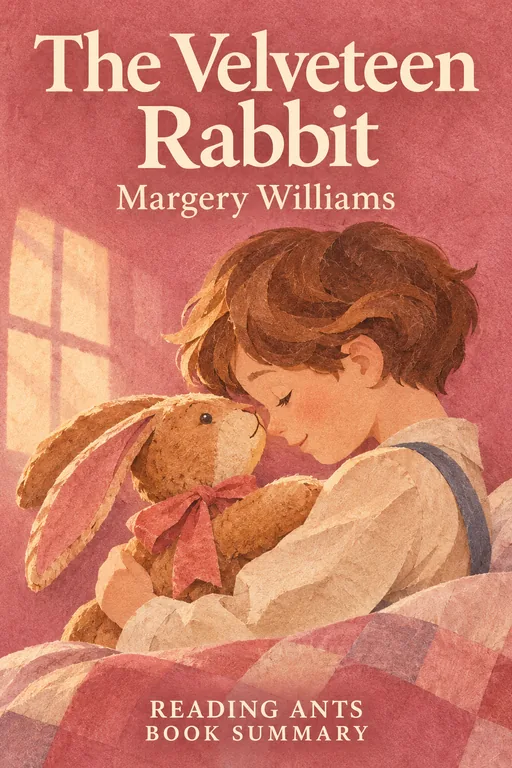
The Velveteen Rabbit
A stuffed toy rabbit, loved by a small boy, learns from an old toy horse that being loved can make a toy Real, and at the end of a sad night, a fairy turns him into a living rabbit.
Overview
The Velveteen Rabbit, or How Toys Become Real is a short children’s story by Margery Williams, first published as a book in 1922, with illustrations by William Nicholson. It is about a simple stuffed rabbit, who wishes to be Real and who learns what that means from an older toy. The tale is gentle and moving, and speaks about love, change and the way that loving someone makes both of you more alive. Although it is short, adults often love it as much as children.
Main Characters
- The Velveteen Rabbit: a soft, humble toy rabbit, sewn from velveteen, who longs to be Real.
- The Boy: a small child who receives the rabbit at Christmas and comes to love him.
- The Skin Horse: the oldest, wisest toy in the nursery, worn from years of love.
- The mechanical toys: proud, expensive toys that look down on the rabbit.
- Nana: the nursery nurse, who tidies the toys away.
- The wild rabbits: living rabbits that the Velveteen Rabbit meets in the garden.
- The nursery magic fairy: a flower fairy who appears at the end.
Full Summary
A Christmas gift
On Christmas morning, a Boy finds in his stocking a handsome toy rabbit made of velveteen, with a round body, thread whiskers and pink-lined ears. At first the Boy is delighted, but after a couple of hours, when relatives arrive and there are other presents to open, the Rabbit is forgotten and left in the toy cupboard or on the nursery floor. The other toys, especially the grand mechanical ones, who think that they are very special, are unfriendly to the Rabbit. He feels shy and plain, and he does not know what he is supposed to do.
The Skin Horse explains
Among the toys is the old Skin Horse, whose coat is worn and whose tail hairs have mostly been pulled out. The Rabbit asks him what it means to be Real. The Skin Horse explains that it is not about how you are made, but about what happens to you: when a child loves you for a long time, not only to play with, you become Real. It sometimes hurts, he admits, but once you are Real you do not mind being hurt, and by then most of your hair is loved off, and your eyes may drop out, but this does not matter.
The Boy’s best friend
One night, when the Boy cannot find his favorite china dog, Nana pulls the Velveteen Rabbit out of the cupboard and puts him in the Boy’s arms. From then on the Rabbit becomes the Boy’s constant companion. They play together in the garden, and sleep together, and the Boy talks to him as a friend. The Rabbit grows shabby and loose, but he is happy, and one day he hears the Boy tell Nana that his Bunny is not a toy but Real, and he knows that the nursery magic has happened.
Meeting the wild rabbits
During a summer evening in the wood near the house, the Rabbit meets two real rabbits who come out of the bracken. One of them asks him to join them for a game, but they notice that he has no proper hind legs and that he does not smell right. He insists that he is Real, because the Boy said so, but the wild rabbits say that he is not a rabbit at all, and he is upset. When the Boy runs past, the wild rabbits vanish. The Velveteen Rabbit is left alone and sad, until the Boy carries him home.
Illness and loss
Later, the Boy falls ill with a high fever. The Rabbit stays hidden in the bedclothes beside him, afraid that someone might take him away, and the Boy needs him. The illness turns out to be scarlet fever. When the Boy recovers and is to go to the seaside, the doctor orders that the room be disinfected and that the toys and books he played with in bed be burned, to prevent the disease from spreading. The Rabbit is wrapped in a sack and put in the garden, to be burned in the morning. That night the Boy sleeps in another room, with a new bunny. Alone and shivering, the Rabbit thinks about the happy times, and a real tear falls from his eye. He remembers the garden, the wood, the day he knew he was Real, and the Skin Horse’s words, and he wonders sadly what use it was to be loved and become shabby if everything ends like this.
Becoming Real
Where the tear falls, a flower grows, and a fairy steps out of it. She says that she is the nursery magic fairy, who takes care of toys that children have loved. She kisses the Rabbit and tells him that he will be Real to everyone, not just to the Boy. He becomes a living rabbit and hops off to join the others. The next spring, the Boy sees a rabbit in the wood with faint spots showing through its fur and thinks that it looks just like his old Bunny, though he never knows that it is.
Why It Matters
The Velveteen Rabbit has become one of the best-loved children’s stories of the twentieth century, and it remains popular with parents and teachers. Its central idea, that love makes things real, speaks to children’s attachment to their toys and to adults’ experience of what is lasting. The story speaks gently about growing old, being worn by life and facing loss, and it suggests that these are signs of love, not of failure. It has been adapted for the stage, television and film, and it is still widely read today. It remains an example of how a very short story can hold deep truths.
Key Takeaways
- Love makes us real. Being loved gives something its true value.
- Wear is a sign of love. Shabbiness shows a life that was cherished.
- Worth is not about appearance. The proud toys are shiny, but not real.
- Change can be gentle. Becoming Real takes a long time, and it does not happen all at once.
- Loss can lead to new life. The Rabbit’s sad night ends in transformation.
What We Can Learn
You can learn that what makes a person or a thing valuable is not newness or perfection, but the love and time put into a relationship. The story offers comfort to children who worry about growing up and to adults who are aging, since signs of age can be signs of having been loved. It also invites us to be patient and to treat the things and people we care about with attention. You might read it with a child, and then talk about a favorite toy, or about someone who made you feel real.
Criticism and Counterpoints
Some readers find the story sentimental, and feel that its closing scene, in which a fairy rescues the rabbit, offers too easy a consolation after the sad burning of the toys. Others point out that the idea of toys that feel pain and loss may upset sensitive children, especially the scenes of illness and disposal. A few critics argue that the notion that a toy can only become Real through a child’s love is unclear, and can be read in different ways. Yet the tale has endured because many find it touching and true.
Who Should Read It
This book is for children from about four, read aloud, and for adults who want a short, tender story about love and change. It takes about half an hour to read aloud. Parents may want to be ready to talk about the sadder parts with young children.
Want the whole book?
A summary is a taste, not the meal. Here is where to find the full book.
You reached the end 🎉
Nicely done. Mark this one as read, and we will suggest what to read next.
Read this next
The Adventures of Pinocchio
Carlo Collodi
A troublesome wooden puppet repeatedly ignores good advice, but love, hard work and responsibility gradually help him become a caring human boy.
🌍 World Literature
Charlotte's Web
E. B. White
A lonely pig named Wilbur learns he is going to be killed, and his clever friend Charlotte, a spider, comes up with an amazing plan to save his life.
🧸 Children's Books
Winnie-the-Pooh
A. A. Milne
A gentle, honey-loving bear and his friends in the Hundred Acre Wood share funny, simple adventures with a boy named Christopher Robin, celebrating friendship, kindness and the joys of childhood.
🧸 Children's Books
Peter Pan
J. M. Barrie
A magical boy who refuses to grow up flies three London children to Neverland, where they battle pirates led by the villainous Captain Hook, until Wendy realizes they must go home and grow up.
🧸 Children's Books
The Little Prince
Antoine de Saint-Exupery
A pilot stranded in the desert meets a small boy from a tiny planet, who teaches him that the most important things in life, like love and friendship, can only be seen with the heart.
🌍 World LiteratureHarry Potter and the Philosopher's Stone
J. K. Rowling
An unloved orphan boy discovers on his eleventh birthday that he is a famous wizard, and during his first year at a magical school he makes true friends and faces the dark wizard who killed his parents.
🧸 Children's BooksWant something different?
Pick another topic and we will show you three books to start with.