 Reading Ants
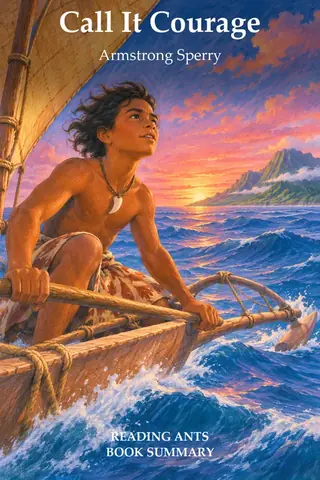
Call It Courage
A Polynesian boy who has been afraid of the sea since it took his mother sets out alone in a canoe to prove his courage.
Overview
Call It Courage is a short adventure novel by Armstrong Sperry, published in 1940, and it won the Newbery Medal in 1941. Mafatu, whose name means Stout Heart, is the son of Tavana Nui, the chief of Hikueru, an island in the Pacific. He has feared the ocean since he lost his mother to a storm at sea when he was very young. His people call him a coward, and his father is ashamed of him. Rather than live with that, he takes a canoe and sails out alone, with his small dog and an albatross for company. It is a short, fast survival story about fear and bravery.
Main Characters
- Mafatu: a boy whose name means Stout Heart, who is afraid of the sea.
- Tavana Nui: his father, the chief of Hikueru, a respected and proud man.
- Uri: Mafatu’s small yellow dog.
- Kivi: an albatross that becomes Mafatu’s companion.
- Mafatu’s mother: who died in a storm at sea when Mafatu was very young.
- The cannibals: people from a neighboring island who appear near the end.
Full Summary
A Boy Who Was Afraid
Mafatu lives on the island of Hikueru, where the sea is the center of life. When he was very small, a storm took his mother, and the sea has terrified him ever since. The other boys tease him, and the island people call him a coward. His father, the great chief Tavana Nui, is ashamed of him, and some of the older villagers blame a spirit said to possess a child at birth. Mafatu himself believes that Moana, the sea god, hates him and is hunting him, and he prays to Maui, another of the old gods, for help. He cannot bear it. His name means Stout Heart, and the joke is that the boy who carries it is the one who is afraid. He decides that the only way to change what they think of him is to face the thing he fears most.
Setting Out
Mafatu sets out alone in a canoe, with Uri, his dog, and Kivi, an albatross, as companions. He has no goal except to prove to himself that he is not a coward. A great storm comes up and destroys the canoe, and Mafatu finds himself on a deserted island. He is alone, his canoe is gone, and the nearest home is far across the open sea. For the first time in his life Mafatu has to rely entirely on himself, and on two animals who need him as much as he needs them.
Learning to Survive
On the island Mafatu has to learn how to survive. He learns to hunt and to fish, and gradually he learns the island’s ways. Each small success makes him feel a bit stronger. He realizes that he has been on the island for about a week, and that nobody knows where he is. Instead of giving in to despair, he makes use of whatever the island offers. The skills he learns are small ones, but together they give him a new feeling: that he is capable.
The Altar
Exploring the island, Mafatu finds a sacred place where people from a neighboring island, who are said to be cannibals, come to make sacrifices. This frightens him, because it means that they may return. At the altar he finds a spearhead, which he fastens to a shaft to make a strong weapon. He begins to build a new canoe and to gather supplies, so that he can leave the island when he must. The altar is a warning that he is not the only person who comes to this island, and that his survival may depend on being ready to go quickly.
Facing Fear
With the new spear, Mafatu faces dangers one at a time. Among them are a shark, a wild boar and an octopus, and he overcomes each of them, so that his fear shrinks. He realizes that he is growing more confident and that the fear he once felt does not rule him now. Then the visitors from the other island return. They see him and chase him, and he escapes in his new canoe, with the canoes of his pursuers behind him for days, before he loses them. The chase is the greatest test of all, and Mafatu passes it with the skills he has built up over his time alone.
Return
When Mafatu returns to Hikueru, he is a different boy. His father does not recognize him at first, and then welcomes him with pride. The tribe accepts him, and the story of his courage is told to future generations. The name that once seemed like a joke now suits him. The book suggests that courage is not something a person is born with, but something earned by choosing, again and again, to go on while afraid.
Why It Matters
Call It Courage won the Newbery Medal in 1941 and has been widely read in schools ever since. It is a brief and exciting story that fits in an afternoon, which makes it popular with young and reluctant readers. It was made into a television film for The Wonderful World of Disney in 1973, and in Britain it was published under the title The Boy Who Was Afraid. It also tells a clear and encouraging story about how courage is learned.
The book is often compared with other survival stories such as Island of the Blue Dolphins and Hatchet. Its message, that bravery does not mean having no fear, but acting despite it, is one that readers of every age can understand.
Key Takeaways
- Courage can be learned. Mafatu grows braver by facing small challenges one by one.
- Fear does not have to rule you. He keeps going even while afraid.
- Others’ opinions are not the whole truth. The tribe calls him a coward, but he proves them wrong.
- Companionship helps. His dog and his albatross keep him going.
- A hard test can change who you are. He returns home as a new person.
What We Can Learn
If something frightens you, try facing it in small steps. Mafatu does not conquer the sea in a day. He learns to hunt, fish and survive, and every success makes the next one easier. You can use the same approach with a fear of speaking, swimming or trying something new.
The story also reminds us not to define people, or ourselves, by their weaknesses. Mafatu was labeled a coward, but he was just a boy who had been hurt by loss.
Finally, it shows how helpful it is to have companions in hard times. Even a small dog and a bird can make a big difference.
Criticism and Counterpoints
Readers today may notice that the book shows people from a neighboring island as cannibals, a stereotype that was common in adventure stories of the period and is not accurate. Others find the plot simple, with a quick series of triumphs over a shark, a boar and an octopus. Parents may also want to know that the story brings in the local sea god Moana and the god Maui, and a spirit that older villagers blame for his supposed cowardice, and that it presents these as part of the characters’ world. Even so, the book remains popular for its pace and clear message.
Who Should Read It
This book suits readers from about eight to twelve who like survival adventure and animals. It is short and easy to read, so it is a good first chapter book. Adults who use it in class may want to discuss its dated portrayal of the island visitors and compare it with other survival stories.
Want the whole book?
A summary is a taste, not the meal. Here is where to find the full book.
You reached the end 🎉
Nicely done. Mark this one as read, and we will suggest what to read next.
Read this next
Island of the Blue Dolphins
Scott O'Dell
After her people leave their island and she is left behind, a Native American girl named Karana survives alone for years, learning to hunt, build and make friends with animals.
🧸 Children's Books
Hatchet
Gary Paulsen
After a plane crash leaves him alone in the Canadian wilderness with only a hatchet, a thirteen-year-old boy must learn to survive, and grows from a frightened city kid into a patient, resourceful young man.
🧸 Children's Books
The Call of the Wild
Jack London
Buck, a big, pampered dog stolen from his comfortable California home, is sold into the freezing Yukon gold rush as a sled dog, where he learns to survive and eventually answers the call of the wild.
📜 Classics
Robinson Crusoe
Daniel Defoe
After a shipwreck, an English sailor named Robinson Crusoe survives for twenty-eight years on a remote island, building a life with his own skill and faith, and eventually befriending a man he calls Friday.
📜 Classics
Charlotte's Web
E. B. White
A lonely pig named Wilbur learns he is going to be killed, and his clever friend Charlotte, a spider, comes up with an amazing plan to save his life.
🧸 Children's Books
Harry Potter and the Philosopher's Stone
J. K. Rowling
An unloved orphan boy discovers on his eleventh birthday that he is a famous wizard, and during his first year at a magical school he makes true friends and faces the dark wizard who killed his parents.
🧸 Children's BooksWant something different?
Pick another topic and we will show you three books to start with.