 Reading Ants
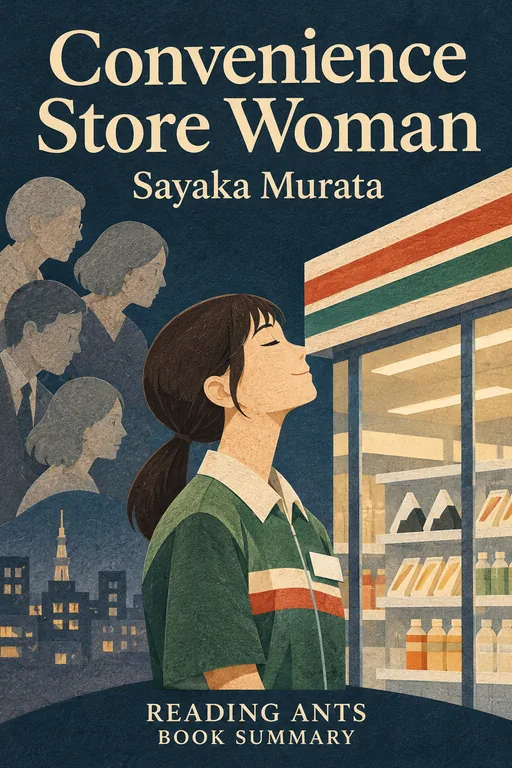
Convenience Store Woman
Original title: コンビニ人間
A woman who has found peace working at a convenience store for eighteen years is pressured by family, friends and society to become "normal," and she must decide what kind of life is truly hers.
Overview
Convenience Store Woman is a short novel by the Japanese writer Sayaka Murata, published in 2016. It won Japan’s Akutagawa Prize, and it was a bestseller in Japan and abroad. It is set in contemporary Tokyo, in a small convenience store. The narrator, Keiko Furukura, is thirty-six, unmarried and has worked part-time at the store since college. People around her think this is strange and sad. The book is a funny, sharp, and sometimes uncomfortable look at conformity, work and what society expects of us.
Main Characters
- Keiko Furukura: the narrator, an odd, literal-minded woman, who is happy at the store.
- Shiraha: a lazy, bitter young man, who joins the store and is soon fired.
- Keiko’s sister: a woman who loves Keiko, but who worries about her.
- Keiko’s friends: old schoolmates, who give her advice about marriage and work.
- The store manager and colleagues: the people who make up Keiko’s daily world.
Full Summary
A Strange Child
From childhood, Keiko feels that she is different. She does not understand why others react as they do. When she sees a dead bird, she suggests that they cook it and eat it. When two boys fight, she hits one with a spade to stop them. Her parents are worried, and Keiko learns to say as little as possible, so that she will not cause more trouble.
In college, she takes a part-time job at a newly opened convenience store, and finds that she has a place. The store has clear rules, and everything is explained, from how to greet customers to how to arrange the shelves.
The Store
Keiko loves the store. In it, she feels that she is a small working part of society, and she knows exactly how to behave. She imitates the speech and dress of her colleagues, and she adjusts her tone to suit each person. For eighteen years, she has been a perfect employee.
She eats, sleeps and thinks of the store. Her body, she says, is made of the food she sells.
Pressure
But when she reaches her mid-thirties, people begin to ask questions. Why does she not have a husband, a career or children? Her friends and sister try to help, with a mixture of curiosity and pity. Keiko, who does not feel the need for these, plays along.
She realizes that, in the eyes of the world, she is a “defect,” and she is tired of the constant questions.
Friends and Family
Keiko’s old friends from school gather for a barbecue, and all of them want to know about her life. She tells them that she has a bad health problem, which stops her from working full time. They nod, and say that she should find a nice husband. Her sister, whom she loves, is also concerned, and asks why Keiko cannot just be like everyone else.
Keiko does not argue. She simply makes a note of how people speak, and copies their words, as she does at the store.
Shiraha
A young man, Shiraha, takes a job at the store. He is bitter, lazy and resentful, and says that society is a place of oppression, that nothing has changed since the Stone Age, and that those who are not useful are cast out. He is soon fired for pestering female coworkers and customers.
Keiko meets Shiraha again after he has lost his job, and, for convenience, she lets him move in. She thinks that having a man living with her will stop the questions. Shiraha, who needs a place to stay, plays along. Soon her family and friends are delighted, and they are very interested in the “relationship.”
Leaving the Store
Under pressure, Keiko quits her job at the store to look for a “proper” job. Without the store, she is lost. She does not know when to wake or eat or how to behave. Shiraha, who lives off her, becomes more demanding.
On the way to a job interview, she stops at a convenience store, and she begins to rearrange the products and to serve the customers on instinct. She realizes that the store is her calling.
The Choice
Keiko decides that she will return to convenience store work, and she tells Shiraha that she does not want to be normal or to follow his plans for her. The book ends with her determined to be what she is: a convenience store woman. It is not a simple liberation, since society has not stopped judging her, and she remains dependent on the store’s rules.
Why It Matters
Convenience Store Woman sold more than a million copies in Japan, and it was translated into many languages. It was praised by readers who felt pressure to follow society’s script, and it started a conversation about conformity, gender roles and work in modern Japan. The book is also notable for its humor, its deadpan voice, and for the way it treats a character who is outside the norm, with respect and affection. It has been adapted for the stage and has been widely discussed in book clubs. The author herself worked part-time in a convenience store while she was writing, and that experience gave the book its sharp, accurate details of how a store is run.
Key Takeaways
- Normal is a social idea. What is expected is not the same as what is right.
- Work can give meaning. The store gives Keiko a clear identity.
- Pressure to conform is strong. People criticize what they do not understand.
- Different is not defective. Keiko’s way of living is valid.
- Freedom is knowing what you want. She finds peace by choosing her own path.
What We Can Learn
The book suggests that we should be careful about judging people whose lives do not match our expectations. Everyone has a different way of finding happiness, and it is not always what society says. It also reminds us that we have the right to choose our own paths, as long as we do no harm.
We can also see how often well-meaning questions about marriage, jobs and children can be hurtful. Finally, it shows that it is possible to find meaning and pride in work that others look down on.
Criticism and Counterpoints
Some readers find the book too short and the story simple. Keiko’s choice at the end is seen by some as sad, as she gives up on growth and relationships. Others note that the book gives an exaggerated view of Japanese society, and that its picture of Shiraha is unfair. Some critics see Keiko as a symbol of those with autism or other differences, and argue that the book does not deal with them honestly. Others feel that the ending is not a victory, but a withdrawal.
Who Should Read It
This book is for readers who like short, funny and thoughtful novels. It is quick to read, and it is a good book for discussing in a group. Those who like big plots may find it slight, but those who enjoy strange characters will love it.
Want the whole book?
A summary is a taste, not the meal. Here is where to find the full book.
You reached the end 🎉
Nicely done. Mark this one as read, and we will suggest what to read next.
Read this next

Normal People
Sally Rooney
Marianne and Connell, two teenagers from a small town in the west of Ireland, begin a secret relationship at school, and over the next four years, as they move to Trinity College in Dublin, they drift together and apart.
✨ Modern Fiction
The Vegetarian
Han Kang
After a disturbing dream, an ordinary Korean housewife stops eating meat, and her quiet refusal sets off a family crisis that pushes her toward a strange, desperate escape.
🌍 World Literature
No Longer Human
Osamu Dazai
A man who feels like an alien among other people hides behind a mask of clowning, and sinks, through drink, drugs and failed relationships, into despair.
🌍 World Literature
The Stranger
Albert Camus
An emotionally detached office worker kills a man on an Algerian beach and discovers that society condemns him as much for refusing its expected feelings as for the murder itself.
🌍 World Literature
A Man Called Ove
Fredrik Backman
A grumpy, rule-loving widower who wants to die finds that the neighbors who keep interrupting him are slowly giving him a reason to live.
🌍 World Literature
The Little Prince
Antoine de Saint-Exupery
A pilot stranded in the desert meets a small boy from a tiny planet, who teaches him that the most important things in life, like love and friendship, can only be seen with the heart.
🌍 World LiteratureWant something different?
Pick another topic and we will show you three books to start with.