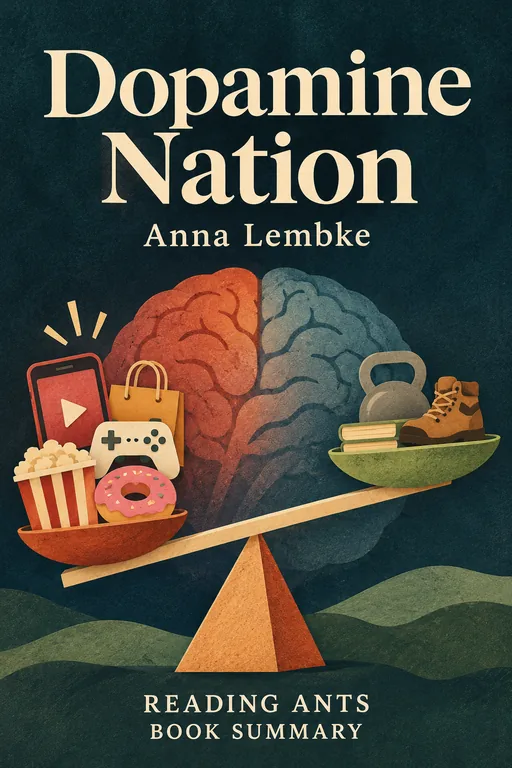
Dopamine Nation
Stanford psychiatrist Anna Lembke explains that the brain balances pleasure and pain like a seesaw, so that constant stimulation from modern comforts can leave us craving more, and she shows how stepping back and embracing some discomfort can restore balance.
Overview
Dopamine Nation: Finding Balance in the Age of Indulgence was published in 2021 by Anna Lembke, a professor and the medical director of addiction medicine at Stanford University School of Medicine. She combines stories from her patients, who struggle with different kinds of compulsive behavior, with her own experience and with neuroscience. She says that we live in a time in which almost everything that gives pleasure is available at all times, and that this abundance has made many of us vulnerable to compulsive behavior. The book offers explanations and practical tools.
Full Summary
1. The pleasure-pain balance
The idea: Lembke explains that dopamine, a brain chemical (a neurotransmitter) that works in the brain’s reward circuit and is linked to reward and motivation, is part of a system in which the brain keeps pleasure and pain in balance, like a seesaw. When we experience pleasure, the balance tips toward pleasure, and the brain then tips back toward pain to restore equilibrium, so that after the high, there is a low. She calls this the opponent-process mechanism. If we repeat the stimulation, the brain adapts (neuroadaptation): the pain side of the seesaw grows heavier, the resting level shifts, and a person can end up in a dopamine-deficit state, feeling worse than before when the stimulus is gone, which drives craving. She illustrates this with brain-scan research on people with addictions to drugs such as cocaine, methamphetamine, alcohol and heroin, whose scans show lower dopamine receptor availability than those of healthy controls.
In real life: The excitement of a new game fades, and a flat, restless feeling can follow the thrill.
2. Too much of a good thing
The idea: The author describes how the modern world is full of rewarding stimuli, such as drugs, food, gambling, shopping and social media, which are cheap, quick and always available, and she calls the smartphone a modern hypodermic needle that delivers digital dopamine around the clock. She names easy access as the biggest risk factor for addiction, and the internet also lets people pursue hidden compulsions in private. She distinguishes ordinary indulgences, which stay occasional, from addiction, which is compulsive use that continues despite harm. She describes this as a plenty paradox: overabundance is itself a stressor, because our primitive wiring does not match a modern world rich in dopamine, and she points to studies showing falling happiness over recent decades in several rich countries, and higher rates of anxiety and depression in richer countries than in poorer ones. In a 2023 talk based on the book, she noted that U.S. adults spent on average more than eight hours a day with digital media in 2021. The book relies on detailed patient stories, and the first is about a man whose compulsive sexual behavior finally came under control.
In real life: Checking a phone constantly can become a habit that is hard to stop.
3. Dopamine fasting: a break
The idea: A key suggestion is to take a break from the thing to which you feel addicted, for a limited period, to allow the brain to recover. Lembke says that with continued abstinence the balance tends to return to a more normal state, and we can feel the pleasures of simple things again. She considers an intentional dopamine fast necessary in an age of excess, and she sets out a step-by-step approach summed up in the acronym DOPAMINE, whose steps stand for data, objectives, problems, abstinence (and a degree of asceticism), mindfulness, insight, next steps and experiment. The first days are often hard, as withdrawal can bring anxiety, irritability, poor sleep, low mood and craving, though she says these symptoms are time limited and tend to lessen with continued abstinence.
In real life: Putting your phone away for a while may feel unpleasant at first, but it may make you enjoy a walk more.
4. Self-binding and honesty
The idea: The book describes strategies to maintain a break. Self-binding means setting up barriers in space, time and meaning. In her talks she gives examples for digital habits: in space, deleting apps, leaving the phone at home or keeping bedrooms free of devices; in time, tech-free meals and regular digital fasts; and in meaning, deciding how you will use a device before you pick it up, turning off alerts, hiding the like button or switching the screen to grayscale. Lembke also encourages honesty with oneself and others, since lying is a key part of addictive behavior and sustains addiction, while honesty tends to help recovery and relationships. She describes radical honesty as not lying about or hiding your use, even to the point of letting someone else look at your phone.
In real life: Telling a friend about your goal and being open about how you use your phone makes it harder to cheat.
5. Pressing on the pain side
The idea: Lembke argues that pain should be accepted and, in a sense, applied, so that deliberately doing things that are hard or uncomfortable, such as exercise, ice-cold water plunges, fasting, prayer or meditation, can press on the pain side of the balance, which is followed by a feeling of reward. She uses the science of hormesis, the idea that a small dose of something painful can be good for us, and describes it as paying for our dopamine up front instead of borrowing it. In her chart of a cold-water plunge, dopamine rises and stays elevated for hours, with no dopamine-deficit state afterward. Her examples of useful hard things also include reading a hard book, walking instead of driving, telling the truth and saying sorry, so she links radical honesty, which can cause discomfort, to the same idea.
In real life: After a tough workout, many people feel a calm sense of well-being.
6. Moderation, recovery and relapse
The idea: In the later chapters, she discusses what happens after the break. She advises planning how to bring the activity back without letting it take over, for example by writing down how the break made you feel better, setting a time limit before you start and using tools such as fewer alerts and deleted apps. She also addresses relapse as part of recovery. She draws on time-tested wisdom from twelve-step programs, adapted to everyday compulsive habits, and she argues for empathy and acceptance, together with radical honesty and a kind of shame that serves other people rather than punishing the self. Her stated goal is balance, as the subtitle of the book suggests.
In real life: Someone who slips up after a week of change can start again without giving up.
Why It Matters
Dopamine Nation became a New York Times bestseller and brought the science of addiction and the pleasure-pain balance to a wide audience, at a time when many people were worried about screens, social media and other compulsions. The book combines compassion with clear advice, and reviewers have praised its patient stories as relatable and its explanations as accessible, with Kirkus calling it a good education on addiction with a sensible formula for treatment. It has also been discussed in clinical journals, in connection with addiction and adolescent mental health. For many readers, it offers a framework for understanding their own cravings and a way to change. In later talks, Lembke has extended the ideas beyond the individual, arguing for limits on children’s access to the most addictive products, for changes in how online platforms are designed and for more responsibility on the companies behind them.
Key Takeaways
- Pleasure and pain are linked. The brain keeps a balance, and strong highs lead to lows.
- Abundance can harm. Easy access to stimulation makes addiction more common.
- A break can reset. Abstaining for a time helps the brain to recover.
- Honesty and barriers help. Tell the truth and make it harder to relapse.
- Discomfort can help. Doing hard things on purpose can restore balance.
What We Can Learn
You can use the book to consider which habits you do compulsively, and how they make you feel afterward. Try a short break, such as a day without screens or a week without a particular app (Lembke herself suggests starting with 24 hours without screens in her talks, while admitting that this is probably not enough), and note your feelings. Tell someone you trust what you are trying to do. Put barriers in place, such as keeping the phone out of the bedroom. Add healthy challenges, such as exercise. And be kind to yourself if you slip. Serious addictions, such as to drugs or alcohol, need professional help, and stopping suddenly can be dangerous, so please consult a doctor.
Criticism and Counterpoints
Some neuroscientists say that the popular picture of dopamine as a pleasure chemical is too simple, since dopamine is more about reward and motivation, and that the seesaw metaphor, though helpful, simplifies the brain’s complexity. Others note that it is a popular book that explains the science in simplified terms and draws heavily on clinical experience and patient stories. Neuroscientists have also criticized the dopamine fasting fad that spread in Silicon Valley, calling its claim that the brain can be reset by avoiding dopamine triggers for a short time unproven or misleading, and saying that the practice varies widely. Kirkus noted that Lembke does not overstate how well her approach works.
Who Should Read It
This book is for adults who struggle with compulsive habits, and for those who want to understand addiction with compassion. It contains frank stories about drug use, sex and self-harm. Those in crisis should seek immediate professional help.
Want the whole book?
A summary is a taste, not the meal. Here is where to find the full book.
You reached the end 🎉
Nicely done. Mark this one as read, and we will suggest what to read next.
Read this next
Stolen Focus
Johann Hari
Johann Hari argues that our collective ability to pay attention is being eroded not just by personal weakness but by twelve forces in modern life, including technology designed to hook us, and that we must change both our habits and the systems around us.
🧩 Mind & Psychology
Atomic Habits
James Clear
Big changes in life come not from huge leaps but from tiny habits repeated every day, and you can build good habits (and break bad ones) by designing your life so the right choices are obvious, attractive, easy and satisfying.
🌱 Self-Improvement
Digital Minimalism
Cal Newport
Computer scientist Cal Newport argues that we should use technology intentionally, by clearing out low-value digital habits, and building a life of high-quality leisure, solitude and real conversation, a philosophy he calls digital minimalism.
🌱 Self-Improvement
Behave
Robert M. Sapolsky
Neuroscientist Robert Sapolsky asks why humans do the best and worst things they do, and answers by working backward in time, from the second before an act to the seconds, hours, years and millennia that shaped it.
🧩 Mind & Psychology
The Obesity Code
Jason Fung
Dr. Jason Fung argues that obesity is mainly a problem of hormones, especially insulin, and not just of eating too many calories, and he recommends cutting sugar and refined carbohydrates and using periods of fasting.
🍎 Health
Thinking, Fast and Slow
Daniel Kahneman
Our minds run on two systems, a fast, intuitive one and a slow, careful one, and understanding how the fast system fools us can help us make better decisions about money, risk, work and happiness.
🧩 Mind & PsychologyWant something different?
Pick another topic and we will show you three books to start with.