 Reading Ants
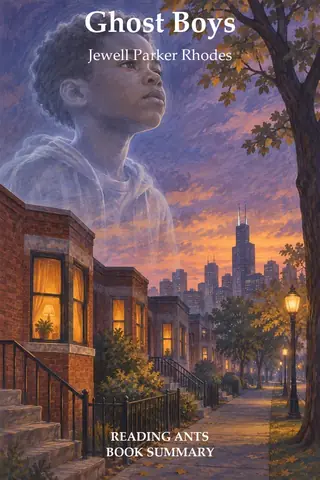
Ghost Boys
A twelve-year-old boy shot by a police officer becomes a ghost who watches what happens to his family and to the officer's daughter, and asks the living to bear witness.
Overview
Ghost Boys is a 2018 novel by Jewell Parker Rhodes. Its narrator is Jerome Rogers, a twelve-year-old Black boy from Chicago, who is shot and killed by a white police officer who thought a toy gun was real. The story moves between Jerome’s life before and after his death, which the book marks with the words “alive” and “dead”. As a ghost, Jerome watches his grieving family and meets the ghost of Emmett Till, who was murdered in 1955. He also meets the officer’s daughter, who can see him and begins to question what her father has done. The book is about racism, grief and the power of telling the truth. It is a serious subject for young readers, written with tenderness.
Main Characters
- Jerome Rogers: the twelve-year-old narrator, a boy who works hard at school and tries to follow his family’s rules.
- Kim Rogers: Jerome’s younger sister.
- Jerome’s father: called Pop, a sanitation worker and a loving parent who is present at the hearing.
- Grandma: Jerome’s grandmother, who lives with the family, asks him every day for “three good things,” and half senses his ghost.
- Carlos: a new boy from San Antonio whom Jerome befriends at school.
- Officer Moore: the white police officer who shoots Jerome.
- Sarah Moore: the officer’s daughter, who can see Jerome’s ghost.
- Emmett Till: the ghost of a Black boy killed in 1955, who guides Jerome.
Full Summary
A Boy in Chicago
Jerome lives in present-day Chicago. He works hard at school and tries to keep the rules his family has given him, but the walk to school is dangerous and bullies pick on him in class and outside. A new boy named Carlos arrives and is bullied too. Jerome befriends him and helps him settle in. When the bullies corner the two of them in a school bathroom, Carlos scares them off with a gun. It turns out to be a toy, but it works. After school Carlos offers the toy to Jerome as a thank-you. Jerome says no at first, and his little sister Kim silently begs him not to take it. But he is tired of being the good kid who is always afraid, and in the end he takes it.
The Shot
Jerome is playing with the toy gun in an empty lot called Green Acres when a police car comes toward him. He turns to run, and a white police officer, Moore, who thinks the toy is a real weapon, shoots him twice. Jerome dies. From this point the story is told by his ghost, who can watch but cannot change what happens, and who does not understand why he cannot leave. He sees how his family grieves and how the community reacts with anger and sadness.
Emmett and the Ghost Boys
Jerome meets the ghost of Emmett Till, a boy killed in 1955 because of racial hatred. At first Jerome only sees a quiet ghost boy in old-fashioned clothes, and only later learns his name. Emmett talks with Jerome and shows Jerome that there are many other boys who died in the same kind of way, and he helps Jerome see that his death is part of a long history and not an isolated event. Later, Emmett lets Jerome see what happened to him in Mississippi, where he was taken from his great-uncle’s house at night and killed after a white woman accused him. Emmett tells Jerome to bear witness. Other real cases, such as that of Tamir Rice, echo through the story.
Sarah
Sarah is the daughter of the officer who shot Jerome, and she turns out to be able to see Jerome’s ghost. She loves her father and at first insists that he was only doing his job and must have made a mistake. Some people call him a hero, which embarrasses her, and she wonders how he could have shot a boy her own age and height. When she watches the video of the shooting and learns that her father and his partner did not help Jerome, her doubts grow. Her talks with Jerome’s ghost, which begin after the first day of the hearing, are an uneasy friendship between two children on opposite sides of the tragedy. At first Jerome does not even want her help. Sarah has to decide what she will do with what she knows.
The Hearing
About four months after the shooting, there is a preliminary hearing at a Chicago courthouse. The judge explains that its purpose is not to decide guilt or innocence, but to decide whether there is enough evidence to charge the officer. Officer Moore says that he felt threatened and thought Jerome was a grown man with a real gun, though Jerome was twelve and the gun was a toy. Jerome’s father stands and shouts that two grown men, the officer and his partner, both armed, were threatened by a child, and the courtroom erupts. Amid the confusion Sarah tells Jerome that she can see him. On the second day the prosecutor asks why Jerome was shot in the back, and the officer answers only that he feared for his life. The hearing also shows that the officer gave no warning and no help afterward. In the end the judge calls the death tragic but says that a police officer’s job is hard. She names the emergency call, the realistic-looking gun and the officer’s fear for his life, and decides that there is not enough evidence to charge Officer Moore with excessive force, manslaughter or murder.
Bearing Witness
After the hearing Jerome comes to terms with his death and learns something about forgiveness. Carlos, who has been looking after Kim on the walk to and from school, finds the courage to tell Jerome’s grandmother that he gave Jerome the toy gun, and Grandma holds him and Kim close. Even the bullies, who have called a truce, walk Kim to class. Jerome tells Sarah that her father made a mistake and that he does not hate him. Sarah builds a website about Emmett Till and other boys killed out of fear, and she asks her father to help her with it. On November 1 Jerome’s family and Carlos’s family share a Day of the Dead picnic at his grave. The final chapters return to Jerome’s last moments, and the book ends with his words that only the living can make the world better. The story ends with the idea that the living and the dead must work together, and that bearing witness, which means looking at what happened and telling the truth about it, is what Jerome asks of all of us. The ending is not happy, but it is hopeful.
Why It Matters
Ghost Boys has won many awards for young readers, including the Walter Dean Myers Award in 2019, the E. B. White Read Aloud Award and the Jane Addams Children’s Book Award. The book draws on real cases of violence against Black children, among them Tamir Rice and Emmett Till. It is one of the books that helped open conversations about police violence and race with children, by focusing on a child’s point of view and by linking the present to history.
The book’s choice of a ghost narrator means that readers can see more than one side: the dead boy, his grieving family and the frightened officer’s child. It is often used in schools alongside lessons on civil rights.
Key Takeaways
- Every life matters equally. Jerome’s ordinary kindness is shown so that readers feel the loss.
- History repeats unless it is told. The story links Emmett Till and Jerome.
- Bearing witness is an act of courage. Telling the truth about what happened is what Jerome asks of everyone.
- Fear and assumptions can lead to terrible mistakes. A child holding a toy is seen as a threat.
- Learning the truth can change a person. Sarah’s doubts about her father grow, and she turns them into action.
What We Can Learn
The book invites us to look at how we see others, and to ask whether fear or assumptions are shaping our judgment. A young person holding a toy was seen as a threat, and that should lead us to examine our own quick reactions.
It also teaches the importance of speaking up when something is wrong. Sarah has to face the truth about her father, even though it is painful, and she chooses to act on it.
Finally, it shows that history is not far away. Learning about people like Emmett Till can help us understand the world around us and decide what we want to change.
Criticism and Counterpoints
Some readers feel that the subject is too heavy for younger children, and recommend that adults read it with them. Common Sense Media suggests it for ages 10 and up, and some parents suggest waiting until 11. One reviewer felt that the writing lacks power and that Jerome is too nice and not angry enough, and that Emmett has too little voice. Others may feel that the book makes a complex issue simple. Still, many teachers and librarians consider it a valuable and carefully written introduction to the topic.
Who Should Read It
Ghost Boys suits readers from about ten or eleven and up, and families and classrooms who want to discuss race, justice and grief. Because it describes the death of a child by police, it is best read with a trusted adult, and some sensitive readers may want to wait until they are older.
Want the whole book?
A summary is a taste, not the meal. Here is where to find the full book.
You reached the end 🎉
Nicely done. Mark this one as read, and we will suggest what to read next.
Read this next
The Watsons Go to Birmingham - 1963
Christopher Paul Curtis
A funny family from Flint, Michigan, drives south to Alabama in the summer of 1963 to straighten out their troublemaking oldest son, and finds themselves close to one of the worst crimes of the civil rights era.
🧸 Children's Books
Roll of Thunder, Hear My Cry
Mildred D. Taylor
A Black family in 1930s Mississippi fights to keep their land and their dignity in the face of racism, and a young girl learns what it means to stand up.
🎒 Young Adult
Wonder
R. J. Palacio
A ten-year-old boy born with a rare facial difference goes to school for the first time, and through bullying, friendship and courage he helps everyone around him learn to choose kindness.
🧸 Children's Books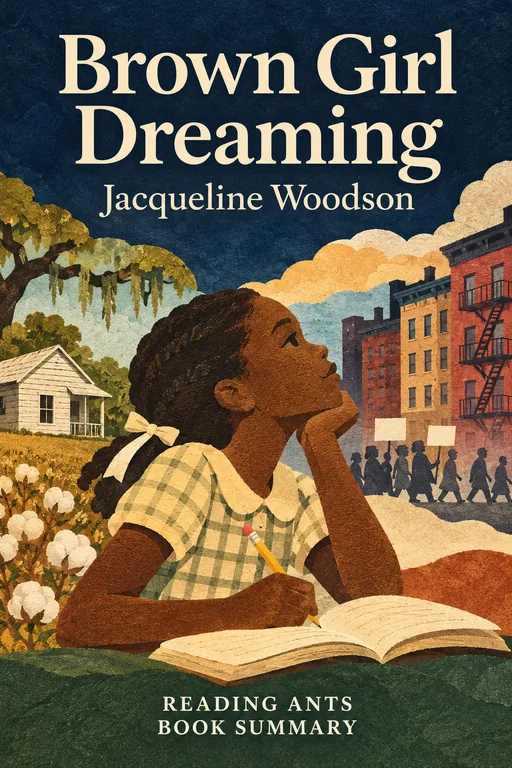
Brown Girl Dreaming
Jacqueline Woodson
A poet tells the story of her childhood in the 1960s and 1970s, moving between South Carolina and New York, and discovering her love of words.
🎒 Young Adult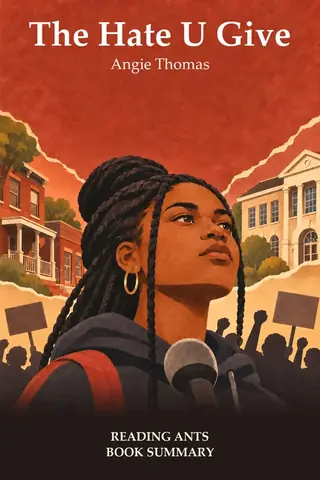
The Hate U Give
Angie Thomas
After witnessing a police officer kill her unarmed friend, a Black teenager finds her public voice while navigating grief, racism and the different expectations of her neighborhood and private school.
🎒 Young Adult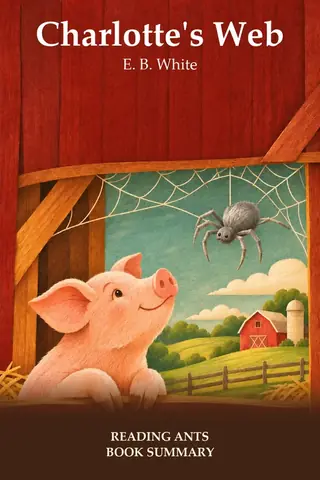
Charlotte's Web
E. B. White
A lonely pig named Wilbur learns he is going to be killed, and his clever friend Charlotte, a spider, comes up with an amazing plan to save his life.
🧸 Children's BooksWant something different?
Pick another topic and we will show you three books to start with.