 Reading Ants
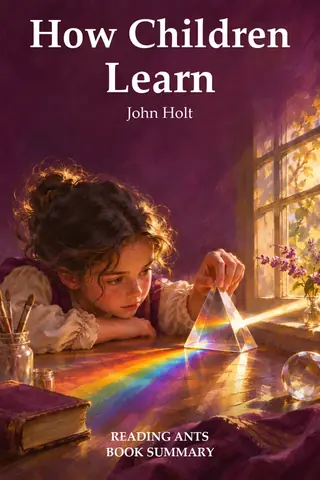
How Children Learn
Teacher John Holt watches young children closely and concludes that they learn best through their own curiosity, play and mistakes, and that adult pressure, fear and unrequested teaching often get in the way.
Overview
How Children Learn was first published in 1967 by the American teacher John Holt, who followed his book How Children Fail with this one. The edition read here is the revised version of 1982 and 1983, reissued by Da Capo in 2017 with a foreword by the educator Deborah Meier. Instead of asking why children do badly in school, Holt asks how small children learn so much when left to explore. The book is built from diary entries, essays, parents’ letters and stories about children he knew, grouped in nine chapters from “Learning About Children” to “Learning & Love.” He admits that this is observation, not laboratory research. The preface to the revision also says he no longer believes schools can be made into the kind of place the book describes.
Full Summary
1. Preface and learning about children
The idea: In the revised preface and first chapter Holt says that if we understood how children do their best learning, we could change school, but he no longer expects most schools to do it. He is sharply critical of brain research and psychological experiments that study children in strange, anxious settings, and of the idea that people are machines. He says that scientific interference can be the most destructive kind, and he praises close, loving observation. He admires Millicent Shinn’s old biography of a baby, Glenda Bissex’s study of her son Paul learning to read and write, and the psychiatrist R. D. Laing’s warnings about intellect without heart.
In real life: A parent who records what a child does in a day learns more about her thinking than any test could show.
2. Games and experiments
The idea: The second chapter is a set of dated diary entries about Holt’s young friends, such as Lisa and Tommy, and the way they explore. Lisa wants to examine, handle and take apart everything she sees. Children play with an electric typewriter or vacuum cleaner, test ideas and invent games, often mixing up what they know on purpose as a joke, and Holt sees this as a sign of real thinking. He notes that children are not born fearful but pick up adult anxiety. Most little children accept a turn on an adult’s cello, while most adults refuse. Holt asks why we alarm ourselves at early independence.
In real life: A boy plugging and unplugging a vacuum cleaner and testing the suction with his hand suddenly looks thoughtfully at the pipe and plug and has an idea.
3. Talk
The idea: Holt believes that babies are not just imitating sounds but trying to talk, to use sounds to say what they want and feel. Babies and small children like to listen to adult conversation, and parents help by talking naturally. Children name things, sort them and understand more than they can put into words. He argues against the school habit of asking children to prove they know the difference between sounds, when they already use the words correctly. He accepts that children will speak the language they hear around them. Mistakes such as “teached” show them working out rules, and he finds that school talk still follows the old pattern.
In real life: A toddler delights in saying “blue,” and Holt sees that the shape of the sound pleases her as much as the meaning.
4. Reading
The idea: The reading chapter says that children learn to read much as they learn to talk, if they are not frightened or shamed. Holt tells of Lisa, who showed a keen interest in reading at four, and of his own puzzlement when a child misread a word she had read correctly before, which he comes to see as part of learning. He cites Bettelheim and Zelan on children humiliated by dull material read aloud, and the many letters to his newsletter Growing Without Schooling about children who learned by being read to. He attacks timetables for learning, saying we treat children like trains. He also criticizes pseudo-open schools where teachers copy open methods without trust.
In real life: A father reads a Mother Goose book so often that, by four, his daughter can recite nearly all the verses.
5. Sports
The idea: Here Holt describes teaching a young child to swim. Tommy, a toddler, had an accident on the pool steps that would have put most children off, and Holt watches how he handles the splash and the crowd. He criticizes parents who try to teach very small children to swim and miss the child’s own rhythm, and he admits that he and others were mistaken to forbid Tommy to swim to the deep end. A three-year-old named Jamie happily swims and bodysurfs in the ocean when she is ready. The lesson is to let children set the pace and trust them to try.
In real life: A child who is nervous in a crowded pool gradually learns to cope with water in her face, once nobody forces the moment.
6. Art, math and other things
The idea: Holt writes about art as a way for children to explore and express, and quotes a teacher’s complaint about worthless art supplies and the way children’s art is exhibited. In math and science he favors freedom, hands-on materials and what the physicist David Hawkins calls “messing about,” so that children’s mental models are rich before they hear abstract talk. He describes children facing a frame with pendulums and a first-grade lesson on drawing a cube. A school prospectus he quotes claims that five-year-olds there do math without fear. In his story of a children’s microscope, children keep busy while they wait for it and read the instructions together.
In real life: Fifth-graders handed simple frames with weights on strings begin to explore pendulums long before anyone names the rules.
7. Fantasy
The idea: Holt rejects the notion that children’s fantasy is escape from the real world. They use it to test reality, to do what adults do with mathematical models, and to build mental models that fill the gaps in their experience. He gives examples such as a boy obsessed with trains whose mother brought home train books again and again, and Seymour Papert’s account of how a childhood love of gears led him to mathematics. He also disagrees with some traditional Montessori teaching about how children should use materials. Fantasies and passions of childhood, if they come from things the child loves, can feed adult life.
In real life: A boy’s love affair with trains leads his mother to bring home books on real trains, which he studies closely.
8. The mind at work, and learning and love
The idea: In “The Mind at Work,” Holt describes his frustration with a Rubik’s cube, which he thought about without touching, and gives better examples of thinking like a child, such as a loom that assembled itself in his mind on a drive home. He says that children learn independently, out of interest, not in bunches, and not to please adults, and that the delay of gratification is a mistake. The mind, he writes, is a mystery we should stop pretending to measure. The last chapter admits his book did not change schools. It ends with a handwritten child’s note, signed with “Love Cloud,” that pleads not to be starved, a sign of how much need and love lie behind children’s play.
In real life: Children who say they can make a paper fan do so, but after a teacher reads out written instructions none of them can, which Holt takes as a sign that explanations can destroy knowledge.
Why It Matters
How Children Learn sold widely. Together with How Children Fail, it helped start a wider discussion in the 1960s of how schools treat children, and it is later linked with the homeschooling movement Holt helped found. Holt later gave up hope of reforming schools from within and became a leading voice for homeschooling and unschooling, where children learn through their own interests.
Many readers still value the book for its warm, attentive picture of small children as eager learners. It reminds teachers and parents that curiosity is the starting point, and that learning is not something done to children but something they do.
Key Takeaways
- Children learn by doing. They try whole activities now, and get better by repeating them.
- Mistakes are part of learning. Children often correct themselves when they are not hurried or made anxious.
- Fear gets in the way. Shame and anxiety make children seem slower than they are.
- Play and fantasy are serious. Pretending and free exploration let children understand the real world and work out ideas on their own.
- Trust helps. Teaching that nobody asked for can imply the child cannot work things out.
What We Can Learn
Watch children before you step in. When a child is absorbed in something, notice what she is working out. You will often find that she is learning more than you assumed.
Try holding back the quick correction. Let a child finish reading a sentence, or retry a puzzle, before you say anything. Offer help when she asks, and make sure she has a space and materials for free play, because that is often where real understanding begins.
Remember too that fear gets in the way of learning. If a child is scared of being wrong, praise effort and curiosity, and treat a mistake as a normal step, not a failure.
Criticism and Counterpoints
The book rests on Holt’s stories and observations of mostly young children, and the publisher itself calls them anecdotal. A reader’s review points out that Holt does sometimes steer children himself, and that few children, without any guidance, would gain real reading or number skills. The same review notes that his insights are hard to apply in an ordinary school, where one teacher has a large class and a fixed curriculum.
Some readers find the observations dated, since people today are already familiar with the idea that play matters. Holt’s later views on children’s rights and on school were also controversial. A fair reading is that the book is rich in insight about curiosity, but it should not be treated as a complete plan for how to teach.
Who Should Read It
This book is for parents, teachers, babysitters and anyone who spends time with young children. It is easy to read, with many short stories, and each chapter can be read on its own. Readers who want controlled studies or step-by-step teaching methods should look elsewhere. It will not please those who believe that children need direct instruction in the basics.
Want the whole book?
A summary is a taste, not the meal. Here is where to find the full book.
You reached the end 🎉
Nicely done. Mark this one as read, and we will suggest what to read next.
Read this next
Summerhill
A. S. Neill
Headmaster A. S. Neill argues that children grow up happier, kinder and more capable when they are given real freedom and shared power at school, with no fear, no forced lessons and no moral lectures.
🎓 Parenting & Education
The Absorbent Mind
Maria Montessori
Maria Montessori, a doctor and educator, explains that young children take in the world around them effortlessly, like a sponge, and that adults should prepare an environment in which they can learn freely through activity and concentration.
🎓 Parenting & Education
Why Don't Students Like School?
Daniel T. Willingham
Cognitive scientist Daniel Willingham uses research on how the mind works to explain why thinking is hard, why knowledge matters and how teachers and students can make learning more effective and enjoyable.
🎓 Parenting & Education
The Self-Driven Child
William Stixrud and Ned Johnson
A neuropsychologist and a test-prep tutor argue that children become calmer and more motivated when parents give them a real sense of control over their own lives, while staying close as a steady, supportive consultant.
🎓 Parenting & Education
The Gardener and the Carpenter
Alison Gopnik
A developmental psychologist and grandmother argues that "parenting," as a craft aimed at producing a certain kind of adult, is the wrong model, and that being a parent is a loving relationship more like tending a garden than carving a table.
🎓 Parenting & Education
How to Talk So Kids Will Listen and Listen So Kids Will Talk
Adele Faber and Elaine Mazlish
Parents can get better cooperation and closer relationships by acknowledging children's feelings, describing problems instead of blaming, and using simple, respectful communication skills.
🎓 Parenting & EducationWant something different?
Pick another topic and we will show you three books to start with.