 Reading Ants
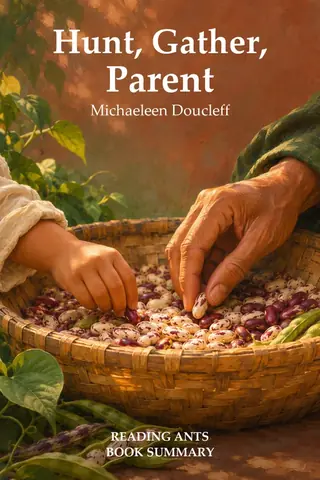
Hunt, Gather, Parent
A science journalist and mother takes her young daughter to Maya, Inuit and Hadzabe communities to learn how they raise helpful, calm and confident children, and boils the lessons down to four habits she calls TEAM.
Overview
Hunt, Gather, Parent: What Ancient Cultures Can Teach Us About the Lost Art of Raising Happy, Helpful Little Humans was published in 2021 and is Michaeleen Doucleff’s first book. Doucleff is a journalist who covers science, and she wrote it after finding parenting a young child more stressful than she expected. She travelled with her three-year-old daughter, Rosy, to families in the Yucatan in Mexico, in the Arctic in Canada and in Tanzania, and she watched how children were raised there. She asks what Western parents have lost by turning child-rearing into a set of expert rules, and what could be borrowed back. The book is part travel story and part practical guide.
Full Summary
1. Why look beyond the West?
The idea: Doucleff starts from a simple claim: many of the habits we think of as normal parenting are recent, unusual and not well tested. She notes that much research on children comes from a group of Western, Educated, Industrialized, Rich and Democratic societies, which researchers abbreviate as WEIRD. She argues that modern advice, with its emphasis on schedules, milestones and close supervision, grew partly out of institutions and expert pamphlets, and that the small nuclear family, cut off from relatives, is a recent arrangement. Communities that have raised children the same way for many generations, she says, may have learned something through long trial and error.
In real life: A parent who feels they are failing because a child will not follow an expert’s chart might ask whether the chart was ever designed for a household like theirs.
2. The Maya: children who help
The idea: In a Maya community in the Yucatan, Doucleff finds children who join in household work without rewards, charts or constant reminders. They are included in everyday tasks from toddler age, even when the help is slow or messy, and they come to see themselves as part of the team. Mothers guide by gentle hints and example, not by orders. The Maya value of being helpful and alert to what needs doing is summed up by a word reviewers give as acomedido. The hardest part for visitors is resisting the urge to do the job yourself because it is faster.
In real life: A seven-year-old who is invited to chop soft vegetables, and not sent away to play, learns that dinner is something the family makes together.
3. The Inuit: parenting without anger
The idea: In an Arctic village in Canada, the author is struck that adults almost never show anger toward children. Anger is treated as childish, so adults are expected to stay calm and model self-control. Children are taught about feelings through everyday talk, through cautionary stories and through small acted-out scenes, in which one adult plays at bad behavior while another adult scolds it. The point is to break the cycle of shouting and power struggles before it begins. Doucleff also finds that local women often offer to take Rosy so that she can rest, and she draws the lesson that children should not depend on one caregiver alone.
In real life: A parent who feels a shout coming might lower their voice, take a breath and turn the moment into a game of pretend, instead of a standoff.
4. The Hadzabe: confidence through autonomy
The idea: Among the Hadzabe, hunter-gatherers living in Tanzania, children spend much of the day free to follow their own plans within the camp, while the community stays close. Doucleff separates independence, in which a child is on their own, from autonomy, in which a child makes their own choices while staying connected to family. She links this to confident, self-reliant and generous children, and to a culture of sharing. Parents who give fewer instructions leave children room to decide for themselves.
In real life: A parent might choose one stretch of the day, such as the hour after school, when they give no instructions at all and only watch.
5. TEAM and the road home
The idea: From these communities, the author draws four elements: togetherness, encouragement, autonomy and minimal interference. Reviewers also report her practical steps, such as taking a regular break from entertaining or teaching your child, giving children real chores, cutting down on directions, and creating zones where a child is never told what to do. Back in San Francisco, she restructures the household, and she reports that she and her daughter both do better. Each chapter ends with a short recap and resources for readers who want to try the ideas.
In real life: A family could start by giving a child one standing job, such as setting the table, and by noticing how often they correct and direct during a single evening.
6. Sharing the load
The idea: A repeated theme is that raising children has usually been shared among relatives and neighbors, while many Western parents carry the whole load alone. In the communities she visits, other relatives and neighbors step in readily, and she argues that parents are calmer and more patient when they have rest and support.
In real life: A parent who trades childcare with a neighbor, so that each gets one free afternoon a week, has built a small version of this support.
Why It Matters
Hunt, Gather, Parent brought a global, anthropological view into a field that often relies on research from one kind of society. It gave many tired parents permission to step back from constant scheduling, praise and entertainment, and offered specific alternatives. By describing communities in Mexico, the Arctic and Africa with curiosity and warmth, it also pushed readers to question the idea that there is one right way to raise a child. Its ideas about chores, calm responses and shared care have been widely discussed in parenting circles. The book is also part of a larger trend of parents looking for older or traditional methods to cope with the pressure of modern life.
Key Takeaways
- Children want to help. Include them in real tasks early, and accept the mess that comes with it.
- Calm is a teaching tool. Adults who stay patient show children how to manage their own feelings.
- Autonomy is not abandonment. Children can choose and explore while staying connected to the family.
- Say less, watch more. Fewer instructions and commands leave room for self-reliance.
- Parenting is a team sport. Children and parents do better with relatives and neighbors sharing the work.
What We Can Learn
Pick one small change and keep it for a month. You could invite your child into a daily chore and resist fixing it. You could hold back your anger by giving yourself a moment before you respond. You could mark out one time or place each day where nobody gives orders. Notice, too, how much you are carrying on your own, and think about who nearby could help. Keep in mind that what works in a village may need adapting to a city, a school day or a child with special needs, and that safety, health and age always matter. The book’s best gift may be the reminder that children are capable partners, not projects.
Criticism and Counterpoints
Reviewers like the book’s warmth and practical tips, but they raise several concerns. Some say it takes tips from traditional communities without the beliefs and social structures that make them work, and that advice built for villages with extended families may not travel to cities. Critics also point out that most of the parents shown are women, so the lessons can read as more work for mothers, and fathers appear only briefly. Others say that it risks idealizing these communities and skipping their real problems, and that older children caring for younger ones can become a burden. Scary stories may frighten sensitive children. Finally, the book draws on a small number of visits, so it is a source of ideas, not proof.
Who Should Read It
This book suits parents and caregivers of toddlers through early teens, teachers, and readers curious about how cultures raise children. It is easy to read and full of stories. Readers who want large-scale research, or advice for medical or safety concerns, should look elsewhere, and parents who are already stretched thin may find it best to try just one idea.
Want the whole book?
A summary is a taste, not the meal. Here is where to find the full book.
You reached the end 🎉
Nicely done. Mark this one as read, and we will suggest what to read next.
Read this next
The Whole-Brain Child
Daniel J. Siegel and Tina Payne Bryson
Understanding how a child's brain develops helps parents respond to tantrums, fears and conflicts in ways that connect, calm and teach, so that different parts of the brain work together.
🎓 Parenting & Education
Positive Discipline
Jane Nelsen
Jane Nelsen argues that children behave better when they are treated with both kindness and firmness, and she offers practical tools, such as family meetings and logical consequences, to teach them responsibility without punishment or pampering.
🎓 Parenting & Education
The Gift of Failure
Jessica Lahey
A middle school teacher and mother argues that fear of failure, in parents and children alike, has led us to rescue, reward and hover, and she shows how stepping back with clear expectations builds motivation, competence and independence.
🎓 Parenting & Education
Free-Range Kids
Lenore Skenazy
A columnist who let her nine-year-old ride the New York subway alone argues that fear sold by news, experts and product makers has shrunk childhood, and she offers fourteen commandments to help parents give freedom back.
🎓 Parenting & Education
The Danish Way of Parenting
Jessica Joelle Alexander and Iben Dissing Sandahl
Two authors, an American writer with a Danish partner and a Danish psychotherapist, say that Danish families raise confident, caring children with six habits that spell PARENT: play, authenticity, reframing, empathy, no ultimatums and togetherness.
🎓 Parenting & Education
How to Talk So Kids Will Listen and Listen So Kids Will Talk
Adele Faber and Elaine Mazlish
Parents can get better cooperation and closer relationships by acknowledging children's feelings, describing problems instead of blaming, and using simple, respectful communication skills.
🎓 Parenting & EducationWant something different?
Pick another topic and we will show you three books to start with.