 Reading Ants
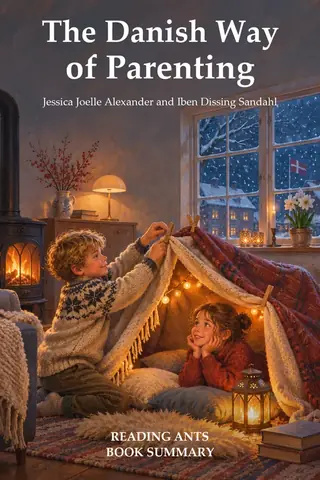
The Danish Way of Parenting
Two authors, an American writer with a Danish partner and a Danish psychotherapist, say that Danish families raise confident, caring children with six habits that spell PARENT: play, authenticity, reframing, empathy, no ultimatums and togetherness.
Overview
The Danish Way of Parenting is a short, practical parenting book that sets Danish family life beside American habits. Jessica Joelle Alexander, an American who raised children with her Danish partner, noticed how differently the two cultures handled everyday problems. She wrote the book with Iben Dissing Sandahl, a psychotherapist and family counselor who works near Copenhagen. Their starting point is that Denmark is often ranked among the happiest countries in the world, and they ask whether the way Danes bring up children has something to do with it. Each of the six chapters explains one principle, adds research and cultural comparison, and ends with tips parents can try at home.
Full Summary
1. Play: let children lead
The idea: The authors say that free play, which children direct themselves and which has no prize at the end, is one of the most important parts of childhood. It teaches self-control, creativity and how to cope with stress. They say that unstructured play has shrunk in many countries, particularly the United States, and that Danish preschools and early school years still give it a central place, with learning woven into play.
In real life: A parent who cancels one activity on a crowded weekly schedule and hands a child a box of blocks or cardboard is making room for this kind of play. The child may complain of boredom for ten minutes, then invent a game that lasts all afternoon.
2. Authenticity: be honest about feelings
The idea: Authenticity means helping children stay true to themselves, and it begins with adults being honest. Parents do not hide hard feelings or hard subjects, and they let children feel the whole range of emotions, including sad and angry ones. The authors prefer praise that names effort and process over praise that calls a child clever or talented, because the second kind can make children afraid to try anything difficult. They also suggest praising less and showing more curiosity.
Reported example: One article about the book says that Danish parents often read classic fairy tales, including darker ones, to start conversations about difficult feelings. Treat this as a single report.
In real life: Instead of saying “What a beautiful picture,” a parent might ask the child what they were thinking about while drawing the dark blue part. That shows interest without handing out a grade.
3. Reframing: find another way to see it
The idea: Reframing means looking at a setback in a more constructive but still realistic way, without pretending nothing is wrong. The authors say our outlook is shaped by how we were raised, and that adults can change the way they speak, so that children learn the same habit by watching. They suggest avoiding absolute words like always and never, and describing what a child did instead of pinning a label on the child. A child described as mean can be described as still learning how to be kind, and a shy child can be seen as someone who is careful and thoughtful.
In real life: When a rainy day cancels a picnic, a parent says the table can become a blanket fort for lunch. The disappointment is acknowledged and the day goes on.
4. Empathy: understand other people
The idea: Empathy is treated as a skill that is taught, not only a feeling that children either have or lack. Parents talk about what other people might feel and why, without judging them, and they affirm their own child’s feelings first. Sources describe Danish programs in schools that help children name emotions and see how they affect friendships, though the details come from one study-guide preview. The authors link empathy to the early bond between a baby and its caregivers.
In real life: After a classmate shouts at your child, you might ask what could have been going on for that classmate that day. The aim is understanding, not excusing the behavior.
5. No ultimatums: rules without threats
The idea: The Danes the authors describe aim to be authoritative but not authoritarian. They set clear limits, explain what they need and why, and look for a solution both sides can accept, instead of ending a standoff with a threat. Testing limits is seen as normal and as a chance to teach. A parent who feels anger rising can pause before responding, and a calm adult helps a child calm down. They also repeat back the child’s feelings, such as telling a sad child that they wanted another cookie.
In real life: At bedtime, instead of announcing there will be no story tomorrow unless the child hurries, a parent says that the late hour is a problem for both of them and asks what would make it easier to start sooner.
6. Togetherness: the Danish habit of hygge
The idea: The last principle is hygge, a Danish word for a warm, relaxed, cozy kind of time together. It is usually described as simple pleasures such as games, a meal, candles and conversation, with phones and television switched off. The authors argue that this kind of shared time builds security and a sense of belonging, and that it does not need money, only attention.
In real life: A family might choose one evening a week with no screens, make hot chocolate and play a board game. Nothing about it is special, and that is the point.
Why It Matters
The book joined a wave of titles in the 2010s that looked abroad for ideas about raising children, and it gave a simple, memorable framework in the acronym PARENT. Its message about play, honest feelings and respect instead of threats echoes current research on authoritative parenting and emotional intelligence, and many parents find it easy to remember and try. It also asked readers to question habits such as heavy scheduling, constant praise and rewards and punishments. It helped spread the Danish word hygge in English-speaking countries. Because it speaks about culture and not only techniques, it invites readers to think about the kind of childhood they want to give their children and what their community can offer.
Key Takeaways
- Free play is not wasted time. Unstructured, child-led play builds creativity, resilience and self-control.
- Honesty about feelings builds trust. Children cope better when all emotions are allowed and named.
- Words shape how children see themselves. Describe behavior and effort instead of attaching labels, and look for the realistic bright side.
- Empathy can be taught. Talk about what others feel, and listen to your child’s feelings first.
- Calm, explained limits beat threats. Aim for firm and kind, and look for solutions together, including the simple warmth of shared time.
What We Can Learn
You do not need to move to Denmark to borrow from this book. Choose one principle and try it for a week. You could leave one afternoon empty so children can invent their own play, or swap a bribe for an honest explanation of why a rule exists. When your child struggles, try describing what you see, such as that they are working hard at something difficult, instead of calling them clever or lazy. Notice your own words too. Absolute phrases like never and always can turn a hard day into a verdict. Finally, set aside a regular time with no screens, even a short one, so that everyone has a calm place to land.
Criticism and Counterpoints
Reviewers like the clear tips and short chapters, but several raise doubts. The first is that the book may idealize Denmark and present its habits as if they worked everywhere, when not all Danish parents act in the same way and the acronym can squeeze a whole culture into a slogan. A second is privilege: Denmark has strong public support for families, and parents elsewhere may have less time and money for relaxed evenings and open-ended play. Some readers find the opening pages too critical of American parents. Others say that the ideas are not new, and that some children need more structure and direct guidance than a negotiated, democratic style gives. The book is best read as a set of ideas to adapt, not as proof.
Who Should Read It
This book suits parents, grandparents, teachers and teenagers who are curious about different ways to bring up children, and anyone who wants short, practical ideas on play, feelings and discipline. It is easy to read in a weekend. Readers who want scientific detail on every claim, or advice for families under heavy financial strain, may find it light.
Want the whole book?
A summary is a taste, not the meal. Here is where to find the full book.
You reached the end 🎉
Nicely done. Mark this one as read, and we will suggest what to read next.
Read this next
The Whole-Brain Child
Daniel J. Siegel and Tina Payne Bryson
Understanding how a child's brain develops helps parents respond to tantrums, fears and conflicts in ways that connect, calm and teach, so that different parts of the brain work together.
🎓 Parenting & Education
Positive Discipline
Jane Nelsen
Jane Nelsen argues that children behave better when they are treated with both kindness and firmness, and she offers practical tools, such as family meetings and logical consequences, to teach them responsibility without punishment or pampering.
🎓 Parenting & Education
The Blessing of a Skinned Knee
Wendy Mogel
A child psychologist who found a new way of parenting in Jewish teaching argues that anxious, child-centered parents raise entitled and fragile children, and that older wisdom about authority, gratitude, chores, food and time can raise self-reliant ones.
🎓 Parenting & Education
Free-Range Kids
Lenore Skenazy
A columnist who let her nine-year-old ride the New York subway alone argues that fear sold by news, experts and product makers has shrunk childhood, and she offers fourteen commandments to help parents give freedom back.
🎓 Parenting & Education
How to Raise an Adult
Julie Lythcott-Haims
A former dean at Stanford University argues that modern parents who do too much for their children, from homework to college applications, are leaving them anxious and unprepared, and she urges them to step back and let young people learn to stand on their own.
🎓 Parenting & Education
How to Talk So Kids Will Listen and Listen So Kids Will Talk
Adele Faber and Elaine Mazlish
Parents can get better cooperation and closer relationships by acknowledging children's feelings, describing problems instead of blaming, and using simple, respectful communication skills.
🎓 Parenting & EducationWant something different?
Pick another topic and we will show you three books to start with.