 Reading Ants
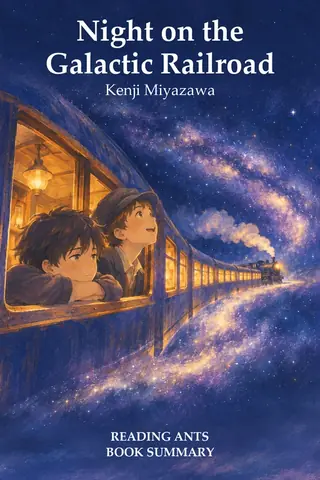
Night on the Galactic Railroad
A poor, lonely schoolboy falls asleep on a hill on the night of a star festival and travels along the Milky Way on a little train with his best friend, and learns on waking what the journey was telling him.
Overview
Night on the Galactic Railroad is an unfinished fantasy novel by the Japanese writer and poet Kenji Miyazawa. He began it in the 1920s and kept reworking it until his death in 1933, and it was first printed in 1934 in his collected works, where the editors, faced with a jumble of manuscript pages, put some of them in the wrong order. Several drafts existed, and two survive complete enough to read as whole stories. The later one, which this summary follows, is the version most readers know. It has nine short chapters, and a few manuscript pages near the end are missing. It is written for young readers but speaks to adults too, and it has been adapted into a 1985 animated film, comics, stage musicals and plays. It is a story of loneliness and friendship, and of the question of what it means to be truly happy.
Main Characters
- Giovanni: a quiet, dreamy boy from a poor family who works after school to support his sick mother.
- Campanella: Giovanni’s classmate and only real friend, clever and well liked, and kind to him.
- Zanelli: a classmate who teases Giovanni about his absent father, and the boy Campanella later saves from the river.
- Giovanni’s mother: a gentle woman who is ill and stays in bed.
- The bird catcher: a rough, friendly man on the train who says he catches birds along the Milky Way for people to eat. To the boys, the bird he offers tastes like candy.
- Kaoruko, her small brother Tadashi and their tutor: passengers who join the train after their ship sinks.
- Campanella’s father: a professor who stands at the river with a watch in his hand while the town searches for his son.
Full Summary
A Lesson About the Milky Way
The story begins in a classroom. The teacher hangs a chart of the stars and asks what the pale, misty band called the Milky Way really is. Giovanni knows that it is made of countless small stars, because he once read about it in a magazine, but he is so tired and so unsure of himself that he cannot answer, and Zanelli laughs at him. Campanella, who had raised his hand, hesitates and says nothing either, and Giovanni feels that his friend is sparing him on purpose. The teacher then explains, with a model shaped like a lens, that the Milky Way is a great band of stars seen from inside, and tells the class to go out that evening and look at the sky, because it is the night of the star festival.
Work and Home
After school Giovanni goes to a printing shop, where he picks out tiny pieces of type to earn a little money, and he buys bread and sugar on the way home. At home he talks with his mother, who lies ill in bed. His father has been away for a very long time, and Giovanni insists that he is a good man who will soon be back from his fishing in the north. Giovanni tells his mother that the other boys tease him, but not Campanella. His sister has left some food for him. His mother’s milk has not been delivered, so Giovanni offers to fetch it, and then he plans to watch the festival from the riverbank.
The Festival Night
Giovanni walks through the decorated town and stops at a shop window to admire a star map. Zanelli shouts at him from behind that an otter-skin jacket is coming from his father. At the dairy an old woman says no one is there who can help him and tells him to come back later. Soon he meets a group of classmates with lanterns, and they all repeat the taunt. Campanella is among them and looks at him with a pitying half-smile but says nothing. Giovanni, hurt and alone, runs away from the lights and music of the festival and climbs the dark hill behind the dairy, where he lies down in the grass by a tall pillar under the stars.
The Train
As he looks up at the sky, he hears a voice announcing Galactic Station. A bright light surrounds him, and he finds himself on a small train running through the night among the stars. To his surprise, Campanella is sitting in front of him, in a jacket that looks wet. Campanella says the others ran after the train but were too late, and that Zanelli has already gone home. The boys travel past a shining white cross on an island in the river, where the passengers stand and pray, and at the Swan Station they get off and walk to a shore of white rock. There a scholar and his assistants are digging up the bones of an ancient animal. Back on the train, a bird catcher joins them, and the boys taste what he gives them, which seems more like candy than meat.
Giovanni’s Ticket
When the conductor comes, Campanella shows an ordinary ticket, but Giovanni only has a folded piece of paper that he found in his pocket. The conductor reads it with great respect, and the bird catcher says that it is a rare ticket, one that would let its holder travel anywhere at all. Giovanni knows nothing about it. Soon the bird catcher vanishes, and Giovanni wishes he had been kinder to him. A scent of apples fills the carriage, and new passengers appear: a young tutor, a little boy named Tadashi and a girl named Kaoruko. They explain that their ship struck an iceberg, and that the tutor held the two children and waited with them as the ship went down. A man who tends a lighthouse hands out apples. Giovanni feels lonely and jealous when Campanella talks cheerfully with the girl.
The Scorpion’s Fire
Out the window Giovanni and Campanella see a red fire burning on the far bank. Kaoruko tells the story of the scorpion, as her father told it to her: it lived by eating small creatures, but when a weasel chased it and it fell into a well and began to drown, it regretted that it had not simply offered its body to the weasel. It prayed that in another life it might be used for the true good of everyone, and its body burned with a beautiful red flame that still lights the night. Giovanni listens in silence.
The Southern Cross
At the Southern Cross, a great cross rising from the river with a halo of cloud, the tutor and the two children get off, along with most of the other passengers, and kneel on the shore. Just before, Giovanni and the girl have briefly argued about whose god is the true one. The two boys are left on a half-empty train, and Giovanni says that he would not mind being burned like the scorpion if it were for everyone’s happiness, and that they should stay together and look for the true happiness of everyone. Then they see a vast black hole in the Milky Way, the Coalsack. Giovanni is afraid, but he encourages his friend. Campanella points to a place in the distance and says that his mother is waiting there, and a moment later he is gone. Giovanni cries out and weeps.
Waking Up
Giovanni wakes on the hilltop, his face wet with tears. He goes down to the dairy, where this time he gets the milk, and then walks toward the river. A crowd has gathered with lanterns. A classmate named Marson tells him that Zanelli fell into the water from the boat, that Campanella jumped in after him and pushed him toward the boat, and that Campanella was never seen again. Campanella’s father stands with his watch in his hand, and says that it is no use, because forty-five minutes have passed. Giovanni wants to say where Campanella has gone but cannot speak. The professor thanks him for his help and says kindly that he had a letter from Giovanni’s father two days ago, and that the father should be home soon. Giovanni runs home with the milk and the news for his mother.
Why It Matters
Night on the Galactic Railroad is one of the best-known works of Japanese literature for young people, and it has been adapted for film, comics, the stage and many other forms. Its great strength is how it turns ordinary loneliness and grief into a quiet cosmic journey, with the lasting image of a little train gliding along the Milky Way. It also gathers the themes that run through Miyazawa’s other work, such as self-sacrifice for others, the search for a happiness that is shared, and a gentle, unspecific spirituality drawn from several faiths. Readers often come back to it as they grow up, because it means something different to a child and to an adult who has lost someone.
Key Takeaways
- Loneliness can become empathy. Giovanni’s hard life leaves him open to the sorrow and the kindness of others.
- True happiness is shared. The scorpion’s story and the boys’ vow point to a happiness that includes everyone.
- Kindness is quiet. Campanella’s small, silent gesture of support is remembered all night.
- Loss changes what we see. Only after Campanella is gone does Giovanni understand the journey.
- Hope can return. The news of his father’s coming lets Giovanni go home with new strength.
What We Can Learn
The book is a gentle reminder that the children and adults around us who seem quiet or awkward may be carrying heavy burdens, such as a sick parent, long hours of work or loneliness. A small kindness, like Campanella’s silent sympathy, can mean a great deal.
It also asks what we would be willing to give for the good of others. The scorpion’s regret is that it fought only to save itself and never gave anything for another’s sake, and the question it raises is a practical one that we can ask about our own lives.
Finally, it offers a way to think about grief. Giovanni’s sorrow at the end is real and deep, and yet the story ends with him going home with milk, news and a renewed sense of purpose.
Criticism and Counterpoints
The book is unfinished, and in parts of the long ninth chapter the text is incomplete or revised, which can make the story feel uneven. Its dreamlike scenes, its religious references and its unexplained images are hard to follow, and readers disagree about what they mean. The wet jacket and the sinking ship suggest that the train carries the dead, and Campanella has drowned by the end, but the book never says outright what the journey is, or whether it is only Giovanni’s dream. Some find the quiet, sad mood too heavy for younger readers, while others find the philosophy of self-sacrifice difficult to accept without question. Translations also differ, and some of the music of the Japanese is lost.
Who Should Read It
This is a good choice for readers who like gentle, thoughtful fantasy and stories about friendship, and for anyone interested in Japanese literature. It suits readers from about ten and up, with a parent or teacher to talk about the sadder parts. Those who want a fast plot or a clear moral answer may find it too slow and open-ended.
Want the whole book?
A summary is a taste, not the meal. Here is where to find the full book.
You reached the end 🎉
Nicely done. Mark this one as read, and we will suggest what to read next.
Read this next
The Little Prince
Antoine de Saint-Exupery
A pilot stranded in the desert meets a small boy from a tiny planet, who teaches him that the most important things in life, like love and friendship, can only be seen with the heart.
🌍 World Literature
Totto-chan: The Little Girl at the Window
Tetsuko Kuroyanagi
A curious little girl, expelled from an ordinary school for being too lively, finds a magical school in old train carriages, where a wise headmaster lets children be themselves.
🌍 World Literature
Kokoro
Natsume Soseki
A young student befriends a quiet, haunted older man known as "Sensei," and learns, from a long letter, the secret of guilt and betrayal that has shadowed his life.
🌍 World Literature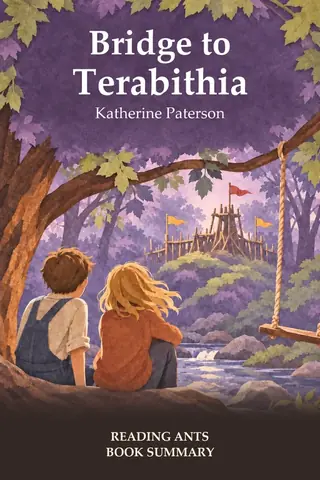
Bridge to Terabithia
Katherine Paterson
A shy country boy and an imaginative new girl create a secret magical kingdom in the woods, and when tragedy strikes, he must find the courage to carry their friendship forward.
🧸 Children's Books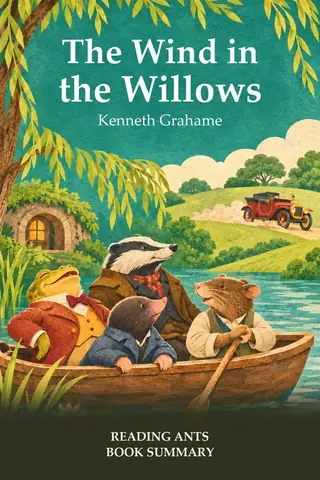
The Wind in the Willows
Kenneth Grahame
A shy Mole, a kindly Water Rat, a gruff Badger and a boastful Toad share riverside adventures in the English countryside, in a story about friendship, home and the madness of Mr. Toad's passion for motorcars.
🧸 Children's Books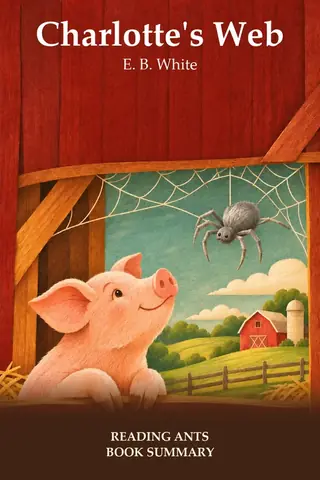
Charlotte's Web
E. B. White
A lonely pig named Wilbur learns he is going to be killed, and his clever friend Charlotte, a spider, comes up with an amazing plan to save his life.
🧸 Children's BooksWant something different?
Pick another topic and we will show you three books to start with.