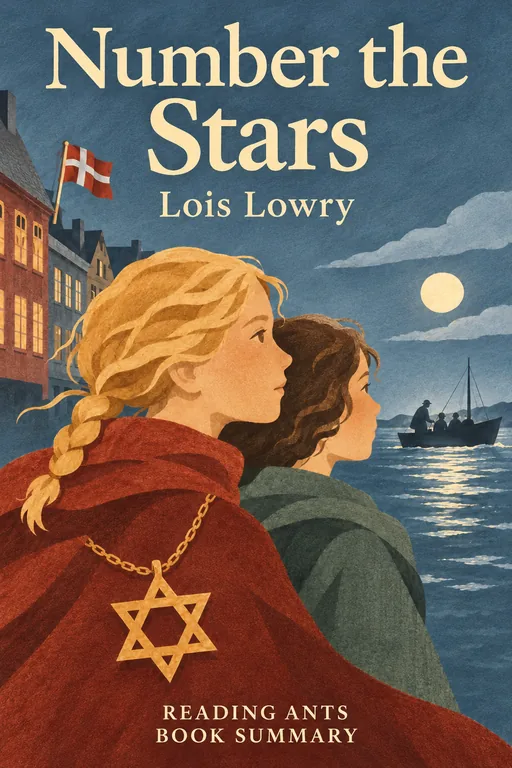
Number the Stars
In 1943, a ten-year-old Danish girl named Annemarie helps her Jewish best friend Ellen escape from Nazi-occupied Copenhagen by pretending that Ellen is her sister and by helping with a daring rescue.
Overview
Number the Stars is a historical novel for young readers by Lois Lowry, published in 1989, which won the Newbery Medal. It is set in Denmark during World War II, when the country was occupied by Nazi Germany. In October 1943, the Germans began to round up Danish Jews, but many Danes, including fishermen and ordinary families, helped about seven thousand of them to escape by boat to neutral Sweden. The story follows Annemarie Johansen, who lives in Copenhagen, and her best friend, Ellen Rosen. It shows how bravery can come from ordinary people, even children, and how friendship can inspire courage.
Main Characters
- Annemarie Johansen: a ten-year-old girl who is brave in a crisis, though she believes herself ordinary.
- Ellen Rosen: Annemarie’s best friend, who is Jewish.
- Kirsti: Annemarie’s lively little sister.
- Mr. and Mrs. Johansen: Annemarie’s calm and brave parents.
- Uncle Henrik: a fisherman, Annemarie’s uncle, who helps the Jews cross to Sweden.
- Peter Neilsen: a young man in the Danish Resistance who was engaged to Annemarie’s late sister Lise.
- The Rosens: Ellen’s parents, who are in danger.
Full Summary
Life Under Occupation
Annemarie and Ellen are best friends who run home from school together. Copenhagen is full of German soldiers, and food is scarce. One day, the soldiers stop the girls on the street and question them, which frightens them. Annemarie’s family lives with the knowledge that their friends, the Rosens, are in danger. Annemarie’s older sister, Lise, who the family has been told died in an accident, has left a space in the family, and Peter, her fiancé, is part of the Resistance.
A Knock at the Door
When the news comes that the Germans plan to arrest Jews, the Rosens must hide. Mrs. Johansen takes Ellen into their home and presents her as Annemarie’s sister. When the soldiers come knocking in the night, Annemarie’s family stays calm. The soldiers notice that Ellen has dark hair and Annemarie has blond hair, and they suspect, and question. Annemarie quickly takes off the necklace with the Star of David that Ellen wears and hides it in her hand. The soldiers leave, and the family realizes how close the danger was.
Journey to the Coast
The next day, Mrs. Johansen and the girls travel to Uncle Henrik’s house, in a fishing village on the coast, while Mr. Johansen stays in Copenhagen. They pretend it is a vacation, and the girls act as sisters. At Henrik’s house, they meet other Jews who are in hiding, including Ellen’s parents. They wait for a boat to take them to Sweden, and learn that the sea crossing is dangerous. The adults keep the girls out of the way, but Annemarie senses that something important is happening.
The Last Hurdle
At Henrik’s house, the adults stage a funeral for a made-up relative, so that the many visitors will not seem odd, while the refugees wait to be smuggled to the boat. When German soldiers arrive, Mrs. Johansen tells them that the body is that of a person who died of a contagious disease, and they leave. Soon the group is to be taken to the boat, but a problem arises: the German soldiers have sniffer dogs, which can detect the scent of the refugees at the harbor. The Resistance has a special handkerchief that is meant to mislead the dogs, but Uncle Henrik needs the packet that holds it, and Mrs. Johansen, who has hurt her ankle, cannot take it to him.
Annemarie’s Run
Annemarie must take the packet through the woods to Uncle Henrik at the boat, and she is warned that the soldiers might stop her. She is terrified but determined. When she meets soldiers with dogs on the road, she tells them she is bringing her uncle’s lunch. They question her and search her basket, and then they let her go. Annemarie reaches the boat and gives the packet to Uncle Henrik, and the boat slips away. Later he explains that the handkerchief was meant to mislead the dogs, so that the refugees could reach Sweden safely, and he tells her the truth about Lise: she was killed because of her work in the Resistance, not in an accident.
The War Ends
After the war, the Danes who had helped are able to speak freely about what they did. The Johansens learn that Peter was captured and executed by the Germans, and that Ellen and the other refugees escaped to Sweden. Annemarie is sad but proud. She keeps Ellen’s Star of David necklace, hoping to return it one day, and it becomes a symbol of her courage and friendship. The ending is hopeful but tinged with loss.
Why It Matters
Number the Stars won the Newbery Medal in 1990 and is widely read in schools. It introduces young readers to the history of the Holocaust through the story of the Danish rescue, and shows ordinary people choosing to resist evil. The title comes from a line in the Psalms about God numbering the stars, a symbol of care for each person.
Lowry, who also wrote The Giver, based the book on stories told by a friend who had grown up in Denmark during the war. The story is also a way to discuss courage, conscience and prejudice.
Key Takeaways
- Ordinary people can be brave. Annemarie is a child, yet she acts bravely.
- Friendship can inspire courage. Her love for Ellen drives her.
- Standing up to injustice matters. The Danes rescued thousands of Jews.
- Fear and courage can coexist. Annemarie is scared but acts anyway.
- Remembering is important. The story keeps alive a rescue that saved lives.
What We Can Learn
The story shows that we all have the power to help. The Danes, from fishermen to children, made choices that saved lives, and this encourages us to act when we see injustice.
It also teaches that bravery often means doing what is right despite fear. Annemarie does not think of herself as brave, yet she does the job.
Finally, it reminds us of the human cost of prejudice. Reading about how a neighbor became a target helps us understand how dangerous hatred can be.
Criticism and Counterpoints
Some critics say that the book simplifies the Holocaust, since it focuses on a successful rescue and not on the extermination of millions, and that the picture may make readers think that most Jews escaped. Historians note that Denmark’s rescue was unusual, and that in other countries, rescue was far less common.
Others say that the danger is not shown in full, and that the suspense is gentle for the sake of young readers. Some find the book a good starting point but point out that it should be accompanied by other accounts. Still, many praise its warmth and clarity.
Who Should Read It
This book suits children from about age eight, and also adults. It has tense moments, and a death, but is written with care for young readers. It works well as an introduction to the history of World War II.
Want the whole book?
A summary is a taste, not the meal. Here is where to find the full book.
You reached the end 🎉
Nicely done. Mark this one as read, and we will suggest what to read next.
Read this next
The Diary of a Young Girl
Anne Frank
A Jewish teenage girl hiding from the Nazis in a secret apartment in Amsterdam records two years of fear, family quarrels, first love and big dreams in a diary that became one of the most famous books in the world.
👤 Real Lives
The Giver
Lois Lowry
In a perfectly controlled community with no pain, choice or color, a boy about to turn twelve is chosen to hold the memories of the past, and discovers the terrible price his people pay for their safety.
🎒 Young Adult
The Book Thief
Markus Zusak
Death narrates how a foster child in Nazi Germany steals books, learns the power of words and forms loving bonds that war eventually destroys.
🎒 Young Adult
Night
Elie Wiesel
Elie Wiesel tells, in short and searing pages, how as a teenager he was taken from his hometown of Sighet to Auschwitz and Buchenwald, lost his family and watched his faith and childhood break apart.
👤 Real Lives
Charlotte's Web
E. B. White
A lonely pig named Wilbur learns he is going to be killed, and his clever friend Charlotte, a spider, comes up with an amazing plan to save his life.
🧸 Children's BooksHarry Potter and the Philosopher's Stone
J. K. Rowling
An unloved orphan boy discovers on his eleventh birthday that he is a famous wizard, and during his first year at a magical school he makes true friends and faces the dark wizard who killed his parents.
🧸 Children's BooksWant something different?
Pick another topic and we will show you three books to start with.