 Reading Ants
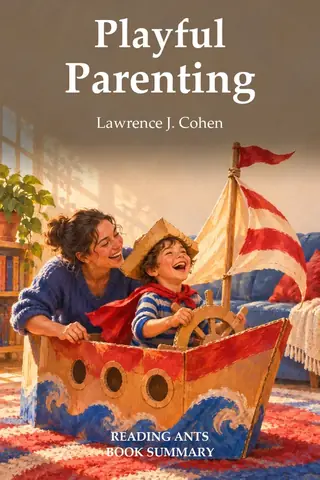
A child psychologist argues that play is the language of childhood, and he shows parents how to follow a child's lead, use laughter and games to connect, and handle fears, rivalry and discipline through play.
Overview
Playful Parenting was published in 2001 by Lawrence J. Cohen, a clinical psychologist who specializes in children’s play and play therapy. Its subtitle promises a way to build close connections, solve behavior problems and encourage children’s confidence. Cohen believes that adults lose touch with how children communicate, which is through play, and that parents who join in can reach their children in ways that words cannot. The book uses many games and stories, and it presents play as serious and useful, not just a break from the real work of parenting. Its publisher describes the tone as warm and humorous, and the advice reaches from babies to teenagers.
Full Summary
1. Play as the child’s language
The idea: Cohen begins with the claim that play is how children explore, express feelings, handle stress and build closeness. Parents who see play as a waste of time miss an opportunity, he says. He invites readers to enter the child’s world on the child’s own terms. This asks many adults to loosen up and get past their self-consciousness, since playing well takes a willingness to be silly. Children also often start a game when they want to say something hard, so joining in is one way to hear it.
In real life: A father drops his phone and lets his daughter lead a game of pretend restaurant.
2. Following the child’s lead
The idea: A basic rule is to let the child be in charge of the play. Parents join the child’s ideas, accept the roles they are given and show real enthusiasm. This builds creativity and confidence, and it tells the child that the parent is interested. Cohen suggests a light touch: offer an idea, see what the child does with it, and take charge only when there is a good reason. Watching what a child plays over and over can also hint at the feelings underneath.
In real life: A boy tells his mother to be the dragon, and she roars and runs when he swings his sword.
3. Connection and laughter
The idea: Cohen sees most behavior problems as a sign that parent and child have lost touch, so the usual cure is more connection, and play is a fast way back. Games such as chase, tag, hide-and-seek and gentle roughhousing build closeness. Laughter releases tension, and shared giggling does more than a lecture. If something makes a child laugh, repeat it. A parent who plays regularly also has more goodwill to draw on in hard moments.
In real life: A parent chases a toddler around the yard, and both end up laughing and hugging.
4. Power reversal and confidence
The idea: Children spend their days being told what to do and often feel small. Cohen suggests games in which the child is the stronger one, such as a pillow fight that the child wins, so the child can practice feeling powerful. The parent plays weak, silly or clumsy, and the child laughs and gains confidence. Winning and losing games work best when the stakes are silly, so a loss does not sting. Parents can also lose cheerfully to help a child who takes defeat hard. The publisher says play can help children with shyness, anger and fear.
In real life: A father pretends he cannot get past his son, who guards a pillow fort and giggles.
5. Fears, separation and big feelings
The idea: Cohen suggests that games can help children work through worries. Hide-and-seek and similar games let a child practice goodbyes and reunions, and pretend play can help a child recover after something frightening, such as a medical visit. A parent can act scared in a silly way, which gives the child some distance from the fear and room to laugh it out, and can play near the edge of the fear and take small steps closer. Tears during play are also a release, so a parent stays close and waits for the wave to pass.
In real life: A girl who is afraid of the doctor plays at being the doctor, and examines her stuffed animals.
6. Discipline, siblings and play
The idea: The book shows how to bring play into discipline and sibling problems. Cohen treats misbehavior as a message about a need or feeling, and he suggests prevention over punishment. Battles over routines can become games, and mock threats delivered with humor can ease tension and win cooperation. Playfulness does not mean excusing bad behavior. For brothers and sisters, play can lower rivalry through teamwork and one-on-one time, and adults should join in so that children do not use games to dominate each other.
In real life: A parent turns putting shoes on into a race against a pretend monster, and the child hurries to the door.
Why It Matters
Playful Parenting drew a starred review from Publishers Weekly when it appeared, and it has stayed in print since, with a paperback in 2002 and an ebook later. It reached parents who find lectures and charts too serious. Its central idea, that children work out their feelings through games, is also at the heart of play therapy, the field Cohen works in. Its reminder that parents can enjoy their children is valuable, especially for tired adults who see parenting as only work. It also links closeness with discipline, so that limits come from a warm relationship and not from fear. For many readers permission to be silly is the most useful part, since a relaxed, laughing parent is a safer presence for a child than a worried or distant one. Cohen later wrote other books on related themes, including one on anxiety and one on roughhousing.
Key Takeaways
- Play is the child’s language. Joining in is a way to reach and understand children.
- Follow the lead. Let the child choose the game and take your role with delight.
- Laughter connects. Chase, tag and roughhousing build closeness and release tension.
- Let children win. Games that let children feel strong build confidence.
- Use play for limits. Humor and games can help with cooperation, but playfulness does not mean excusing bad behavior.
What We Can Learn
Set aside ten minutes today to play with your child and let them choose the game. Put away your phone and follow their ideas, even if they seem silly. Notice what feelings show up in the play.
Try one game of reversed power: let your child win a race or pretend you cannot catch them. For a daily chore, such as getting dressed or cleaning up, invent a short game with a silly voice or a race. And if your child is anxious, ask whether a pretend game might help them practice the scary thing, staying close and keeping the steps small.
Criticism and Counterpoints
No well-known formal critique of the book turned up, but readers can weigh some limits. Some parents find it hard to be playful when they are tired, stressed or short of time, and the advice can feel like one more job. Play will not solve every behavior problem, and children with strong anxiety, trauma or developmental needs may need more than games from a parent. Playful discipline can be misread as avoiding limits, which the book itself warns against. Not every child enjoys roughhousing or silly games, so the games should fit the child, and physical play needs to stay safe and fun for both sides. The book is written for general readers, so it is not a technical review of the research on play.
Who Should Read It
This book is for parents, grandparents, teachers and caregivers of children, especially those who want to feel closer to their children and have more fun. It is friendly and full of examples. Readers who want a research-heavy or technical treatment of play should look elsewhere, and parents of children with serious difficulties should combine it with professional guidance.
Want the whole book?
A summary is a taste, not the meal. Here is where to find the full book.
You reached the end 🎉
Nicely done. Mark this one as read, and we will suggest what to read next.
Read this next
The Whole-Brain Child
Daniel J. Siegel and Tina Payne Bryson
Understanding how a child's brain develops helps parents respond to tantrums, fears and conflicts in ways that connect, calm and teach, so that different parts of the brain work together.
🎓 Parenting & Education
Raising Good Humans
Hunter Clarke-Fields
A mindfulness teacher argues that kind, cooperative children grow best from calmer parents, and she teaches eight skills for easing reactivity, listening, speaking without blame, solving conflicts without punishment and building a peaceful home.
🎓 Parenting & Education
Peaceful Parent, Happy Kids
Laura Markham
A parenting writer and clinical psychologist argues that peaceful, cooperative children grow best when parents first regulate themselves, then build connection, and then coach their children's feelings and behavior without punishment.
🎓 Parenting & Education
How to Talk So Kids Will Listen and Listen So Kids Will Talk
Adele Faber and Elaine Mazlish
Parents can get better cooperation and closer relationships by acknowledging children's feelings, describing problems instead of blaming, and using simple, respectful communication skills.
🎓 Parenting & Education
Simplicity Parenting
Kim John Payne with Lisa M. Ross
A Waldorf-trained family counselor argues that children are overloaded by too much stuff, too many choices, too much information and too much speed, and he shows parents how to reduce that load through toys, rhythm, schedules and a filtered adult world.
🎓 Parenting & Education
Siblings Without Rivalry
Adele Faber and Elaine Mazlish
Two parent-group leaders argue that sibling fights are normal but not hopeless, and show how listening to feelings, refusing to compare, and teaching children to settle their own disputes can make home calmer.
🎓 Parenting & EducationWant something different?
Pick another topic and we will show you three books to start with.