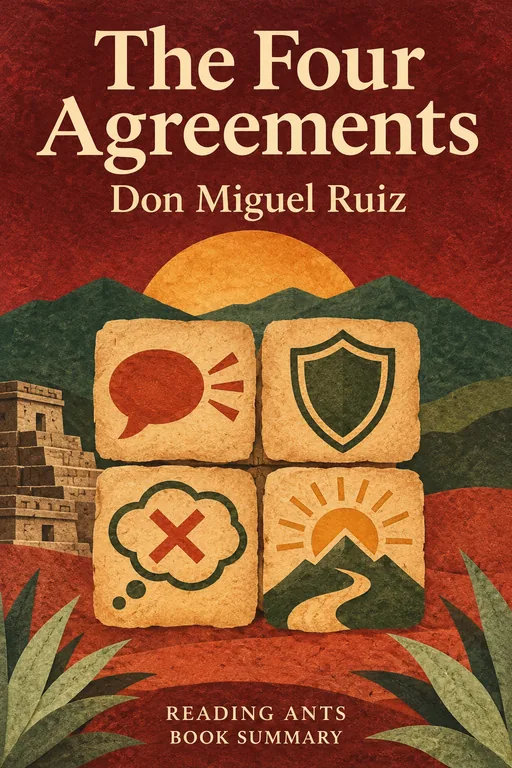
Don Miguel Ruiz offers four simple agreements to make with yourself, to be impeccable with your word, to not take things personally, to not make assumptions and to always do your best, as a path to freedom from fear and self-judgment.
Overview
The Four Agreements: A Practical Guide to Personal Freedom was written by Don Miguel Ruiz, a Mexican author and teacher who trained as a surgeon before becoming a spiritual teacher, and published in 1997. Ruiz presents the book as an introduction to the wisdom of the Toltec, an ancient civilization of central Mexico, though historians point out that there is little evidence for the philosophy described and that the book’s version of their teaching is Ruiz’s own interpretation based on his family tradition. The book is short and written in plain language, and it became a long-running bestseller. Its message is that the beliefs we have absorbed from family and society can trap us in suffering, and that four simple commitments can free us.
Full Summary
1. The domestication and the dream
The idea: Ruiz begins by explaining how people are “domesticated.” From childhood, we receive rules and beliefs from parents, teachers and society, with rewards for obedience and punishments for disobedience. We learn to judge ourselves and others, and we make agreements about what is right and wrong, who we are and what we can do. These agreements form what he calls the “dream of the planet,” a shared story that shapes our experience. Many of the agreements, he says, are based on fear, and they make us suffer.
In real life: A child who is repeatedly told they are “bad at math” may accept this as a fact and avoid math for years.
2. The first agreement: be impeccable with your word
The idea: The first and most important agreement is to speak with integrity. “Impeccable” means without sin, and Ruiz explains that this means not using words against yourself or others. Words are powerful, he says: they can create love and joy or spread fear and hatred through gossip and lies. To be impeccable, he suggests speaking honestly, avoiding gossip, using your words to share truth and love, and speaking kindly to yourself.
In real life: Refusing to join in gossip and giving sincere compliments are small ways of putting this agreement into practice.
3. The second agreement: don’t take anything personally
The idea: Ruiz teaches that what others say and do is a projection of their own reality, their own dream, and not really about you. If someone insults you, it reflects their state of mind and beliefs. If you take it personally, you agree with it and let it hurt you. Not taking things personally gives immunity from needless suffering, and also helps you to not be affected by the opinions of others, positive or negative.
In real life: When a friend snaps at you after a bad day, you can remember that it is about their stress and not a judgment on you.
4. The third agreement: don’t make assumptions
The idea: We tend to assume that we know what others think and feel, and then take these assumptions as truth, causing misunderstandings, drama and conflict. Ruiz urges us to ask questions, to express what we want clearly and to check what others mean, instead of guessing. By communicating honestly, we avoid many of the troubles that come from imagined problems. He says that with this agreement, much suffering in relationships can be removed.
In real life: If a friend does not answer a message, asking “Is everything OK?” works better than assuming they are angry.
5. The fourth agreement: always do your best
The idea: The final agreement is to do your best in every moment, which will vary depending on health, mood and circumstances. Doing your best means acting with sincerity, without overdoing it or underdoing it. If we do our best, we avoid self-judgment, guilt and regret, because we know we have acted as well as we could. This agreement also helps the others, because it gives us the strength to keep them.
In real life: A student who studied as well as they could for an exam can accept the result without blaming themselves.
6. Breaking old agreements and the path of transformation
The idea: Ruiz explains that changing is difficult because old habits are strong. He suggests practice, forgiveness of ourselves when we slip, and persistence. He mentions ways to support change, such as the “initiation of the heart” and the art of transformation, including the idea that we are constantly dreaming and can choose to create a new dream. He imagines a life without fear, in which we live in a kind of heaven on earth, with more love and joy.
In real life: Each time we catch an automatic harsh thought about ourselves, we can practice replacing it with a kinder one.
Why It Matters
The Four Agreements has sold millions of copies worldwide and has remained on bestseller lists for many years, helped in part by the support of Oprah Winfrey. Its simple, memorable framework is widely used by readers, therapists, teachers and coaches, and it has been adapted into audio and workbook versions. Ruiz’s later books and the contributions of his family have expanded on its themes.
The book’s popularity shows the appeal of a short, practical guide to personal change, and many readers find that the four agreements offer a manageable way to approach communication and self-esteem.
Because the agreements are short enough to memorize, many readers keep them on a card or note and use them as a quick check when they are upset, which is one reason the book has stayed in circulation for so long.
Key Takeaways
- Words have power. Speak honestly and kindly, including to yourself.
- Others’ actions reflect their own lives. Don’t take things personally.
- Ask, don’t assume. Clear communication prevents conflict.
- Do your best. Your best changes, and that is enough.
- We can change old agreements. Beliefs can be examined and replaced.
What We Can Learn
The book invites us to notice the beliefs we hold about ourselves and others. By asking whether these beliefs are true and helpful, we may find that some are inherited and no longer serve us.
It also gives practical tools for communication. Speaking clearly, asking questions and not reading minds can reduce misunderstandings in friendships, families and workplaces.
Finally, it teaches self-compassion. The idea that doing your best is enough, even when your best varies, can reduce the cycle of guilt and perfectionism.
Criticism and Counterpoints
Historians and anthropologists have criticized the book’s claim to present Toltec wisdom, noting that the Toltec were an ancient civilization in central Mexico and that there is little evidence of the philosophy the book describes, which appears closer to a modern spiritual system. Some have also criticized the commercial use of Indigenous traditions.
Other readers find the advice simplistic, and say that not taking anything personally can be unrealistic or can discourage people from setting boundaries when someone is truly harming them. Some mental health professionals say that the book is not a substitute for therapy. Still, many appreciate it as a short and encouraging guide.
Who Should Read It
This book suits teenagers and adults. It is short and easy to read, often in an afternoon. Readers may wish to treat it as a collection of useful ideas, not as a history of Toltec culture.
Want the whole book?
A summary is a taste, not the meal. Here is where to find the full book.
You reached the end 🎉
Nicely done. Mark this one as read, and we will suggest what to read next.
Read this next
The Power of Now
Eckhart Tolle
Eckhart Tolle teaches that much of our suffering comes from living in thoughts about the past and future, and that peace is found by paying full attention to the present moment.
🌱 Self-Improvement
The Miracle of Mindfulness
Thich Nhat Hanh
Thich Nhat Hanh shows, through simple practices like washing dishes, breathing and walking, how paying full attention to the present moment can bring calm, joy and a deeper connection to life.
🕊️ Philosophy & Religion
The Courage to Be Disliked
Ichiro Kishimi and Fumitake Koga
In a dialogue between a philosopher and a skeptical young man, this book introduces the psychology of Alfred Adler and argues that we can be free from our past, from others' expectations and from the need for approval, by choosing how we live.
🌱 Self-Improvement
How to Win Friends and Influence People
Dale Carnegie
People are driven by emotion and the desire to feel important, so the way to get along with them, and win them to your point of view, is to stop criticizing, show genuine interest and appreciation, and see things from their side.
🌱 Self-Improvement
The Alchemist
Paulo Coelho
A young Spanish shepherd follows a recurring dream across the desert to the Egyptian pyramids in search of treasure, and learns that the journey toward one's dream is itself the greatest treasure.
🌍 World Literature
Atomic Habits
James Clear
Big changes in life come not from huge leaps but from tiny habits repeated every day, and you can build good habits (and break bad ones) by designing your life so the right choices are obvious, attractive, easy and satisfying.
🌱 Self-ImprovementWant something different?
Pick another topic and we will show you three books to start with.