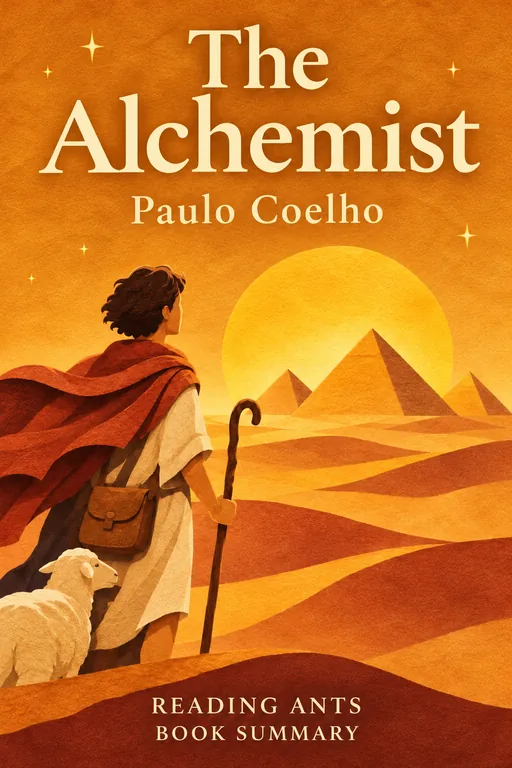
The Alchemist
Original title: O alquimista
A young Spanish shepherd follows a recurring dream across the desert to the Egyptian pyramids in search of treasure, and learns that the journey toward one's dream is itself the greatest treasure.
Overview
The Alchemist is a short, simple fable by Brazilian author Paulo Coelho. Santiago, a shepherd boy from Andalusia in southern Spain, has the same dream twice: a child tells him that treasure is hidden at the pyramids of Egypt. Encouraged by a mysterious old king, he sells his sheep and sets out on a journey across North Africa and the Sahara. Along the way he is robbed, works for a crystal merchant, crosses the desert with a caravan, falls in love and meets a wise alchemist who teaches him to listen to his heart. The book is about following your dreams, which Coelho calls your “Personal Legend,” and the signs and lessons that guide you. It became one of the best-selling books of all time.
Main Characters
- Santiago: a curious young shepherd who dreams of treasure.
- Melchizedek: an old man who claims to be the King of Salem.
- The crystal merchant: a shopkeeper in Tangier who is afraid to follow his own dream.
- The Englishman: a bookish traveler searching for the secrets of alchemy.
- Fatima: a young woman of the desert whom Santiago loves.
- The alchemist: a powerful, wise man who becomes Santiago’s teacher.
Full Summary
The Dream
Santiago’s parents wanted him to become a priest, but he longed to travel, so he became a shepherd, wandering the fields of Andalusia with his flock. One night, sleeping in a ruined church where a sycamore tree grows, he dreams for the second time that a child leads him to the pyramids of Egypt and tells him that treasure is hidden there.
He visits a fortune-teller who tells him to go to the pyramids, in exchange for a tenth of the treasure. Then, in a town square, an old man named Melchizedek, who says he is the King of Salem, explains that everyone has a Personal Legend, the thing they have always wanted to accomplish. When you truly want something, he says, the whole universe works together to help you achieve it. He gives Santiago two stones, Urim and Thummim, to help him read omens, and tells him to follow the signs.
Tangier
Santiago sells his sheep and sails to Tangier in North Africa. On his first day, a man who offers to guide him steals all his money. Alone, poor and unable to speak Arabic, Santiago nearly gives up. But he decides to see himself as an adventurer rather than a victim.
He finds work with a crystal merchant whose shop is failing. Santiago suggests new ideas, such as a display case outside and selling tea in crystal glasses, and business booms. The merchant has always dreamed of making the pilgrimage to Mecca, but he never goes, because he fears that if he fulfilled his dream he would have nothing left to live for. After almost a year, Santiago has earned enough to go home and buy a bigger flock, but he decides instead to continue toward the pyramids.
Across the Desert
Santiago joins a caravan crossing the Sahara. He meets an Englishman who has spent years studying books to find the secret of alchemy, turning ordinary metal into gold, and who is searching for a famous alchemist said to live at an oasis. While the Englishman reads, Santiago watches the desert, the camels and the people, learning to read the world itself.
Tribal wars slow the caravan, and they stop at the great oasis of Al-Fayoum. There Santiago meets Fatima, a young woman drawing water at a well, and falls in love at first sight. She tells him that desert women are proud when their men go off to pursue their dreams, and that she will wait for him.
The Omen of the Hawks
One day Santiago sees two hawks fighting in the sky and has a vision of an army attacking the oasis. He warns the tribal chieftains, even though the oasis is considered neutral ground. They prepare, and when the attack comes, the defenders win. The chieftain rewards Santiago with gold and makes him a counselor. Soon after, the alchemist appears and agrees to guide him to the pyramids.
Lessons of the Alchemist
As they travel, the alchemist teaches Santiago to listen to his heart, which is often afraid of suffering. The alchemist explains that fear of suffering is worse than suffering itself, and that no heart suffers when it is pursuing its dreams. He also teaches the idea of the Soul of the World: all things are connected, and people who pursue their Personal Legends can understand its language.
They are captured by warriors who suspect them of being spies. To save their lives, the alchemist hands over Santiago’s gold and claims the boy can turn himself into the wind. Santiago has three days. He speaks to the desert, the wind and the sun, and finally to the Hand that wrote everything, and a great sandstorm rises. When it passes, Santiago is standing on the other side of the camp. Amazed, the warriors let them go.
The Treasure
The alchemist demonstrates his art, turning lead into gold, and gives Santiago some of it. Then Santiago continues alone. At the pyramids, guided by a scarab beetle, he begins to dig. Men fleeing the wars find him and beat him, and he explains his dream. Their leader laughs. He says he once had a dream of treasure buried under a sycamore tree in a ruined church in Spain, but he was not foolish enough to cross a desert because of a dream.
Santiago realizes where the treasure really is. He returns to Spain, to the ruined church where his journey began, and digs beneath the sycamore. He finds a chest full of gold and jewels. He keeps his promise to give a tenth to the fortune-teller, and he prepares to return to Fatima.
Why It Matters
The Alchemist was first published in Brazil in 1988 with little success, but after a new publisher took it on, it became a worldwide phenomenon. It has sold tens of millions of copies and has been translated into more than eighty languages, making it one of the most translated books by a living author.
The book speaks to readers of all ages and cultures because of its simple message: follow your dreams, pay attention to the signs around you, and don’t let fear stop you. It has been praised by celebrities, entrepreneurs and spiritual teachers, and its phrases about the universe helping those who pursue their dreams are widely quoted. For many people, it is a book they reread at important turning points in life.
Key Takeaways
- Follow your Personal Legend. Everyone has a dream worth pursuing.
- The journey is the treasure. What Santiago learns matters more than the gold he finds.
- Fear holds us back more than failure. The crystal merchant’s fear keeps him from his dream.
- Learn from the world around you. Omens, nature and experience teach as much as books.
- Love supports dreams. True love lets each person pursue their purpose.
What We Can Learn
The story encourages us to take our dreams seriously. Whether you want to become a musician, start a business or travel, it helps to name your goal and take a first step, however small.
It also reminds us that setbacks are part of every journey. Santiago is robbed on his first day abroad, but he chooses to keep going. When things go wrong, ask what the experience can teach you.
Finally, the book suggests paying attention to the present and to the people we meet. Santiago learns from a merchant, an Englishman, a camel driver and a woman at a well. Teachers can appear anywhere if we are open to them.
Criticism and Counterpoints
Critics often describe The Alchemist as simplistic, more a collection of inspirational sayings than a rich novel. Its characters are symbolic rather than realistic, and some readers find its message, that the universe will help those who follow their dreams, naive, especially for people facing poverty, illness or injustice. The idea can seem to suggest that people who fail simply didn’t want it enough.
Others note that the plot borrows from an old folk tale found in The Thousand and One Nights and other traditions, about a man who travels far to find treasure that was at home all along. Coelho has acknowledged this inspiration. Readers who love the book usually respond that its simplicity is the point: it is a fable, not a realistic novel.
Who Should Read It
This short, easy book suits readers from about 10 upward who enjoy fables and inspirational stories, especially those at a crossroads in life. It is a good choice for reluctant readers. Readers who prefer complex characters or realistic stories may find it too simple.
Want the whole book?
A summary is a taste, not the meal. Here is where to find the full book.
You reached the end 🎉
Nicely done. Mark this one as read, and we will suggest what to read next.
Read this next

The Little Prince
Antoine de Saint-Exupery
A pilot stranded in the desert meets a small boy from a tiny planet, who teaches him that the most important things in life, like love and friendship, can only be seen with the heart.
🌍 World Literature
Siddhartha
Hermann Hesse
A gifted young man leaves teachers, wealth and family behind in search of enlightenment, only to discover through love, grief and a river that wisdom must be lived rather than borrowed.
🌍 World Literature
The Prophet
Kahlil Gibran
Before sailing home, a wise exile answers a city's questions about love, work, freedom and death, presenting life as a unity built from apparent opposites.
🌍 World Literature
Life of Pi
Yann Martel
A teenage boy from India survives 227 days adrift in a lifeboat with a Bengal tiger, then tells two versions of what happened and asks which one we prefer to believe.
✨ Modern Fiction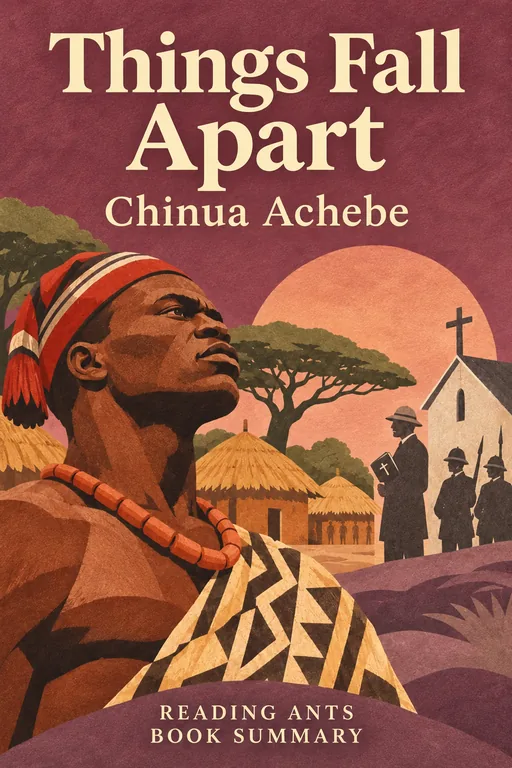
Things Fall Apart
Chinua Achebe
Okonkwo, a proud and fearsome leader in an Igbo village in Nigeria, struggles against his own fears and against the arrival of British missionaries and colonial rulers, who change his world forever.
🌍 World Literature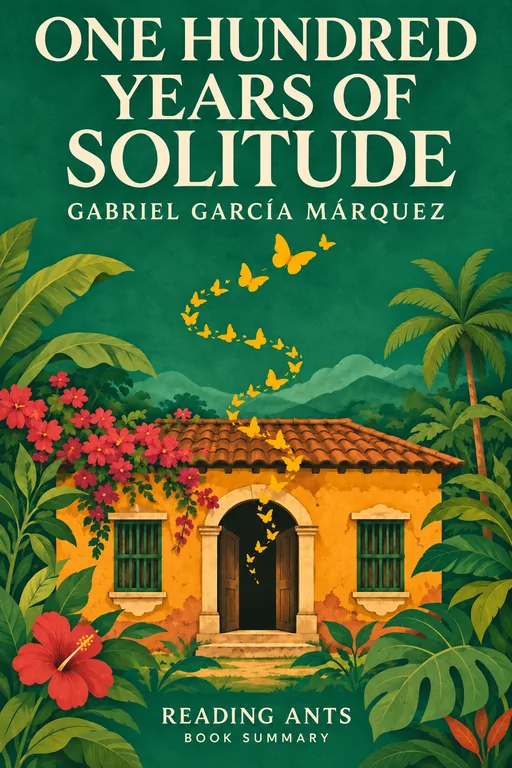
One Hundred Years of Solitude
Gabriel Garcia Marquez
Seven generations of the Buendía family live, love, fight and repeat the same mistakes in the magical Colombian town of Macondo, from its founding to its final destruction.
🌍 World LiteratureWant something different?
Pick another topic and we will show you three books to start with.