 Reading Ants
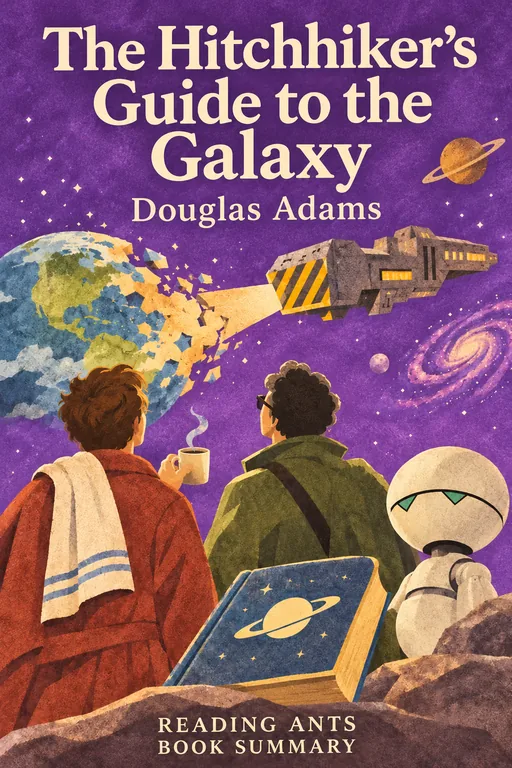
The Hitchhiker's Guide to the Galaxy
Moments before Earth is demolished to make way for a hyperspace bypass, an ordinary Englishman is rescued by his friend, who turns out to be an alien, and begins a hilarious journey through space in search of the meaning of life.
Overview
The Hitchhiker’s Guide to the Galaxy began as a BBC radio comedy series in 1978 and became a novel in 1979, written by Douglas Adams. It is the first of five books in what Adams called “a trilogy in five parts.” It follows Arthur Dent, a mild, tea-loving Englishman who is rescued by his friend Ford Prefect just before the Vogons, an alien race of bureaucrats, destroy the Earth. Ford, who is secretly a researcher for a galactic travel book called The Hitchhiker’s Guide to the Galaxy, takes Arthur on a wild ride through the universe. The book combines silly invention, sharp satire and deep questions in a style that has made it a favorite of generations of readers.
Main Characters
- Arthur Dent: a bewildered, polite human, always in his dressing gown.
- Ford Prefect: Arthur’s friend, a field researcher for the Guide, from a small planet near Betelgeuse.
- Zaphod Beeblebrox: the two-headed, three-armed, reckless President of the Galaxy.
- Trillian: a brilliant human woman, whom Arthur met at a party.
- Marvin: a robot with a “brain the size of a planet,” who is depressed.
- Slartibartfast: a planet designer who builds fjords.
- The Vogons: bureaucratic aliens who write terrible poetry.
- Deep Thought: a giant computer that calculates the answer to life.
Full Summary
The End of the Earth
Arthur Dent wakes up on a Thursday morning to find a bulldozer about to demolish his house to make way for a bypass. He lies in front of it. His friend, Ford Prefect, appears, urges him to come to the pub and explains that the world is about to end. That afternoon, a fleet of Vogon ships appears and announces that Earth will be demolished to make way for a hyperspace bypass. The Vogons say the plans had been on display at the local planning office for years. Ford, who is actually from a small planet near Betelgeuse, uses a device to hitch a ride onto a Vogon ship just as the Earth is destroyed.
The Guide
Ford explains to Arthur that he writes for The Hitchhiker’s Guide to the Galaxy, an electronic encyclopedia with the words “Don’t Panic” printed in large friendly letters on its cover. Arthur learns that the Guide’s entry for Earth, after fifteen years of research, is “Mostly harmless.” They are discovered by the Vogons, forced to listen to the captain’s terrible poetry, and thrown out of an airlock. Just as they are about to suffocate, they are saved by an improbable coincidence: the Heart of Gold, a stolen spaceship powered by an Infinite Improbability Drive, picks them up.
The Heart of Gold
The ship was stolen by Zaphod Beeblebrox, Ford’s semi-cousin and the galaxy’s President, who has two heads and three arms. With him is Trillian, the woman Arthur had met at a party and failed to impress, and Marvin, a very depressed robot. The ship’s drinks machine cannot produce proper tea, a running frustration for Arthur.
Zaphod’s goal is to find the legendary planet Magrathea, home of a forgotten race that built planets for the very rich. They arrive, after an improbable journey, and land on a barren, dead world.
Magrathea
On Magrathea, they meet Slartibartfast, a designer who explains that he won an award for building the fjords of Norway. He takes Arthur on a tour of the planet-building factory and reveals the truth: Earth was a gigantic computer, designed to find the question to the ultimate answer of life, the universe and everything. Long ago, a computer, Deep Thought, was asked for the answer, and after seven and a half million years of calculation, it said: forty-two. No one knew what the question meant, so the mice, who are really hyper-intelligent beings, commissioned the Earth to calculate it. The Earth was destroyed five minutes before the program was completed.
The Mice and the Ending
The mice, who run the experiment, offer to buy Arthur’s brain to extract the question. Arthur refuses. In the confusion, police pursuing Zaphod corner the group, but Marvin talks their ship’s computer into despair until it destroys itself, and the police die when their life-support fails. The five then leave Magrathea aboard the Heart of Gold. The crew heads to the Restaurant at the End of the Universe, as the book ends, which leads into the sequel. The “question” is never discovered.
Throughout, the story keeps its comic tone even as it deals with the destruction of the Earth. The survivors are an odd group, and their escapes depend far more on luck, improbability and bad timing than on skill.
Why It Matters
The Hitchhiker’s Guide to the Galaxy became a cult classic and has sold many millions of copies, and the series has sold many more. It spawned radio, television, stage and film adaptations, including a 2005 film. It has inspired generations of comedy writers and scientists. The number “forty-two” and the phrase “Don’t Panic” are famous in popular culture, and the book’s version of the “Babel fish,” a translating creature, inspired the name of a real internet translation tool.
Adams’s gift was to blend science fiction with British humor, absurd logic and sharp satire of bureaucracy, technology and the search for meaning. The book’s cheerfully chaotic attitude to the universe appealed to readers who might never have picked up traditional science fiction.
Key Takeaways
- Life can be absurd. The universe doesn’t always make sense.
- Bureaucracy can be ridiculous. The Vogons use paperwork to excuse destruction.
- Don’t panic. Staying calm helps in a crisis.
- The question may matter more than the answer. Forty-two means nothing without the question.
- Humor helps us cope. Laughter is a way to deal with an uncertain world.
What We Can Learn
The book encourages us to keep a sense of humor, even when things go wrong. Arthur loses his house and planet in one day, yet he continues, often with a cup of tea.
It also invites us to ask good questions. Deep Thought gives the “answer,” but no one knows what the question was. Learning to ask clear, meaningful questions is at least as important as finding answers.
Finally, it reminds us not to let rules and procedures override common sense, as the Vogons do.
Criticism and Counterpoints
Some readers find the humor too silly, or feel that the plot, held together by improbable coincidences, goes nowhere. The book’s lack of a conventional ending, and its jokes, which can seem repetitive, disappoint those who prefer a serious science fiction story.
Others note that the cast is almost entirely male, and that Trillian is given little to do in this first book. Adams himself admitted that he often wrote under deadline pressure, which shows in places. Most readers, however, enjoy its energy and wit.
Who Should Read It
This novel suits readers from about 10 upward who enjoy comedy and imaginative stories. It is a good gateway to science fiction. It is best enjoyed by readers who like British humor and wordplay.
Want the whole book?
A summary is a taste, not the meal. Here is where to find the full book.
You reached the end 🎉
Nicely done. Mark this one as read, and we will suggest what to read next.
Read this next
Good Omens
Terry Pratchett and Neil Gaiman
An angel and a demon who have grown fond of life on Earth team up to prevent the end of the world, after they lose track of the baby Antichrist.
🚀 Sci-Fi & Fantasy
Foundation
Isaac Asimov
A mathematician predicts that the vast Galactic Empire will fall, and sets up a small colony of scientists at the edge of the galaxy to shorten the coming dark age from thirty thousand years to one thousand.
🚀 Sci-Fi & Fantasy
The Princess Bride
William Goldman
A farm boy and the most beautiful woman in the world are torn apart and reunited through pirates, giants, a prince and a good deal of swordplay, in a story that is both a fairy tale and a joke about fairy tales.
🚀 Sci-Fi & Fantasy
Alice's Adventures in Wonderland
Lewis Carroll
A curious girl follows a white rabbit down a hole into a crazy world where she keeps changing size, meets mad and marvelous creatures, and stands up to a furious Queen.
🧸 Children's Books
Frankenstein
Mary Shelley
A young scientist creates a living being from dead body parts, then abandons it in horror, and his rejected creation, longing for love, turns to revenge.
🚀 Sci-Fi & Fantasy
The Time Machine
H. G. Wells
A Victorian inventor, known only as the Time Traveller, builds a machine that carries him to the year 802,701, where he finds humanity split into two species, the gentle Eloi and the monstrous Morlocks, and then to a dying Earth.
🚀 Sci-Fi & FantasyWant something different?
Pick another topic and we will show you three books to start with.