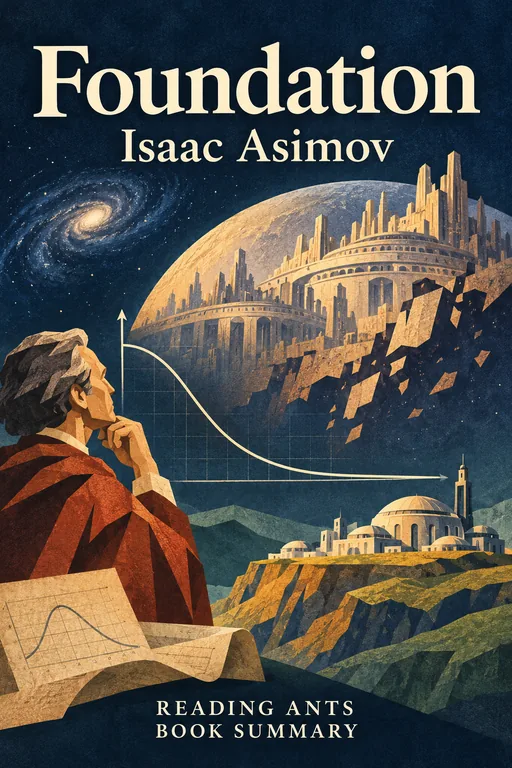
Foundation
A mathematician predicts that the vast Galactic Empire will fall, and sets up a small colony of scientists at the edge of the galaxy to shorten the coming dark age from thirty thousand years to one thousand.
Overview
Foundation, by Isaac Asimov, was published as a book in 1951, drawing on stories he had written for science fiction magazines in the 1940s. It is the first of a series that became one of the best-loved in science fiction. The story is set in a far-future age, roughly twelve thousand years into the Galactic Empire’s calendar, when humanity has spread across millions of planets and is ruled by a Galactic Empire from the capital, Trantor. A mathematician named Hari Seldon invents “psychohistory,” a science that predicts the future of huge populations using mathematics. He foresees that the Empire will collapse and that a dark age will follow. The novel is made up of linked stories spanning about two hundred years, in which the people of the Foundation use wit, trade and politics, instead of force, to survive.
Main Characters
- Hari Seldon: the genius mathematician who founds psychohistory.
- Gaal Dornick: a young mathematician who comes to Trantor and joins Seldon’s plan.
- Salvor Hardin: the clever first mayor of Terminus.
- Hober Mallow: a bold trader who faces a rival power.
- Lord Dorwin: a pompous emissary of the Empire.
- Wienis: the scheming regent of the neighboring Anacreon.
- Sef Sermak: a young politician who challenges Hardin.
Full Summary
The Psychohistorians
Gaal Dornick, a young mathematician from a remote planet, travels to Trantor, the great capital of the Galactic Empire, a world entirely covered with a single metal city. He is invited to join a project by Hari Seldon, who has developed psychohistory. Seldon has used it to predict that the Empire, which looks strong, is decaying and will fall within a few centuries. After its collapse, thirty thousand years of chaos will follow.
The government, afraid of Seldon’s prediction, arrests him but allows him to set up a project: the creation of an Encyclopedia Galactica, to preserve all human knowledge. The Encyclopedists will be sent to a remote, resource-poor planet called Terminus at the edge of the galaxy. Seldon says this can shorten the dark age to a thousand years.
The Encyclopedists
Fifty years later, Terminus is a small colony of scholars who work on the Encyclopedia. The four neighboring worlds, including Anacreon, have broken away from the Empire and are growing aggressive, and Terminus is vulnerable. The committee that runs the colony is complacent, assuming the Empire will protect them. Salvor Hardin, the mayor, sees that the Empire is no longer able or willing to help. He plays the neighboring kingdoms against each other and uses the colony’s advanced technology as leverage.
When the crisis comes and Anacreon is ready to attack, a recorded message from Hari Seldon plays in a vault on Terminus. It reveals that the Encyclopedia was only a cover, and that the colony’s real purpose is to shape the future. Hardin is proved right, and the committee is replaced.
The Mayors
As time passes, the Foundation spreads its technology through the neighboring kingdoms in the form of a religion. Scientists from Terminus act as priests of a “Galactic Spirit,” teaching that technology is holy. This makes it safe from attack, since the neighbors worship the machines they use. Hardin, who distrusts violence, believes that it is what people turn to when they have run out of ideas.
When a young politician named Sef Sermak demands a military response to Anacreon, and Anacreon’s ruthless regent, Wienis, prepares to attack, Hardin triggers a religious uprising against Wienis, using the Foundation’s priests. The ruler loses control, and Terminus is saved without a battle.
The Traders and the Merchant Princes
A century into the Foundation’s history, its traders, adventurous merchants who travel from star to star, have become its most powerful members. They sell atomic gadgets on distant worlds and spread the Foundation’s influence. Stories of traders such as Limmar Ponyets and Hober Mallow show that trade, not religion, is the Foundation’s real strength.
Hober Mallow, a daring trader, is sent to the wealthy planet of Korell to find out what happened to missing Foundation ships. He concludes that religion has outlived its usefulness as the Foundation’s tool, and that the Foundation’s true advantage is economic. When Korell turns hostile, Mallow, by then the Foundation’s mayor, simply cuts off the supply of goods that the Korellians have come to depend on. Without trade, Korell’s economy collapses, and the threat ends. The traders replace the priests as the leaders of the Foundation.
The Seldon Plan
Throughout the book, at moments of crisis, a recorded image of Hari Seldon, who died long ago, appears to tell the people of Terminus what has happened and what comes next. Each crisis, Seldon says, was predicted, and the Foundation’s choices were limited by history. The Foundation, he explains, will grow by trade, ideas and necessity until it can rebuild order across the galaxy. The novel ends with the sense that Seldon’s plan is working, though many crises still lie ahead.
Why It Matters
The Foundation series won the Hugo Award for Best All-Time Series in 1966, a one-time special award, beating out The Lord of the Rings. It is one of the most important science fiction works of the twentieth century, and it influenced scientists, economists and writers. Nobel Prize-winning economist Paul Krugman has said that he became an economist partly because of Foundation’s idea of a “science of history.”
The series gave science fiction a sweeping vision of the future, combined with a belief in rationality and human ingenuity over brute force. It inspired concepts in later works, from Star Wars’ Galactic Empire to Frank Herbert’s Dune, and was adapted into an Apple TV+ series in 2021.
Key Takeaways
- History has patterns. Large groups of people follow predictable trends.
- Brains can beat force. Hardin and Mallow win through cleverness, not violence.
- Knowledge preserves civilization. The Encyclopedia stands for saving learning.
- Economics matters. Trade becomes the Foundation’s weapon.
- Institutions can decay. Even mighty empires can crumble.
What We Can Learn
Foundation encourages us to think about long-term consequences. Hardin and Seldon plan for centuries, not just for the next problem. Thinking ahead helps us make wiser decisions.
It also celebrates problem-solving through creativity and cooperation. Characters like Hardin avoid violence, using clever strategy to turn rivals against each other.
Finally, it reminds us that knowledge is fragile and needs protecting. Libraries, schools and science preserve what a society has learned, and when they are neglected, hard-won understanding can be lost surprisingly quickly.
Criticism and Counterpoints
Critics have noted that the characters in Foundation are thin, and the book consists mostly of men talking in rooms about politics and strategy. There is little action, and women are almost absent. Asimov wrote it in the 1940s, and it shows its period in some of its attitudes.
Some scientists have pointed out that real human behavior is too unpredictable for psychohistory to work. Asimov himself wrote sequels in which this idea is challenged, introducing a mutant, the Mule, who upsets all predictions. Readers who prefer action-heavy science fiction may find it slow.
Who Should Read It
This novel suits teens and adults who like ideas-driven science fiction. It is a good starting point for the series. Fans of history, politics and economics, as well as science fiction, will enjoy it.
Want the whole book?
A summary is a taste, not the meal. Here is where to find the full book.
You reached the end 🎉
Nicely done. Mark this one as read, and we will suggest what to read next.
Read this next
I, Robot
Isaac Asimov
Nine linked stories follow the early history of intelligent robots, as a veteran robot psychologist named Susan Calvin recalls how the Three Laws of Robotics led to puzzles, mistakes and, in the end, a world quietly managed by machines.
🚀 Sci-Fi & Fantasy
Dune
Frank Herbert
When his noble family is betrayed and destroyed, young Paul Atreides escapes into the deserts of the planet Arrakis and rises to lead its native people, the Fremen, in a revolution that will change the universe.
🚀 Sci-Fi & Fantasy
The Left Hand of Darkness
Ursula K. Le Guin
A lone envoy from a league of human worlds travels to the frozen planet Gethen, where people have no fixed gender, and learns to trust a local statesman, Estraven, who is exiled for his politics and who comes to the envoy's aid.
🚀 Sci-Fi & Fantasy
Ender's Game
Orson Scott Card
A gifted boy is taken from his family to a military space school to train as humanity's commander against an alien enemy, and does not realize until too late that his final test was real.
🚀 Sci-Fi & Fantasy
Frankenstein
Mary Shelley
A young scientist creates a living being from dead body parts, then abandons it in horror, and his rejected creation, longing for love, turns to revenge.
🚀 Sci-Fi & Fantasy
The Time Machine
H. G. Wells
A Victorian inventor, known only as the Time Traveller, builds a machine that carries him to the year 802,701, where he finds humanity split into two species, the gentle Eloi and the monstrous Morlocks, and then to a dying Earth.
🚀 Sci-Fi & FantasyWant something different?
Pick another topic and we will show you three books to start with.