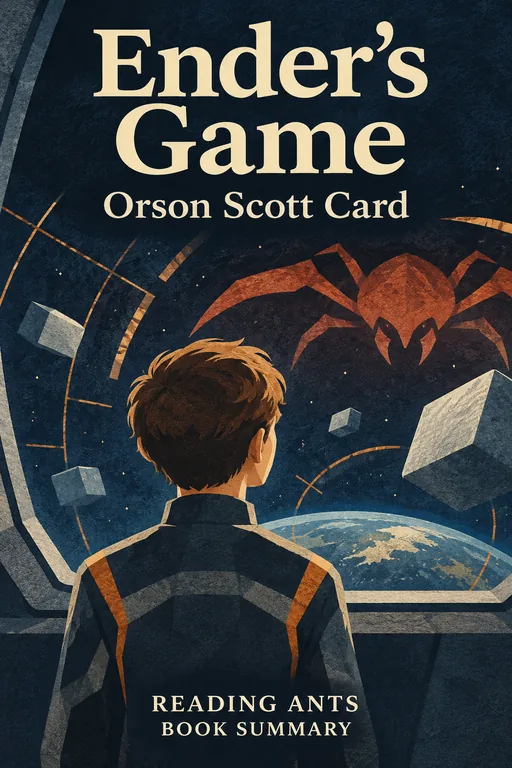
Ender's Game
A gifted boy is taken from his family to a military space school to train as humanity's commander against an alien enemy, and does not realize until too late that his final test was real.
Overview
Ender’s Game, by Orson Scott Card, was first published as a short story in 1977 and as a novel in 1985. It won both the Hugo and Nebula awards. It is set in a future Earth that has survived two invasions by an insect-like alien species, the “Buggers” or Formics, and is preparing for a third. The military believes that the next commander must be a child, since children are quick, creative and free from fixed habits. Six-year-old Andrew “Ender” Wiggin is recruited for Battle School, an orbiting space station where children play zero-gravity war games. The novel is a gripping story of leadership, loneliness and the cost of winning, and it raises hard questions about how much we can ask of children.
Main Characters
- Ender (Andrew) Wiggin: a brilliant, sensitive boy chosen as a future commander.
- Valentine Wiggin: Ender’s gentle, clever older sister.
- Peter Wiggin: Ender’s cruel, ambitious older brother.
- Colonel Hyrum Graff: the Battle School’s cold, manipulative commander.
- Major Anderson: Graff’s colleague, who feels guilty.
- Bean: a small, extremely smart boy who becomes Ender’s friend.
- Petra Arkanian: one of Ender’s friends.
- Bonzo Madrid: an arrogant older student who hates Ender.
- Mazer Rackham: a legendary war hero who trains Ender.
Full Summary
A Third
On Earth, population control laws limit families to two children, but Ender is a “Third,” allowed because the military hoped for a child with the best features of his siblings, Peter, who is brilliant but cruel, and Valentine, who is brilliant but too gentle. At six, Ender is monitored by a device on his neck. When it is removed, Ender takes this to mean that he has been rejected. Soon afterward, a bully attacks him at school, and Ender survives the fight by hurting him badly so that he will never be attacked again, a lesson that haunts him. Colonel Graff, who hears about the fight, recruits him for Battle School, and Ender leaves his family and goes into space.
Battle School
At Battle School, Ender is the youngest, and the other children resent him. The teachers deliberately isolate him, so he will become tough and strategic. The school’s main activity is the Battle Room, a huge zero-gravity chamber where teams play war games. Ender quickly sees new tactics, treating the room as a three-dimensional space rather than one with a floor.
He is promoted early and becomes friends with Alai, Petra and others. His rise provokes the jealousy of older boys.
Dragon Army
Ender is made commander of his own army, Dragon Army, a group of poorly trained students. He trains them intensively and pushes them to be creative. They win game after game. The teachers, eager to see how far Ender can go, change the rules, giving him tougher opponents, and several battles in a row. Ender, exhausted, begins to wish for a way out, but Graff persuades him to continue, telling him it matters. Later, Bonzo Madrid, a proud commander resentful of Ender’s success, confronts him in a shower room. Ender defends himself and, without realizing it, seriously injures Bonzo, who later dies.
Meanwhile, at home, Peter and Valentine use fake identities, “Locke” and “Demosthenes,” to write political essays on the planet’s networks, and Peter gains growing influence.
Mazer Rackham
Ender is sent to Command School on a distant station, where he meets Mazer Rackham, the great hero who won the last war with the Formics. Mazer trains him in simulations of battle against the aliens, which grow harder every day. Some of Ender’s friends from Battle School, including Bean, Petra and Alai, join him as his sub-commanders. The simulations are punishing, and Ender is sleepless.
The Final Test
In the last test, a difficult simulation with Ender hopelessly outnumbered, he decides to destroy the enemy home planet entirely, using a powerful weapon against the planet itself. The “simulation” ends in a tremendous explosion, and the room erupts in cheers. Ender learns that it was not a simulation: he has commanded the real fleet and destroyed the Formic homeworld, wiping out the aliens entirely.
Aftermath
Ender is horrified. He had never wanted to kill. As he recovers, he leaves Earth with his sister Valentine for a former Formic colony, where he becomes the colony’s governor. There he finds a place that matches a fantasy computer game from Battle School, and inside it a dormant Formic queen’s egg. Through a connection to him, the queen explains that the Formics had not understood that each human was an individual, thinking being, and that she wanted to make peace. Ender vows to find a new home for the last queen and to write the truth about the Formics. He then sets out to find a world where the egg can hatch.
Why It Matters
Ender’s Game is one of the most popular science fiction novels of all time, and it has won both major awards for science fiction, the Hugo and the Nebula. It is widely read in schools and by the military: it has been on the United States Marine Corps’s reading list. It has led to several sequels, beginning with Speaker for the Dead, and a 2013 film.
The novel’s central question, whether the ends justify the means, and how far we can go in training children for war, has made it a subject of discussion among ethicists as well as science fiction fans. It also anticipated modern concerns about video-game-like warfare, since Ender commands real battles through screens.
Key Takeaways
- Children can be pushed too hard. Ender’s talents are exploited.
- Winning has a moral cost. The destruction of a species is a tragic victory.
- Isolation shapes character. Ender is deliberately kept alone.
- Understanding enemies matters. Ender grasps the aliens only after it is too late.
- Deception can be harmful. The adults hide the truth from Ender.
What We Can Learn
The novel encourages us to consider the impact of pressure and isolation on young people. Ender is highly capable, but he is also a child who needs friends, family and kindness.
It also invites us to think about empathy. Ender wins by understanding his enemies’ thinking, and he is destroyed by his compassion for them. Trying to understand others, even those who seem like enemies, can lead to better outcomes.
Finally, it warns about using people as tools. The adults justify their actions by saying it is necessary, but they harm Ender. Considering the human cost of our goals is part of acting ethically.
Criticism and Counterpoints
The novel has been criticized for its violence by and toward children and for the unrealistic maturity of Ender and his siblings, who write and talk like adults. Others find it unconvincing that a military would trust such a decision to a child.
Card’s public statements, especially his strong opposition to same-sex marriage, led to calls to boycott the 2013 film, and many readers have struggled to separate the book from its author. Some critics also argue that the novel’s twist, that the aliens meant no harm, is told too quickly.
Who Should Read It
This novel suits readers from about 13 upward who enjoy science fiction and stories about strategy. It contains violence, including children harming one another. It is a good introduction to classic science fiction.
Want the whole book?
A summary is a taste, not the meal. Here is where to find the full book.
You reached the end 🎉
Nicely done. Mark this one as read, and we will suggest what to read next.
Read this next
Foundation
Isaac Asimov
A mathematician predicts that the vast Galactic Empire will fall, and sets up a small colony of scientists at the edge of the galaxy to shorten the coming dark age from thirty thousand years to one thousand.
🚀 Sci-Fi & Fantasy
The Hunger Games
Suzanne Collins
A teenager volunteers for a televised fight to the death and learns to turn the regime's own spectacle into a fragile means of survival and defiance.
🎒 Young Adult
Lord of the Flies
William Golding
A group of British schoolboys stranded on a deserted island try to govern themselves, but fear and the desire for power slowly turn them into savages, revealing the darkness inside human nature.
📜 Classics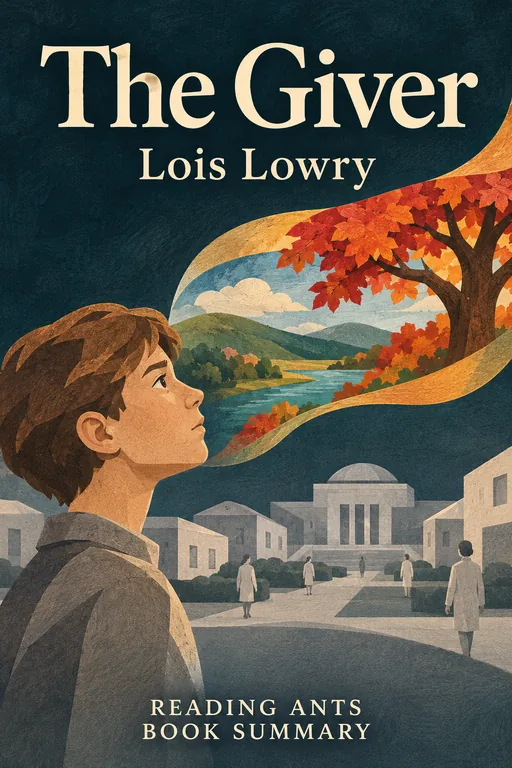
The Giver
Lois Lowry
In a perfectly controlled community with no pain, choice or color, a boy about to turn twelve is chosen to hold the memories of the past, and discovers the terrible price his people pay for their safety.
🎒 Young Adult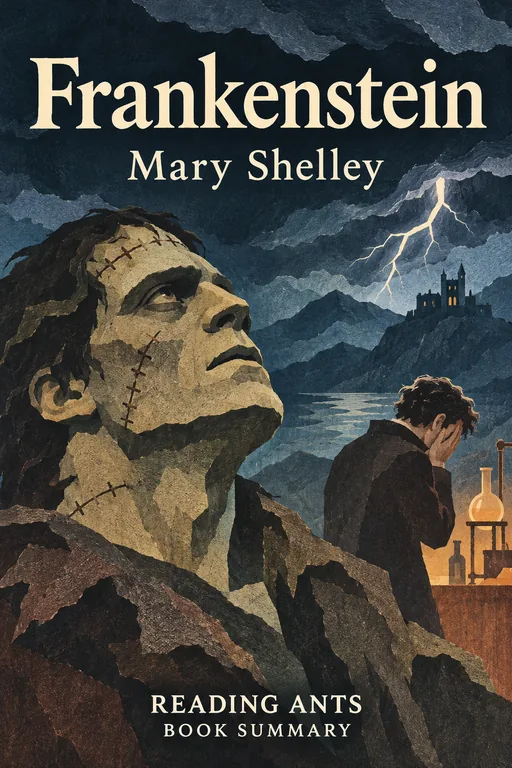
Frankenstein
Mary Shelley
A young scientist creates a living being from dead body parts, then abandons it in horror, and his rejected creation, longing for love, turns to revenge.
🚀 Sci-Fi & Fantasy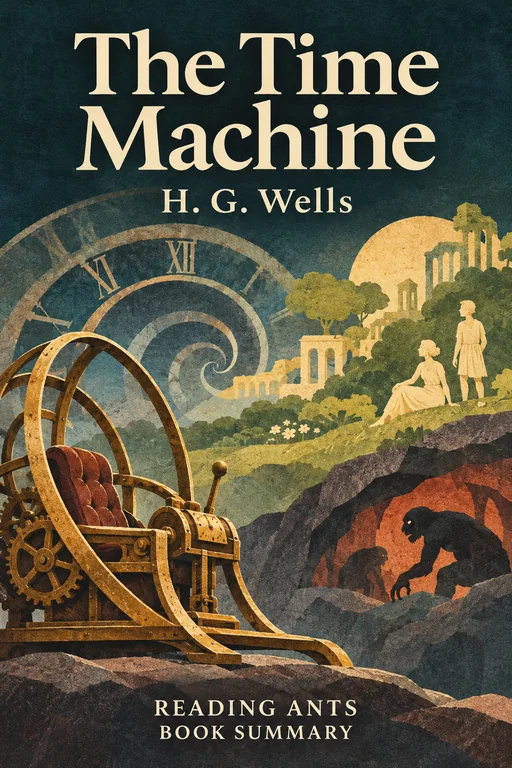
The Time Machine
H. G. Wells
A Victorian inventor, known only as the Time Traveller, builds a machine that carries him to the year 802,701, where he finds humanity split into two species, the gentle Eloi and the monstrous Morlocks, and then to a dying Earth.
🚀 Sci-Fi & FantasyWant something different?
Pick another topic and we will show you three books to start with.