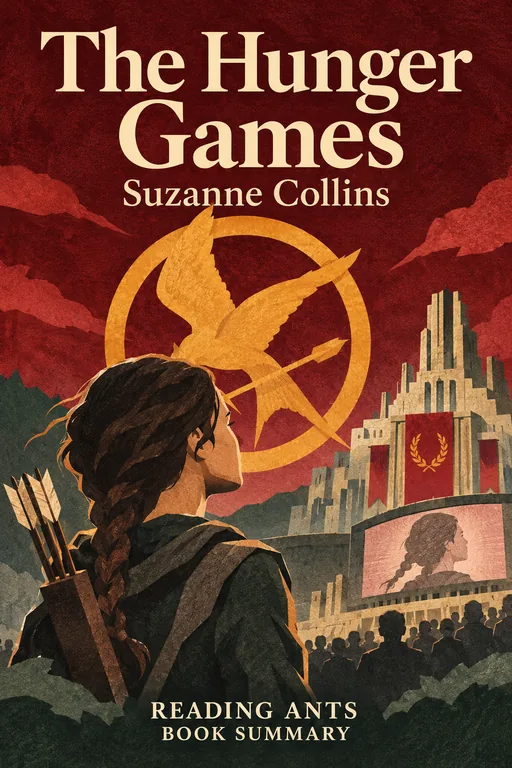
The Hunger Games
A teenager volunteers for a televised fight to the death and learns to turn the regime's own spectacle into a fragile means of survival and defiance.
Overview
The Hunger Games is the first novel in Suzanne Collins’s dystopian trilogy. In Panem, the wealthy Capitol controls twelve districts and forces each to send two children into an annual televised death match. Sixteen-year-old Katniss Everdeen volunteers when her younger sister is selected. She enters the arena beside Peeta Mellark, whose public declaration of love becomes both emotional truth and survival strategy. Katniss is skilled at hunting but uncertain about performance, trust and the political meanings others assign to her actions. The novel combines fast-paced survival with criticism of authoritarian punishment, economic inequality and entertainment built from suffering. It ends with Katniss alive but newly endangered, not with the system defeated.
Main Characters
- Katniss Everdeen: a skilled hunter who supports her family and narrates from a guarded perspective.
- Peeta Mellark: the baker’s son, compassionate and strategically gifted at public performance.
- Prim Everdeen: Katniss’s younger sister, for whom she volunteers.
- Haymitch Abernathy: District 12’s traumatized former victor and mentor.
- Gale Hawthorne: Katniss’s hunting partner and closest friend at home.
- Effie Trinket: the Capitol escort who embodies its manners and distance from district suffering.
- Cinna: Katniss’s stylist, whose designs give her a powerful public image.
- Rue: a young tribute from District 11 who becomes Katniss’s ally.
Full Summary
The Reaping
Katniss lives in impoverished District 12, where her father’s death in a mine explosion left her family near starvation. She hunts illegally with Gale and trades food. At the annual reaping, Prim’s name is drawn. Katniss immediately volunteers in her place. Peeta Mellark is selected as the male tribute.
Katniss remembers that Peeta once gave her burned bread when she was starving. She cannot decide whether his kindness creates a debt or whether he will become an enemy. On the train, Haymitch tells them that gaining sponsors may determine survival, making public appeal another arena skill.
The Girl on Fire
In the Capitol, Cinna dresses Katniss and Peeta in costumes that appear to burn, presenting them as a united pair. During a televised interview, Peeta reveals that he has long loved Katniss. She initially sees the confession as manipulation, but Haymitch explains that it makes her desirable as the heroine of a tragic romance.
Training reveals dangerous competitors from wealthier districts who have prepared for the Games. Katniss displays her archery after the Gamemakers ignore her, shooting an arrow toward their feast. Her high score attracts attention while showing the anger that could make the Capitol view her as a threat.
Entering the Arena
When the Games begin, many tributes die at the Cornucopia. Katniss escapes with basic supplies and searches for water. The Gamemakers use fire to drive her toward action, demonstrating that the arena is a controlled production rather than neutral wilderness.
Peeta appears to join the Career tributes hunting Katniss, but his motives remain uncertain. Trapped in a tree, Katniss is shown by Rue a nest of genetically altered wasps. Katniss cuts it loose onto the Careers, and some of them are killed by the stings. She is stung too, but she gains a bow, and Peeta, still with the Careers, tells her to run, which helps her escape. After she recovers, she and Rue form an alliance.
Rue’s Alliance
Rue helps Katniss recover and points out the Careers’ stockpile. Katniss destroys it by triggering buried mines. While she is away, another tribute traps Rue in a net and fatally wounds her. Katniss kills him, comforts Rue as she dies and covers her body with flowers.
The flowers turn a required death into a public act of mourning and refuse the Capitol’s effort to present tributes as disposable enemies. District 11 sends Katniss bread, showing that viewers can answer the broadcast with meanings the producers did not intend. Her private grief has become politically visible.
The Star-Crossed Lovers
A rule change announces that two tributes from the same district may both win. Katniss finds Peeta badly injured and plays up their romance to attract medicine and food from sponsors. Her care is strategic but not therefore false; she struggles to identify where performance ends and feeling begins.
At a feast, Katniss risks her life to obtain medicine. Thresh, the remaining District 11 tribute, spares her because of what she did for Rue. As the field narrows, the Gamemakers manipulate weather, food and genetically engineered creatures to force a finale.
The Berries
Katniss, Peeta and Cato reach the Cornucopia while wolf-like creatures attack. After a brutal struggle, Cato falls and suffers for hours until Katniss kills him in mercy. Katniss and Peeta believe they have won together, but the Gamemakers revoke the two-winner rule.
Rather than kill each other, they prepare to eat poisonous nightlock berries simultaneously. The Capitol stops them and declares both winners because a Games with no victor would ruin the spectacle. Their act succeeds by exploiting the regime’s need for a satisfying ending, though Katniss does not initially understand its full political impact.
Victory Without Safety
After leaving the arena, Katniss learns that the Capitol interprets the berries as defiance. Haymitch warns that she must convince President Snow and the audience that love, not rebellion, drove her. Peeta is hurt to discover that some of her romance was performed for survival.
They return to District 12 as victors, wealthy but traumatized and watched. Katniss cannot neatly separate affection for Peeta from her bond with Gale or from the persona built around her. The immediate contest is over, yet her refusal to submit completely has made her a potential symbol. Survival has created political danger rather than freedom.
Why It Matters
The novel makes media performance part of survival rather than decoration around the action. Clothing, editing, interviews and sponsor reactions determine material outcomes. Katniss survives not only because she shoots well but because she learns to communicate through images the Capitol cannot fully control.
Its first-person perspective also creates productive uncertainty. Katniss often understands practical danger better than emotions or political symbolism. Readers can see rebellion developing around acts she experiences as grief, loyalty or desperation. This gap asks whether resistance requires pure intention, or whether an action can gain public force beyond what its actor planned.
Key Takeaways
- Spectacle is a form of control. The Capitol turns punishment into entertainment and makes viewers participate in its values.
- Performance can contain truth. Katniss and Peeta’s romance is strategic, yet real care develops inside the strategy.
- Mourning can resist dehumanization. The flowers insist that Rue’s life matters beyond the Games’ scorekeeping.
- Skills depend on systems. Hunting helps Katniss, but sponsors, image and arbitrary rule changes also shape survival.
- Winning is not liberation. Victors remain traumatized, managed and politically vulnerable.
What We Can Learn
When consuming competitive entertainment or news, ask who designed the frame, who profits and what suffering has been converted into content. Emotional stories can be sincere while also being edited to serve institutional goals. Media literacy means examining both levels.
Katniss’s alliances show that cooperation can challenge systems built to isolate people. Rue and Thresh preserve obligations across district lines even when the rules reward betrayal. Still, individual courage cannot by itself remove structural violence. We should not demand that vulnerable people perform perfect resistance while trying to survive. Their immediate safety and agency matter alongside the symbolism others attach to them.
Criticism and Counterpoints
The fast pacing can leave district cultures and many tributes thinly developed. Because violence is central to the suspense, the novel risks making readers consume the same spectacle it criticizes, though Katniss’s trauma and moral revulsion work against simple enjoyment.
The romantic triangle sometimes draws attention from poverty and authoritarianism. Katniss’s limited knowledge is intentional, but it means the first volume offers only a partial view of Panem. Later-series information should not be projected backward as if she knows it here.
Who Should Read It
This novel suits readers from about thirteen upward who enjoy survival stories, dystopia and political themes. It is highly readable but includes child deaths, severe injuries, starvation and trauma. Readers looking for a self-contained overthrow of the regime should expect an unresolved trilogy opening.
Want the whole book?
A summary is a taste, not the meal. Here is where to find the full book.
You reached the end 🎉
Nicely done. Mark this one as read, and we will suggest what to read next.
Read this next
Nineteen Eighty-Four
George Orwell
In a future Britain ruled by an all-seeing Party, one man secretly rebels by keeping a diary and falling in love, and discovers just how completely a totalitarian state can crush the human mind.
📜 Classics
The Giver
Lois Lowry
In a perfectly controlled community with no pain, choice or color, a boy about to turn twelve is chosen to hold the memories of the past, and discovers the terrible price his people pay for their safety.
🎒 Young Adult
The Handmaid's Tale
Margaret Atwood
In a near-future United States taken over by a religious dictatorship that strips women of their rights, a woman forced to bear children for a powerful couple secretly remembers her old life and searches for a way to survive.
✨ Modern Fiction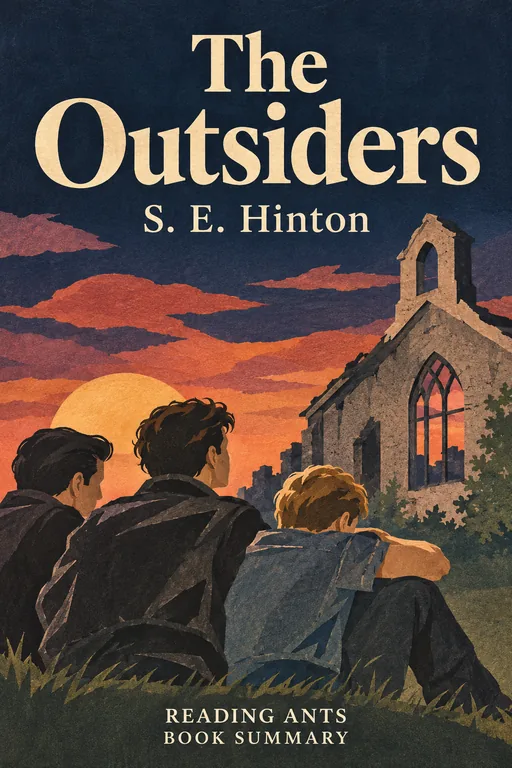
The Outsiders
S. E. Hinton
After a deadly clash between rival social groups, teenager Ponyboy Curtis learns that loyalty can sustain people without making violence noble or erasing their shared humanity.
🎒 Young Adult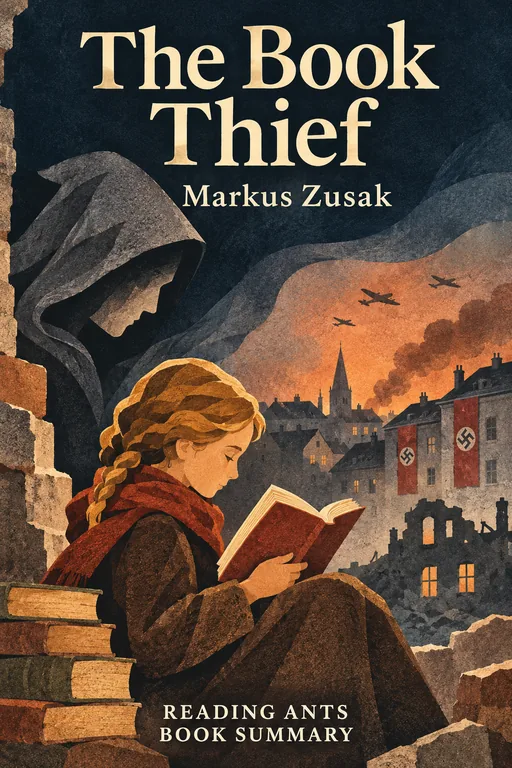
The Book Thief
Markus Zusak
Death narrates how a foster child in Nazi Germany steals books, learns the power of words and forms loving bonds that war eventually destroys.
🎒 Young Adult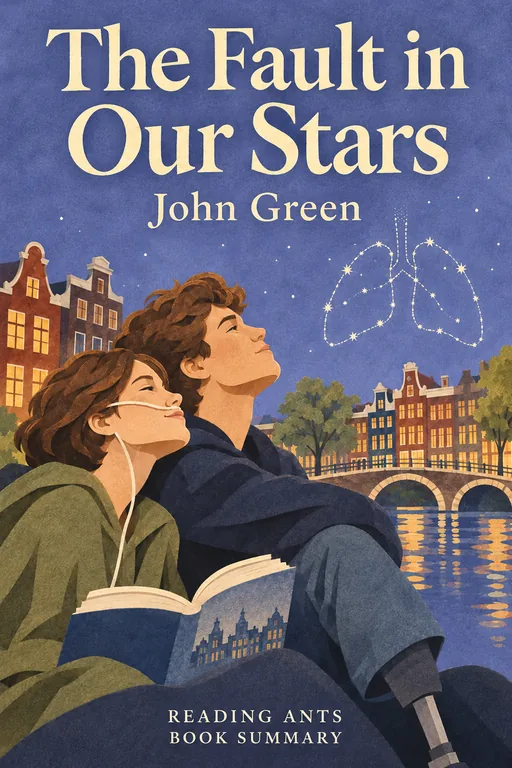
The Fault in Our Stars
John Green
Two teenagers with cancer fall in love, travel in search of a novel's missing ending and discover that a short life can hold real meaning without becoming a sentimental lesson.
🎒 Young AdultWant something different?
Pick another topic and we will show you three books to start with.