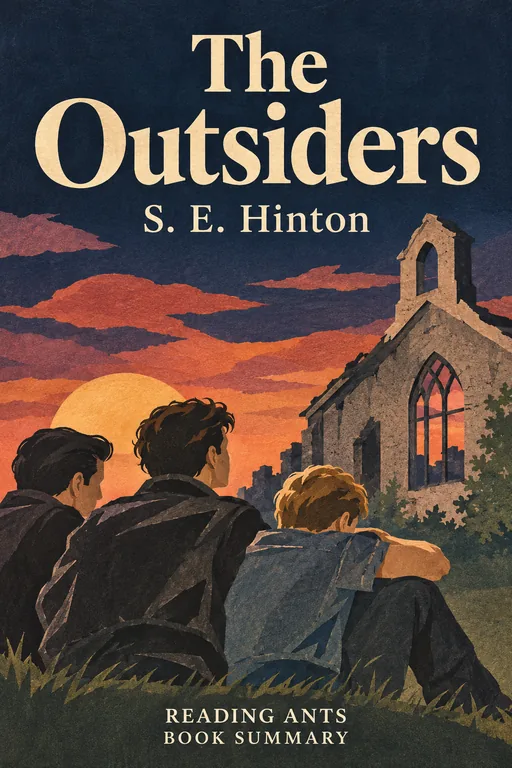
The Outsiders
After a deadly clash between rival social groups, teenager Ponyboy Curtis learns that loyalty can sustain people without making violence noble or erasing their shared humanity.
Overview
The Outsiders is a young-adult coming-of-age novel narrated by fourteen-year-old Ponyboy Curtis. He belongs to the greasers, working-class youths in conflict with the wealthier Socs. When Ponyboy’s friend Johnny kills a Soc while saving him from an attack, the boys hide in an abandoned church and confront consequences larger than neighborhood rivalry. Heroic rescue, courtroom judgment and further deaths force Ponyboy to reconsider the simple categories through which both groups see each other. S. E. Hinton wrote the novel while still a teenager, giving its account of class, family and masculinity unusual immediacy. The book values chosen family while showing how expectations of toughness prevent frightened boys from asking for help.
Main Characters
- Ponyboy Curtis: a thoughtful greaser who loves books, films and sunsets.
- Johnny Cade: Ponyboy’s abused, fearful friend, traumatized by an earlier Soc attack.
- Dallas “Dally” Winston: a hardened greaser fiercely protective of Johnny.
- Darry Curtis: Ponyboy’s oldest brother and guardian, who sacrificed his plans to keep the family together.
- Sodapop Curtis: Ponyboy’s warm, charismatic middle brother.
- Cherry Valance: a Soc girl who helps Ponyboy see complexity across the class divide.
- Bob Sheldon: Cherry’s boyfriend, whose violence and death drive the central crisis.
- Two-Bit Mathews: a joking, loyal member of the greaser group.
Full Summary
Greasers and Socs
Ponyboy is walking home alone when Socs attack him. His brothers and fellow greasers drive them away. Since their parents died, strict Darry has supported Ponyboy and Sodapop and fears that any trouble could separate the family. Ponyboy mistakes much of Darry’s pressure for rejection.
At a drive-in, Ponyboy and Johnny meet Cherry and Marcia. Dally harasses the girls, but Johnny unexpectedly tells him to stop. Ponyboy and Cherry discuss books and sunsets, discovering common feeling across class lines. Cherry still explains that Socs and greasers experience different kinds of pain and remains connected to her own group.
The Park
After Ponyboy comes home very late, Darry strikes him during an argument. Ponyboy runs away with Johnny. At a park, Bob and other Socs confront them and hold Ponyboy underwater in a fountain. Believing Ponyboy will be killed, Johnny stabs Bob. When Ponyboy regains awareness, Bob is dead.
The killing is presented as rescue under terror, not a triumph. Dally gives the boys money, a gun and directions to an abandoned church near Windrixville. To disguise themselves, the boys cut their hair, and Ponyboy’s is also bleached, so both surrender part of the identity they once displayed proudly.
Nothing Gold Can Stay
While hiding, Ponyboy reads Gone with the Wind to Johnny, and they discuss courage. Watching a sunrise, Ponyboy recites Robert Frost’s “Nothing Gold Can Stay.” Their conversations reveal sensitivity that their social roles teach them to conceal.
Dally visits and reports that Cherry is helping the greasers because she believes Bob’s killing occurred in self-defense. Johnny decides to turn himself in, and he and Ponyboy head out; on their return, they find the church on fire with children inside. Ponyboy and Johnny rush in to save them, and Dally joins the rescue. A falling beam critically injures Johnny.
The Rumble
Ponyboy is reunited with his brothers and finally recognizes that Darry’s tears and strictness come from love and fear. Reporters call the boys heroes, but legal uncertainty remains. Johnny’s condition worsens, while Dally cannot accept that the person he most cares about may die.
The greasers and Socs proceed with a planned rumble. The greasers win the fight, but victory changes nothing essential. Ponyboy and Dally hurry to the hospital, where Johnny dies after telling Ponyboy to “stay gold.” His words connect the sunrise, the poem and the wish that Ponyboy preserve openness in a violent environment.
Dally’s End
After Johnny’s death, Dally runs from the hospital, robs a store and calls the gang while police pursue him. When officers confront him, he raises an unloaded gun and is shot dead. Ponyboy believes Dally wanted the police to kill him because he could not live with Johnny’s death.
The rumble’s winners have therefore lost two friends in a single night. Ponyboy becomes ill and confused, at times insisting that he killed Bob or that Johnny is still alive. Trauma disrupts his narration, showing why his account must be understood as a young survivor’s effort to make events bearable.
The Story as Homework
At the hearing, Ponyboy is allowed to remain with his brothers. Yet he struggles at school, fights with denial and risks failing English. Sodapop finally breaks down over being trapped between Darry and Ponyboy, forcing the brothers to promise they will stop tearing the family apart.
Johnny’s final note, which Ponyboy reads only after both Johnny and Dally are dead, says that saving the children was worth his life and asks Ponyboy to tell Dally that there is still good in the world, a message that has come too late for Dally. For an English assignment, Ponyboy begins writing about the attack he experienced while walking home from a movie. The novel circles back to its opening words: telling the story becomes his way to reach young people divided by labels like greaser and Soc.
Why It Matters
The novel helped establish modern young-adult fiction by speaking directly about class conflict, abuse, grief and adolescent identity in a teenager’s voice. Its boys are expected to be hard, yet the story values crying, poetry, fear and tenderness. That challenge to narrow masculinity remains central to its appeal.
It also refuses to make shared humanity an excuse for ignoring inequality. Ponyboy and Cherry see the same sunset, but they do not face the same economic risks or public assumptions. The insight that Socs suffer too complicates hatred without pretending both groups have equal power. Hinton shows how social labels become self-fulfilling when institutions and peers expect violence from young people.
Key Takeaways
- Class labels hide individuals. “Greaser” and “Soc” predict social treatment but cannot fully describe a person.
- Vulnerability is not weakness. The boys’ suppressed fear and grief become more dangerous when toughness is their only acceptable language.
- Violence does not solve grief. Winning the rumble cannot restore Bob, Johnny or Dally.
- Family care needs communication. Darry’s sacrifice feels like rejection until Ponyboy understands the fear beneath his strictness.
- Stories can cross divisions. Ponyboy writes so others may recognize themselves before conflict turns fatal.
What We Can Learn
Before treating a group label as a character judgment, seek specific information about the person. Shared interests can begin conversation, though recognizing common humanity should not erase differences in money, safety or opportunity.
The Curtis brothers show why care must be communicated in ways the recipient can understand. Sacrifice does not excuse hitting or constant criticism, and affection should not remain hidden until crisis. Johnny’s situation also stresses the need for trustworthy adults and services for abused children. Friends can provide vital support, but they should not have to manage violence alone. Finally, grief requires help and time; provoking lethal force, as Dally appears to do, is tragedy rather than proof of devotion.
Criticism and Counterpoints
The novel’s fast pace and first-person perspective simplify some characters, especially girls and Socs other than Cherry and Randy. Its gang categories can seem cleaner than real class divisions, and the dramatic cluster of deaths risks romanticizing doomed young men despite the anti-violence message.
Some language and gender expectations reflect the 1960s. Classroom readings should discuss abuse, policing and unequal consequences rather than reducing the book to a lesson that everyone has problems. Ponyboy’s compassionate perspective is valuable but not socially complete.
Who Should Read It
This accessible novel suits readers from about thirteen upward who enjoy friendship, family drama and coming-of-age stories. It is often effective for reluctant readers and group discussion. Readers should be prepared for stabbing, drowning danger, child abuse, fatal fire injuries and police shooting.
Want the whole book?
A summary is a taste, not the meal. Here is where to find the full book.
You reached the end 🎉
Nicely done. Mark this one as read, and we will suggest what to read next.
Read this next
The Catcher in the Rye
J. D. Salinger
After being expelled from his boarding school, a lonely, sarcastic sixteen-year-old wanders New York City for three days, struggling with grief, phoniness and the frightening idea of growing up.
📜 Classics
Lord of the Flies
William Golding
A group of British schoolboys stranded on a deserted island try to govern themselves, but fear and the desire for power slowly turn them into savages, revealing the darkness inside human nature.
📜 Classics
The Hate U Give
Angie Thomas
After witnessing a police officer kill her unarmed friend, a Black teenager finds her public voice while navigating grief, racism and the different expectations of her neighborhood and private school.
🎒 Young Adult
The Giver
Lois Lowry
In a perfectly controlled community with no pain, choice or color, a boy about to turn twelve is chosen to hold the memories of the past, and discovers the terrible price his people pay for their safety.
🎒 Young Adult
The Book Thief
Markus Zusak
Death narrates how a foster child in Nazi Germany steals books, learns the power of words and forms loving bonds that war eventually destroys.
🎒 Young Adult
The Hunger Games
Suzanne Collins
A teenager volunteers for a televised fight to the death and learns to turn the regime's own spectacle into a fragile means of survival and defiance.
🎒 Young AdultWant something different?
Pick another topic and we will show you three books to start with.