 Reading Ants
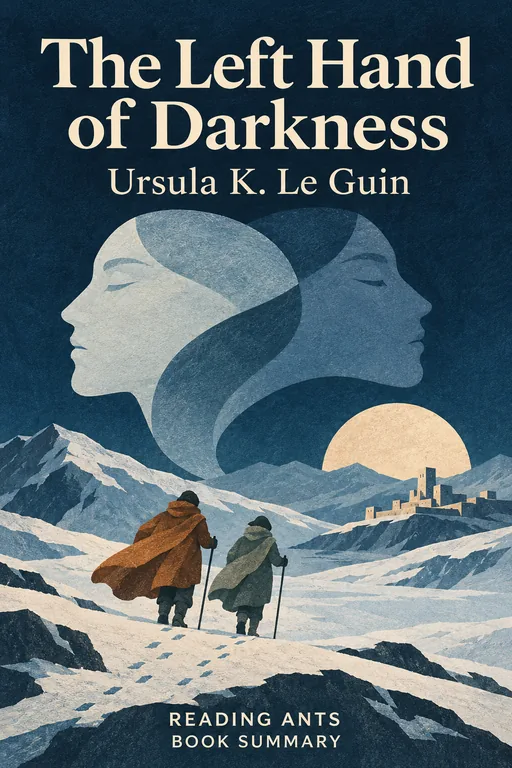
The Left Hand of Darkness
A lone envoy from a league of human worlds travels to the frozen planet Gethen, where people have no fixed gender, and learns to trust a local statesman, Estraven, who is exiled for his politics and who comes to the envoy's aid.
Overview
The Left Hand of Darkness is a science-fiction novel by Ursula K. Le Guin, published in 1969, and is one of the most celebrated books of its kind. It won both the Hugo and the Nebula awards for best novel. The story is set on a planet that its inhabitants call Gethen, and which the rest of the galaxy, because of its harsh climate, calls Winter. Its people are ambisexual: for most of the month they have no sex, and for a short period they become either male or female, depending on circumstances. Le Guin uses this invention to ask what a society would look like without the fixed roles that people take for granted. She has said that she was not predicting the future but using science fiction as a thought experiment. The book is as much about trust, loyalty and friendship as it is about gender.
Main Characters
- Genly Ai: an envoy from the Ekumen, a league of planets, who is sent alone to invite Gethen to join.
- Estraven: the prime minister of the nation of Karhide, who is later exiled and becomes Genly’s ally.
- King Argaven: the unstable ruler of Karhide.
- Tibe: a politician who becomes Estraven’s rival and takes power.
- The Orgota officials: leaders of the neighboring nation of Orgoreyn.
- The Foretellers: a group of mystics who predict the future.
Full Summary
The Envoy
Genly Ai arrives in Karhide, one of the two main nations on the planet, where he has been sent by the Ekumen as a single representative. The Ekumen usually sends one person to a new world, so that the first contact will be as peaceful as possible. Genly is treated with suspicion. The king, Argaven, is moody, and his court is full of rivalries. The prime minister, Estraven, is the only person who seems to take Genly’s message seriously, but Genly distrusts him, because of the secrecy and ambiguous behavior of the people around him. He finds it hard to read the Gethenians, who look and act differently from the men and women he knows.
Gethenian Life
Interspersed with the plot are chapters of stories and reports that describe Gethenian culture, including a creation myth, a legend about two brothers and a tale of a village’s decision. One report explains that the people of Gethen are neither male nor female for most of the month, and that during a brief period called kemmer, each person takes on one sex or the other. Everyone can become either a mother or a father in different periods. Genly, a man from a world of fixed sexes, struggles to see them as people rather than as men or women. Their society has no history of organized war, though nationalism threatens that, and has little concept of a gender hierarchy, but it has other rivalries, including a delicate sense of honor called shifgrethor.
Exile
Estraven is accused of treason and exiled, after the king comes to see his handling of a border dispute with Orgoreyn as disloyal. The rival Tibe gains the king’s favor. Genly, believing that he cannot make progress in Karhide, leaves for the neighboring country, Orgoreyn, where he is greeted warmly and given a comfortable welcome. He is introduced to officials who seem more open to the idea of joining the Ekumen, and who are more willing to talk.
Orgoreyn
Genly soon discovers that Orgoreyn is a highly bureaucratic state, run by commissions, and its welcome is not what it seems. The officials are not interested in the Ekumen so much as in using him, and a dangerous political shift leaves him vulnerable. He is arrested and sent to a labor camp, where prisoners are held in hard conditions and drugged. He becomes sick and weak, and he believes he will die there. He remembers that Estraven, whom he mistrusted, was the only person who told him the truth.
The Rescue
Estraven, who is in Orgoreyn after his own exile, learns where Genly is held and arranges his rescue, taking a great risk. He frees Genly from the camp and takes him across the border. The two decide that the only way to return to Karhide safely, and to bring the message of the Ekumen to the king, is to travel by foot across a vast ice sheet, the Gobrin Ice, in the middle of winter. It is a journey of great danger.
The Ice
For weeks the two men haul a sledge across the frozen waste, through storms, in blinding cold. In close company, the barrier between them breaks down; Genly teaches Estraven mindspeech, and Estraven hears Genly’s voice in his mind take on the voice of his dead brother. Genly, who has trouble thinking of Estraven as a person rather than as a strange being, comes to know him as a friend. They talk about their different worlds, and Estraven describes his own loss. Genly feels a deep bond with Estraven, and they begin to understand one another in ways that words cannot express. This section is the emotional center of the book.
The End of the Journey
They reach Karhide, but Estraven, betrayed, is shot while trying to cross the frontier toward Orgoreyn, and dies. Genly, devastated, is able to contact the Ekumen, and the ship that has been waiting in orbit lands. Karhide, shaken by Estraven’s death and by the evidence of the ship, agrees to join the Ekumen. Genly then visits Estraven’s family to tell them what happened, and in doing so, he finally accepts the people of Gethen as they are. The book closes with an act of kindness, and Genly’s understanding.
Why It Matters
The Left Hand of Darkness is a landmark of science fiction, and it helped to show that the genre could ask serious questions about society, politics and identity. It is among the first widely read novels to imagine a world without fixed gender roles, and it has influenced writers and readers for decades. It is frequently taught in schools and universities, and it appears on lists of the best science-fiction novels.
Its value lies partly in how it reverses our assumptions. By asking a reader to see through the eyes of an outsider who cannot immediately place the people he meets, the book invites us to notice how much our own expectations shape what we see. It also holds up as a story of friendship and courage.
Key Takeaways
- Our assumptions about gender shape how we see people. Genly sees the Gethenians through the lens of his own world and must unlearn his habits.
- Trust takes time and shared hardship. Genly and Estraven become friends only after they face danger together.
- Loyalty can look like betrayal from the outside. Genly misreads Estraven for much of the story and learns that his suspicion was wrong.
- Bureaucracy and nationalism can be dangerous. Both Karhide and Orgoreyn use fear, pride and secrecy for power.
- Understanding another person requires seeing them as an individual. The book’s emotional heart is the friendship that ignores differences.
What We Can Learn
The novel invites us to question assumptions that we may not know we have. Genly’s struggle to see the people of Gethen clearly is a reminder that we often fit others into categories, and that real understanding begins with setting those categories aside.
It also shows that friendship across difference needs patience and risk. Genly and Estraven grow close not through speeches but through shared work and honesty, a pattern that holds in everyday life.
The story also warns about political systems that rely on secrecy and fear. The two nations take different forms, but both put the interests of the state above individuals, and the book suggests that this is a danger wherever it appears.
Criticism and Counterpoints
Some readers find the pace slow, particularly in the sections that describe politics and culture, and they feel that the plot is interrupted by background material. Critics have also pointed out that, although the Gethenians are described as having no fixed gender, the book often refers to them as “he,” which can seem to make them male. Le Guin herself later said that she regretted that choice and discussed it in essays.
Others say the story presents a limited view of sexuality, since it does not explore same-sex relationships directly. A few readers consider the political plot thin compared with the ideas. Still, the novel is widely admired for its writing, its imagination and its humane spirit.
Who Should Read It
This book is suitable for teenagers and adults who enjoy thoughtful science fiction and character-driven stories. It is a good choice for readers interested in questions of gender, politics and friendship, and for anyone who wants to read one of the most important novels of its genre. It requires some patience, but it rewards it.
Want the whole book?
A summary is a taste, not the meal. Here is where to find the full book.
You reached the end 🎉
Nicely done. Mark this one as read, and we will suggest what to read next.
Read this next
A Wizard of Earthsea
Ursula K. Le Guin
A proud, gifted boy named Ged becomes a powerful wizard, but his arrogance releases a dark shadow that he can defeat only by facing it.
🚀 Sci-Fi & Fantasy
2001: A Space Odyssey
Arthur C. Clarke
A mysterious black slab guides human evolution from ape-like ancestors, and millions of years later a spaceship crew travels toward Saturn to follow its trail, with a computer named HAL as their companion and, eventually, their greatest danger.
🚀 Sci-Fi & Fantasy
The Martian Chronicles
Ray Bradbury
Through a series of linked stories, Ray Bradbury follows human beings as they travel to Mars, destroy the people who live there, build towns that copy the Earth they left behind, and are then pulled back home when a nuclear war breaks out.
🚀 Sci-Fi & Fantasy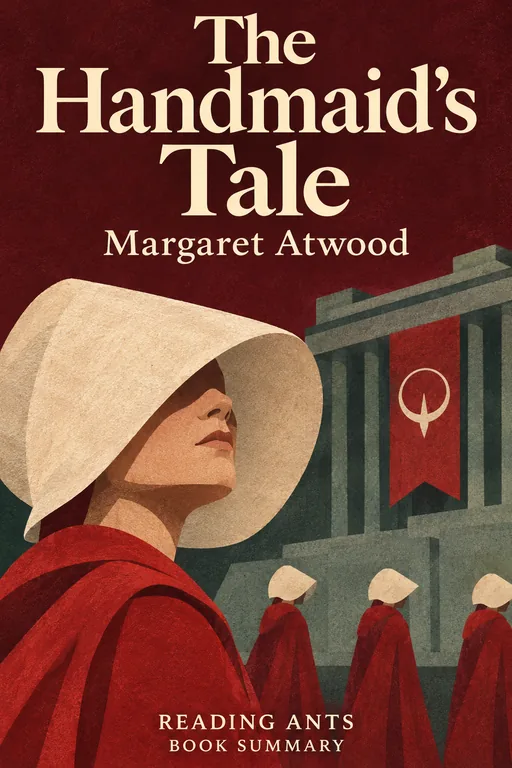
The Handmaid's Tale
Margaret Atwood
In a near-future United States taken over by a religious dictatorship that strips women of their rights, a woman forced to bear children for a powerful couple secretly remembers her old life and searches for a way to survive.
✨ Modern Fiction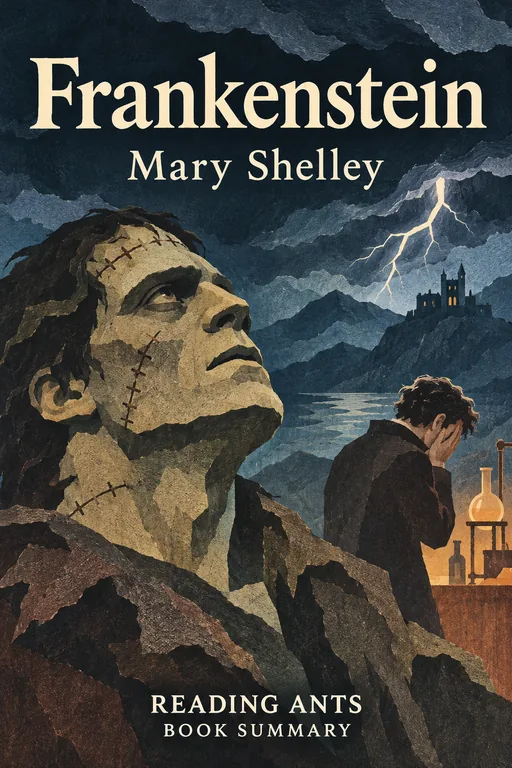
Frankenstein
Mary Shelley
A young scientist creates a living being from dead body parts, then abandons it in horror, and his rejected creation, longing for love, turns to revenge.
🚀 Sci-Fi & Fantasy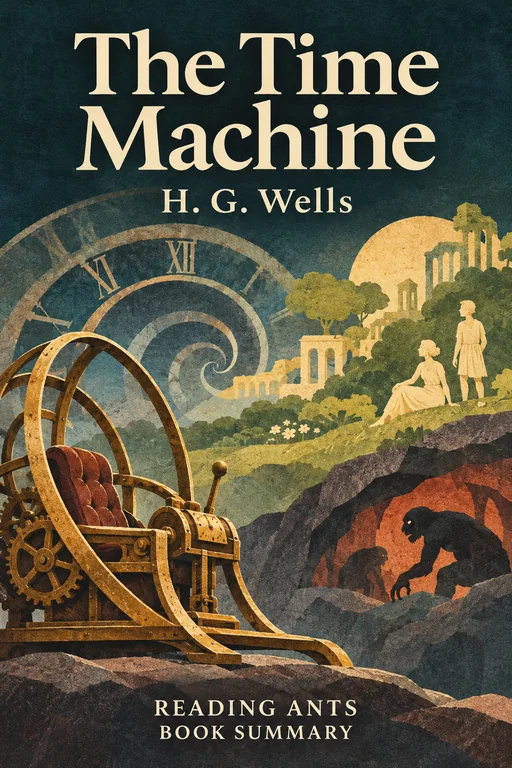
The Time Machine
H. G. Wells
A Victorian inventor, known only as the Time Traveller, builds a machine that carries him to the year 802,701, where he finds humanity split into two species, the gentle Eloi and the monstrous Morlocks, and then to a dying Earth.
🚀 Sci-Fi & FantasyWant something different?
Pick another topic and we will show you three books to start with.