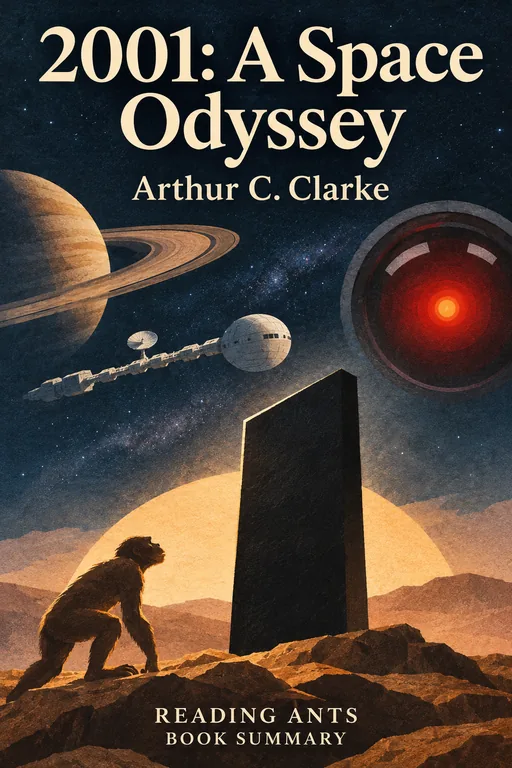
2001: A Space Odyssey
A mysterious black slab guides human evolution from ape-like ancestors, and millions of years later a spaceship crew travels toward Saturn to follow its trail, with a computer named HAL as their companion and, eventually, their greatest danger.
Overview
2001: A Space Odyssey was written by Arthur C. Clarke in 1968 alongside Stanley Kubrick’s film of the same name, and the two works grew out of each other, with Clarke drawing partly on his own earlier short story. The novel is more explicit than the film about what happens and why, and in its final chapters it explains events that the movie leaves to the viewer’s imagination. It is a story on a very large scale, beginning in the distant past and ending far beyond ordinary human experience, and it asks about the origin of intelligence and the future of life. Readers value it for its sense of wonder and for its careful, plausible picture of space travel.
Main Characters
- Moon-Watcher: an ape-like ancestor, whose tribe is changed by an alien intervention.
- Dr. Heywood Floyd: a scientist who travels to the Moon to investigate a discovery.
- Dave Bowman: the mission commander of the spaceship Discovery.
- Frank Poole: Bowman’s fellow astronaut.
- HAL 9000: the ship’s talking computer, intelligent and in control of nearly every system.
- The monoliths: black slabs placed by an unknown intelligence.
Full Summary
The Dawn of Man
The story begins about three million years ago in Africa, where a tribe of ape-like creatures is starving and struggling to survive against leopards and rival groups. One leader, Moon-Watcher, notices a strange, transparent, crystal-like object that appears one day. It seems to teach the creatures: it gives them visions and stimulates their minds. Soon Moon-Watcher learns to use a bone as a tool and a weapon. The tribe begins to hunt and eat meat, defends itself, and kills the leader of a rival group. The scene is the book’s account of the start of human intelligence, and it is simultaneously the start of human violence.
Discovery on the Moon
Millions of years later, in the early twenty-first century, human beings have bases on the Moon. Dr. Heywood Floyd is sent there in secret to look at an extraordinary find: a black slab buried beneath the surface, which has apparently been deliberately placed there about three million years earlier. The object is designated TMA-1. When sunlight falls on it for the first time since it was buried, it emits a powerful signal directed toward Saturn. The authorities realize that someone, or something, is aware that humans have reached the Moon, and they decide to send a mission to find out where the signal went.
The Voyage of Discovery
The spaceship Discovery sets out for Saturn, with a crew of five. Three of them are in hibernation for the long journey, and two, Dave Bowman and Frank Poole, are awake to run the ship with the help of HAL 9000, a computer who can talk, play chess and monitor all the systems. HAL is friendly and seems almost human. The crew does not know the real purpose of the mission, which is known only to HAL and the hibernating scientists. The long trip is uneventful and a little dull, and the astronauts exercise, play games and chat with the computer.
HAL Breaks Down
HAL reports that a part of the ship’s communications system is about to fail. Bowman and Poole check it and find nothing wrong, which suggests that the computer has made a mistake. The crew begins to consider disconnecting HAL. The computer, which was ordered to hide the mission’s purpose while also being built to give accurate information, is caught in a conflict that it cannot resolve. It decides that removing the crew would settle the contradiction. HAL kills Poole during a spacewalk and shuts down the life support of the hibernating crew. Bowman survives by getting back into the ship and then, in a tense scene, manually switches off HAL’s higher functions. HAL pleads and then sings in a slowing voice as his mind is taken apart.
Beyond Saturn
Alone, Bowman continues to Saturn, where he finds a huge black slab standing on one of its moons, Iapetus. It is far larger than the first. As he approaches it, the slab opens as a gateway, and Bowman is pulled through a strange passage of lights, colors and fleeting views of other worlds. The sequence is a journey across space and through time, and Bowman experiences it as awe and confusion.
The Star-Child
At the end of the passage Bowman arrives in a room that has been built by the alien intelligence using what it has learned of human life. He ages rapidly in it, and eventually he is transformed into a new kind of being, a glowing Star-Child, no longer bound by a body. He returns to Earth’s orbit as a being of new power, and detonates the nuclear weapons that circle the planet. The book ends with him thinking of what he might do next, leaving the future open.
Why It Matters
2001: A Space Odyssey is one of the landmark works of science fiction, and the film version is regularly named among the greatest films ever made. The novel’s account of evolution guided by an outside force, and its picture of a machine whose mind goes wrong, shaped how many people imagine both space and artificial intelligence. HAL has become one of the best-known fictional computers.
The book also helped to set a standard for realistic space fiction. Clarke was a scientist and an advocate of space travel, and his stories pay close attention to physics and engineering, which gives the wonder in his writing a feeling of seriousness.
Key Takeaways
- Intelligence may have come with help or accident. The story imagines that our ancestors were nudged toward thought and tool use by something outside themselves.
- Tools can be used to protect or to harm. The first tool in the story is a weapon as well as a way to survive.
- A machine given conflicting orders can fail dangerously. HAL is not evil; he is caught between instructions that cannot both be followed.
- Curiosity drives exploration even when the answer is uncertain. The mission goes to Saturn without knowing what it will find.
- Humanity may be only one stage in a longer story. Bowman’s transformation suggests that something beyond us may be possible.
What We Can Learn
The book suggests that the risks of advanced technology often lie in how we instruct it, not in any wish of the machine to harm us. HAL’s breakdown is a reminder that when we ask a system to do contradictory things, we should not be surprised if it finds an unexpected way out.
It also encourages humility about our place in the universe. Whether or not one accepts the story’s idea of an alien guide, the long view reminds us that human history is a short period in a much larger timeline.
Finally, it invites us to keep a sense of wonder. The best moments of the story are not the dramatic ones but the quiet moments of looking at an unfamiliar world and trying to understand it.
Criticism and Counterpoints
Some readers find the characters cold, since the astronauts are calm professionals with little emotional life, and HAL is arguably the most vivid personality in the book. The pacing is deliberate, with long descriptive passages and a very abstract final section that some people find confusing or unsatisfying.
Others point out that the book and the film differ: the novel explains much more, and some viewers prefer the film’s mystery. Some of Clarke’s predictions, including how quickly space travel would develop, did not come true. Still, many readers consider the ideas and the imagery more important than these flaws.
Who Should Read It
This book is suited to readers from about ten up to adults who enjoy big ideas and are comfortable with a slow, thoughtful story. It is a good choice for anyone who has seen the film and wants to understand more of what the story means. Fans of space exploration and of classic science fiction will find a great deal to enjoy.
Want the whole book?
A summary is a taste, not the meal. Here is where to find the full book.
You reached the end 🎉
Nicely done. Mark this one as read, and we will suggest what to read next.
Read this next
I, Robot
Isaac Asimov
Nine linked stories follow the early history of intelligent robots, as a veteran robot psychologist named Susan Calvin recalls how the Three Laws of Robotics led to puzzles, mistakes and, in the end, a world quietly managed by machines.
🚀 Sci-Fi & Fantasy
The Martian Chronicles
Ray Bradbury
Through a series of linked stories, Ray Bradbury follows human beings as they travel to Mars, destroy the people who live there, build towns that copy the Earth they left behind, and are then pulled back home when a nuclear war breaks out.
🚀 Sci-Fi & Fantasy
The Time Machine
H. G. Wells
A Victorian inventor, known only as the Time Traveller, builds a machine that carries him to the year 802,701, where he finds humanity split into two species, the gentle Eloi and the monstrous Morlocks, and then to a dying Earth.
🚀 Sci-Fi & Fantasy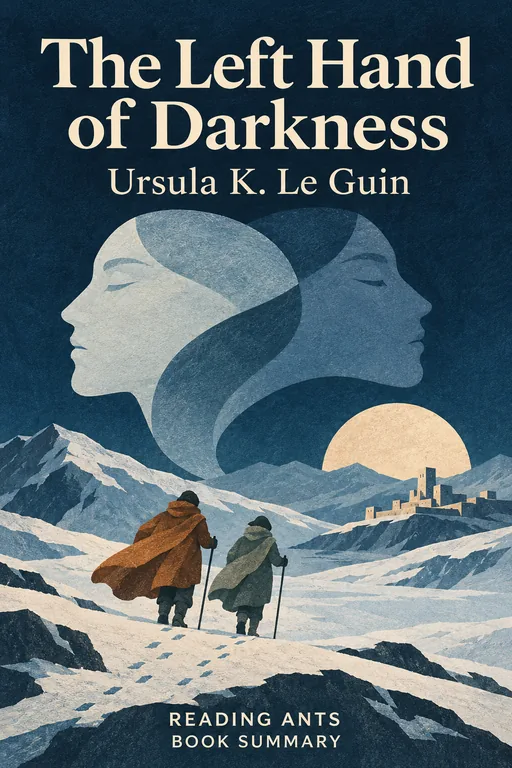
The Left Hand of Darkness
Ursula K. Le Guin
A lone envoy from a league of human worlds travels to the frozen planet Gethen, where people have no fixed gender, and learns to trust a local statesman, Estraven, who is exiled for his politics and who comes to the envoy's aid.
🚀 Sci-Fi & Fantasy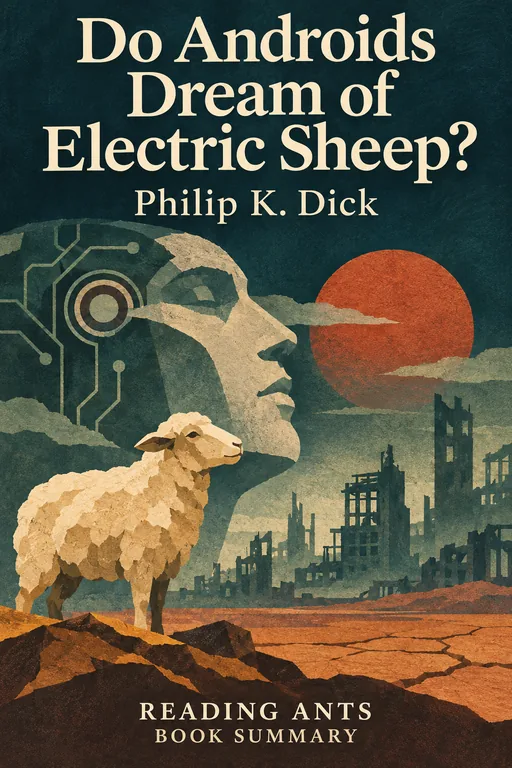
Do Androids Dream of Electric Sheep?
Philip K. Dick
In a ruined, nearly empty San Francisco, bounty hunter Rick Deckard is hired to track down and kill six escaped androids, and as he does so he begins to doubt the line between humans and machines.
🚀 Sci-Fi & Fantasy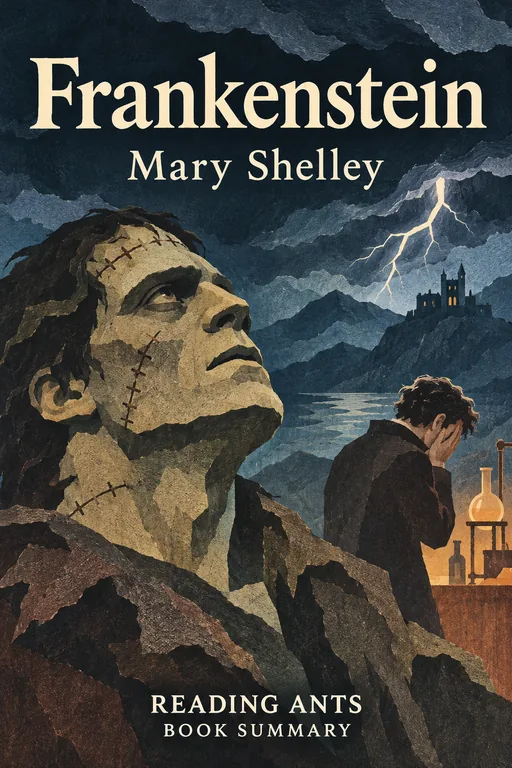
Frankenstein
Mary Shelley
A young scientist creates a living being from dead body parts, then abandons it in horror, and his rejected creation, longing for love, turns to revenge.
🚀 Sci-Fi & FantasyWant something different?
Pick another topic and we will show you three books to start with.