 Reading Ants
Do Androids Dream of Electric Sheep?
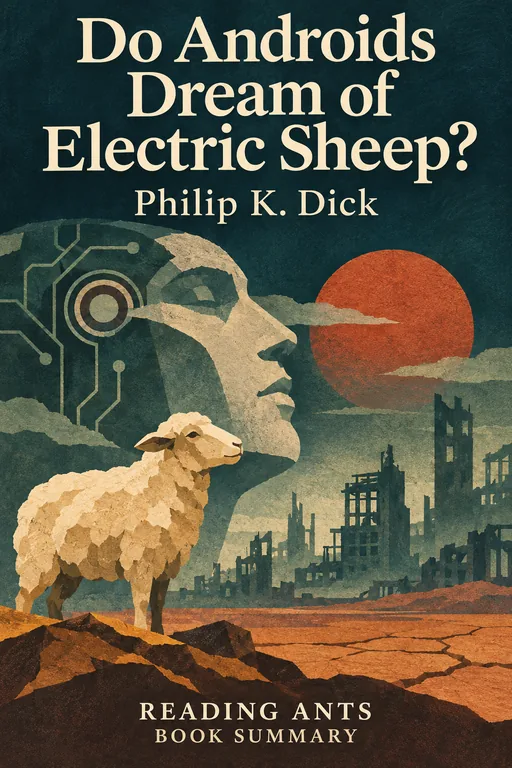
In a ruined, nearly empty San Francisco, bounty hunter Rick Deckard is hired to track down and kill six escaped androids, and as he does so he begins to doubt the line between humans and machines.
Overview
Do Androids Dream of Electric Sheep? is a science-fiction novel by Philip K. Dick, published in 1968. It is set in the aftermath of a nuclear war, which has killed many animals and driven many people off Earth to colonies on Mars. Those who remain prize real animals as status symbols, and those who cannot afford them keep lifelike electric copies. The book is the source for Ridley Scott’s 1982 film Blade Runner, though the novel differs from the film in many ways and has a stranger, more philosophical focus. Its main question is what makes someone truly human: intelligence, feeling, or the ability to care for others.
Main Characters
- Rick Deckard: a bounty hunter for the San Francisco police, who is tired of his work and ashamed of the electric sheep he owns.
- Iran Deckard: his unhappy wife, who dials moods on a device.
- John Isidore: a lonely, slow-witted man who lives in an abandoned building and befriends fugitive androids.
- Rachael Rosen: an android who works for the company that makes them, and who is more complicated than she seems.
- Roy and Irmgard Baty, and Pris Stratton: escaped androids.
- Phil Resch: another bounty hunter, whose coldness troubles Deckard.
- Wilbur Mercer: the figure at the center of a religion called Mercerism.
Full Summary
A Dead World
The story is set in the 1990s in a version of the future that Dick imagined, in which dust from a global war has poisoned the planet. Many species of animals have died out, and owning a live animal is a sign of wealth and compassion. Rick Deckard, who works for the police, owns only an electric sheep, which he tends as if it were real so that his neighbors will not guess the truth. He dreams of buying a real animal with the money he can earn from his work. The book opens with this ordinary, slightly sad domestic scene, which sets out one of its themes: in a world with little life, fake things are treated as if they matter.
The Assignment
Deckard’s supervisor tells him that a group of advanced androids of the Nexus-6 type has escaped from Mars and come to Earth. Another hunter has been badly injured trying to stop them, and Deckard must take over the job. He is paid a reward for each android he retires, and he hopes it will be enough to buy a real animal. To identify them he uses an empathy test, called the Voigt-Kampff test, which measures a subject’s emotional responses to disturbing questions. The idea is that androids do not feel empathy, even though they can imitate everything else about human behavior.
Rachael
To make sure the test works, Deckard visits the company that makes the androids and meets Rachael Rosen, a young woman who seems human. The test takes longer than expected, and he concludes that she is an android, a claim her employer at first denies, and she later admits it. Later she proves herself both manipulative and surprisingly vulnerable. Deckard finds himself attracted to her even though he knows what she is, and his feelings begin to disturb his belief that androids are just machines to be turned off.
The Hunt
Deckard tracks down the escaped androids one by one. In one encounter he works with another bounty hunter, Phil Resch, whose cool manner leaves Deckard wondering whether Resch is an android himself. The test shows that Resch is human, but the hunter’s lack of feeling for the androids he kills is its own kind of warning. Deckard finds that he feels some sympathy for a few of the androids, including an opera singer whom he admires and whom Resch kills. Each killing leaves him less sure of his job.
Isidore and the Fugitives
Meanwhile, the remaining androids hide in an abandoned apartment building where John Isidore, a man whom society has labeled a “special,” lives alone. Isidore, rejected by others, is happy to have company, and he befriends them without realizing what they are. When he finds a spider, the androids pull its legs off one by one to see how it behaves, a cruel scene that shows how little they understand the value of life, or at least how differently they view it. Isidore is appalled and shaken.
The Last Fight
Deckard finds the final androids in Isidore’s building and kills them. Rachael, who has by this point slept with Deckard, takes revenge for her friends in a cruel way, by killing his goat, which he had just bought. Deckard goes alone to a desolate landscape in the north and has a spiritual experience that resembles the one Mercerism offers followers. He finds a small toad, which he believes is real until his wife discovers that it is electric. He accepts it anyway, as part of a world where the fake and the real are not easy to tell apart.
Why It Matters
Do Androids Dream of Electric Sheep? is one of the most influential science-fiction novels of its era, and through Blade Runner it shaped the look and feel of many later stories about artificial beings. Dick was interested less in technology than in the human questions that technology raises, and this book helped to establish the idea that empathy is the quality that defines us.
The novel also remains topical, because it asks what we will owe to machines that seem to think and feel. As artificial intelligence improves, readers still turn to the book to think about how to tell a person from a very good imitation, and what it might mean if the difference stops being clear.
Key Takeaways
- Empathy may be what makes us human. The test in the story measures feeling, and the humans who lose it seem almost like machines.
- Fakes can come to matter as much as originals. Deckard grows attached to the electric animals and accepts a false toad at the end.
- Cruelty is a human failing as well as a machine one. The androids’ cruelty to the spider is mirrored by the casual violence of the hunters.
- Shared suffering can create community. Mercerism offers lonely people a way to feel connected through pain.
- Identity is not simple. Rachael and several other characters force Deckard to question what he thinks he knows.
What We Can Learn
The novel encourages us to consider how we treat beings who seem different from ourselves, whether they are animals, strangers or machines. If a person’s job depends on seeing someone as not quite real, that belief deserves to be examined.
It also reminds us how much people value connection. The characters in the book are lonely, and they try to fill the gap with pets, mood-changing devices and shared religion. The story suggests that real attention to other people is more fulfilling than such substitutes.
Lastly, it invites us to be wary of certainty. Deckard begins with a confident method for sorting the human from the artificial, and the story gradually shows how that confidence can fail.
Criticism and Counterpoints
Some readers find the book confusing, since it moves between several story threads and includes a strange religion that is never fully explained. Others say that the female characters are poorly developed, and that Rachael is used mainly to affect Deckard’s feelings. The setting, with its long passages of philosophical conversation, may feel slow to readers who expect a fast detective story.
Fans of the film sometimes find the novel quite different, with fewer scenes of action and more reflection. The ending also divides readers, who may see it as moving, uncertain or flat. Still, the book is widely praised for the questions it raises.
Who Should Read It
This book is for teenagers and adults who enjoy thoughtful science fiction. It contains some violence and a few mature themes, and it deals with big questions about identity, so it is best read by those who like to think about what they have read. It is a strong choice for fans of Blade Runner and anyone curious about the roots of modern stories about artificial intelligence.
Want the whole book?
A summary is a taste, not the meal. Here is where to find the full book.
You reached the end 🎉
Nicely done. Mark this one as read, and we will suggest what to read next.
Read this next
I, Robot
Isaac Asimov
Nine linked stories follow the early history of intelligent robots, as a veteran robot psychologist named Susan Calvin recalls how the Three Laws of Robotics led to puzzles, mistakes and, in the end, a world quietly managed by machines.
🚀 Sci-Fi & Fantasy
2001: A Space Odyssey
Arthur C. Clarke
A mysterious black slab guides human evolution from ape-like ancestors, and millions of years later a spaceship crew travels toward Saturn to follow its trail, with a computer named HAL as their companion and, eventually, their greatest danger.
🚀 Sci-Fi & Fantasy
Brave New World
Aldous Huxley
In a future world where people are made in factories, programmed for their roles and kept happy with drugs and entertainment, a man raised outside the system discovers that this perfect comfort comes at the cost of everything that makes us human.
📜 Classics
Frankenstein
Mary Shelley
A young scientist creates a living being from dead body parts, then abandons it in horror, and his rejected creation, longing for love, turns to revenge.
🚀 Sci-Fi & Fantasy
Neuromancer
William Gibson
A washed-up computer thief named Case is hired for one last job that pulls him into a hidden contest between two artificial minds.
🚀 Sci-Fi & Fantasy
The Time Machine
H. G. Wells
A Victorian inventor, known only as the Time Traveller, builds a machine that carries him to the year 802,701, where he finds humanity split into two species, the gentle Eloi and the monstrous Morlocks, and then to a dying Earth.
🚀 Sci-Fi & FantasyWant something different?
Pick another topic and we will show you three books to start with.