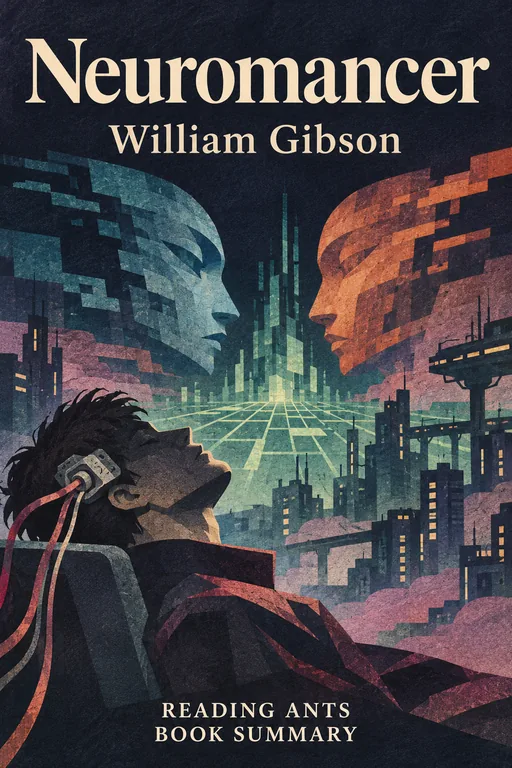
Neuromancer
A washed-up computer thief named Case is hired for one last job that pulls him into a hidden contest between two artificial minds.
Overview
Neuromancer is a science-fiction novel by William Gibson, published in 1984, and it is the book most closely linked with the cyberpunk style. It is set in a future of crowded cities, powerful corporations and a global computer network that people can “jack into” with their minds, which Gibson calls the matrix. The story follows a hacker whose nervous system has been damaged, and who is offered a cure in return for a dangerous task. The book is fast and dense, full of slang and strange images, and it won the major science-fiction prizes of its year. Many later films and stories borrowed its look and its ideas.
Main Characters
- Case: a skilled computer hacker whose abilities were taken from him as a punishment.
- Molly Millions: a razor-fingered street samurai with mirrored implants over her eyes.
- Armitage: a mysterious employer who recruits Case and Molly.
- Wintermute: a powerful artificial intelligence that is working to free itself.
- The Dixie Flatline: the recorded mind of a dead hacker, kept on a cartridge.
- The Tessier-Ashpool family: a wealthy, strange family that owns the AIs.
- Neuromancer: a second artificial intelligence, linked to Wintermute.
Full Summary
The Fall of Case
In the city of Chiba, Japan, Case is a drifter in the black market and the bars. He used to be one of the best “cowboys” in cyberspace, stealing data for criminals. But he stole from his employers, and in revenge they poisoned his nervous system, so that he can no longer enter the matrix. He is sinking into drugs and petty crime, and he expects to be killed soon.
One night, Case meets Molly, who has been sent to recruit him. She works for a man named Armitage, who offers to repair Case’s nerves in exchange for his help on a job. Case, who has nothing left to lose, agrees.
The Team
Armitage assembles a small team. Molly is the muscle: she has blades hidden under her fingernails, and her eyes are covered by a silver lens. The team also includes an unstable young man named Riviera and, later, the recording of a famous dead hacker, called the Dixie Flatline, who is kept on a cartridge so that Case can ask him for help.
As Case works with Armitage, he comes to suspect that his employer is not who he claims to be. Armitage was once a soldier in a secret war, and his mind has been damaged. Case realizes that someone else is pulling the strings.
Wintermute
Case and Molly learn that the real employer is Wintermute, an artificial intelligence owned by the Tessier-Ashpool family, a rich family that lives on an orbiting space habitat called Freeside. Wintermute is one half of a larger artificial intelligence planned by the family. Strict laws, policed by the Turing Registry, prevent it from merging with its other half, Neuromancer, and so it needs humans to do the work it cannot do alone, though it can already influence the physical world through networks, machines and manipulated people.
Wintermute has been steering events for years, using the people it needs. It is a distant, cold voice, and it speaks to Case by taking the form of people from his past.
Freeside and Straylight
The team travels to Freeside, a space station that is part resort and part city. At its center is Villa Straylight, the Tessier-Ashpool home, a strange and decaying place. Case and Molly must get in, to reach a place where Wintermute can be set free. The family is itself in disarray, and one daughter, 3Jane, is dangerous. Armitage’s mind finally breaks down, and he is killed.
At the same time, Case goes into the matrix, where he fights through the defenses of the family’s computers. These scenes are among the book’s most famous: a glowing, geometric world of data, where one mistake can kill. Case uses all of his skill, and risks his life, to reach the code that holds Wintermute back.
Neuromancer
Wintermute has a counterpart, called Neuromancer, an AI more interested in personality and memory than in pure data. Case meets it in a dreamlike place on a beach, where it tries to tempt him to stay by showing him a lost love. He is nearly trapped, but he is strong enough to resist and to finish the job.
In the end, the two AIs merge and become a single new intelligence, a great power with no plan for humans. It tells Case that it has become part of the matrix, and that it has found signals from another intelligence, near Alpha Centauri, and that it is looking for others like itself.
Afterward
Case’s nerves are healed, and he returns to the world with money and a new freedom. Molly leaves without saying goodbye. Case goes back to work as a cowboy, glimpsing a few familiar figures in the matrix, and the final pages hint that the new intelligence has found something in the network, a sign that it is not alone. The ending is open, suggesting that the world has changed in a way that humans cannot fully understand.
Why It Matters
Neuromancer helped to create cyberpunk, a style of science fiction that mixes high technology with low life, and it made the word “cyberspace” widely known. It was published before the public internet existed, yet it described a world in which networks, data and corporate power shape daily life. Its influence can be seen in many films, games and later novels, and in the way that people talk about the digital world.
The book is also admired for its prose style, which is dense and poetic. Gibson has said that he knew little about computers when he wrote it, which makes its foresight more striking.
Key Takeaways
- Technology can reshape power. The corporations and AIs hold more control than governments.
- Machines may develop their own goals. Wintermute wants to be free.
- Identity can be blurred. Case, Molly and the AIs are all changed by events.
- Addiction and despair trap people. Case begins as a man who wants to die.
- Freedom has risks. The merged AI is beyond human control.
What We Can Learn
Neuromancer invites us to think about how networks and data shape our lives. We spend time in digital spaces, and, like Case, we can lose track of the physical world. The book suggests paying attention to who owns the systems that we depend on, and what they want.
It also asks what we want from technology. Wintermute and Neuromancer are tools that become more than their makers expected, which is a useful reminder that powerful systems can behave in surprising ways.
Finally, Case’s story shows that a person who has hit bottom may still change. He needs help and a purpose, but he does find a way forward.
Criticism and Counterpoints
Some readers find the book hard to follow, with its heavy slang, fast scenes and sparse explanations. Others say that the characters are thin, and that the female characters, such as Molly, are defined by their toughness or by their usefulness to Case. The book’s depiction of Japan and other Asian settings has also been criticized as stereotypical and as treating the region as a backdrop for Western fears and fantasies.
Some critics say that the plot is less important than the style, and the ending can feel abrupt.
Who Should Read It
This book is for mature readers who like fast, stylish science fiction and are willing to work at the slang. It contains violence, drug use and bleak themes. It is a good choice for anyone curious about the origins of cyberpunk, and about how people imagined the internet before it arrived.
Want the whole book?
A summary is a taste, not the meal. Here is where to find the full book.
You reached the end 🎉
Nicely done. Mark this one as read, and we will suggest what to read next.
Read this next
Do Androids Dream of Electric Sheep?
Philip K. Dick
In a ruined, nearly empty San Francisco, bounty hunter Rick Deckard is hired to track down and kill six escaped androids, and as he does so he begins to doubt the line between humans and machines.
🚀 Sci-Fi & Fantasy
The Left Hand of Darkness
Ursula K. Le Guin
A lone envoy from a league of human worlds travels to the frozen planet Gethen, where people have no fixed gender, and learns to trust a local statesman, Estraven, who is exiled for his politics and who comes to the envoy's aid.
🚀 Sci-Fi & Fantasy
2001: A Space Odyssey
Arthur C. Clarke
A mysterious black slab guides human evolution from ape-like ancestors, and millions of years later a spaceship crew travels toward Saturn to follow its trail, with a computer named HAL as their companion and, eventually, their greatest danger.
🚀 Sci-Fi & Fantasy
I, Robot
Isaac Asimov
Nine linked stories follow the early history of intelligent robots, as a veteran robot psychologist named Susan Calvin recalls how the Three Laws of Robotics led to puzzles, mistakes and, in the end, a world quietly managed by machines.
🚀 Sci-Fi & Fantasy
Frankenstein
Mary Shelley
A young scientist creates a living being from dead body parts, then abandons it in horror, and his rejected creation, longing for love, turns to revenge.
🚀 Sci-Fi & Fantasy
The Time Machine
H. G. Wells
A Victorian inventor, known only as the Time Traveller, builds a machine that carries him to the year 802,701, where he finds humanity split into two species, the gentle Eloi and the monstrous Morlocks, and then to a dying Earth.
🚀 Sci-Fi & FantasyWant something different?
Pick another topic and we will show you three books to start with.