 Reading Ants
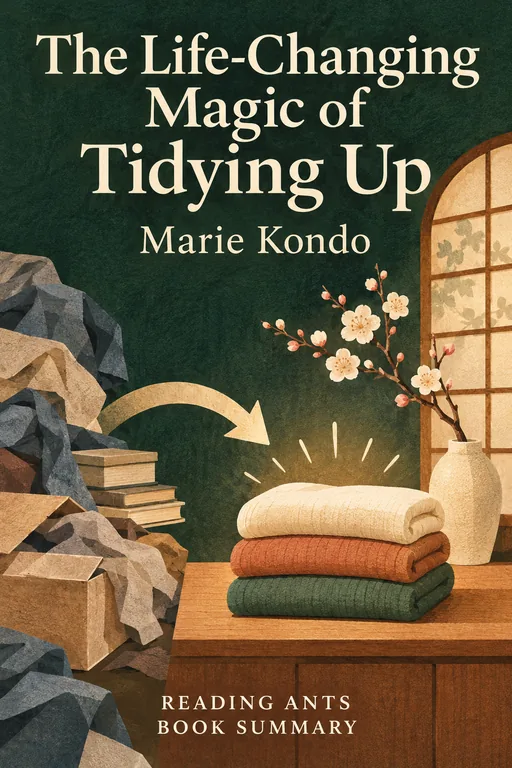
The Life-Changing Magic of Tidying Up
Original title: 人生がときめく片づけの魔法
Marie Kondo teaches that tidying once, by category and by keeping only what sparks joy, can transform both your home and your outlook on life.
Overview
The Life-Changing Magic of Tidying Up: The Japanese Art of Decluttering and Organizing was written by Marie Kondo, a Japanese organizing consultant, and first published in Japan in 2010. The English translation appeared in 2014 and became a global phenomenon, followed by a Netflix series in 2019. Kondo says she has been fascinated by tidying since she was a child, and that she developed the KonMari Method through years of experimentation and work with clients. Her method differs from standard advice, which often recommends tidying a little each day, one room at a time. She argues for a single, concentrated effort, which she says prevents rebound clutter.
Full Summary
1. Why tidying never lasts and the right mindset
The idea: Kondo begins by saying that most people fail to stay tidy because they approach it the wrong way, tidying a bit at a time without addressing their relationship with their possessions. She argues that you should make a firm decision to tidy completely, and do it all at once, as one concentrated project rather than a little at a time (a project that can still take months), which she calls a “tidying festival.” If you finish properly, she says, you will not rebound. She emphasizes visualizing the kind of life you want, and the reason for tidying, before you begin.
In real life: Picturing a calm, comfortable room you want to live in gives a goal that makes the work feel worthwhile.
2. Discard first, and choose what sparks joy
The idea: The next step is to discard before organizing. To decide what to keep, Kondo advises picking up each item and asking whether it sparks joy. If it does, keep it; if not, thank it for its service and let it go. She stresses focusing on what you want to keep, instead of what to throw away, which changes the experience from loss to choosing. She recommends not asking whether the item might be useful someday, which often leads to hoarding.
In real life: Holding a shirt and noticing whether you feel happy or neutral about it makes decisions clearer than debating whether it still fits.
3. Tidy by category, not by location
The idea: Kondo recommends tidying by category instead of by room, because the same kind of item is often scattered around the house. She gives an order: clothes, then books, papers, komono (miscellaneous items, such as kitchen goods and tools) and finally sentimental items. The order moves from easier to harder decisions, building your ability to judge what sparks joy. For each category, she suggests gathering everything in one place, so you can see the true quantity.
In real life: Putting all your clothes on the bed at once shows how many you really own and makes it easier to choose.
4. How to store
The idea: After discarding, you decide where each item lives. Kondo gives practical tips: store items of the same kind together, avoid piling things up, store things upright instead of stacking, and fold clothes into small rectangles that stand on their edge in drawers, so you can see everything. She recommends using boxes already in the home as dividers, and keeping storage simple. She says that if you can’t see an item, you tend to forget it.
In real life: Folding a T-shirt into a neat rectangle and standing it in the drawer makes it easier to pick one out without disturbing the rest.
5. Respect for things and the home
The idea: One of the more distinctive parts of Kondo’s approach is her attitude of respect for belongings. She suggests greeting your house when you come home, thanking your shoes and bags for their work, and taking care of items, such as emptying your bag each day. She believes that treating things with gratitude changes how we live with them and ourselves. Some readers find this delightful and others find it eccentric.
In real life: Putting your keys in the same spot every day and thanking your belongings is a ritual of care that some people find calming.
6. A life changed
The idea: In the final chapters, Kondo shares stories of clients whose lives changed after tidying: they felt more confident, they made decisions about their jobs and relationships and they discovered what they truly valued. She says that tidying is a way of confronting the past and preparing for the future, as it makes us decide what is essential. She concludes that when your space is in order, your mind and life follow.
In real life: Clearing out old items can make room, literally and mentally, for new plans.
Why It Matters
Kondo’s book sold millions of copies worldwide and made “KonMari” a household word, and “spark joy” a common phrase. It helped spark a global interest in decluttering and minimalism, and led to many donations of unwanted items to charities. The Netflix series Tidying Up with Marie Kondo introduced the method to a new audience.
The book changed how many people think about possessions, shifting the focus from getting rid of things to choosing what to cherish. It also made tidying a topic of conversation and a way of thinking about personal values.
For many families, the biggest impact was practical: a simple sequence of steps, with a clear order, turned a vague wish to be more organized into a project that could actually be finished in a few weeks.
Key Takeaways
- Tidy once, completely. A single big effort prevents rebound.
- Keep what sparks joy. Choose what you love, not what to discard.
- Go by category. Gather all items of one type before deciding.
- Store simply. Keep like with like, and make things visible.
- Practice gratitude. Respect for belongings changes how we live with them.
What We Can Learn
The book teaches that our possessions affect our mood and time. By choosing to keep fewer, more meaningful things, we can reduce the stress of clutter and the time spent managing it.
It also invites us to notice how we feel about things. Paying attention to what brings joy can help us make choices about not only objects but also activities and commitments.
Finally, it encourages us to be thankful for what we have. A bit of gratitude can make everyday objects seem more valuable and discourage careless buying.
Criticism and Counterpoints
Some critics say that Kondo’s method is not practical for everyone, especially families with small children, shared spaces or limited resources, for whom “sparking joy” is not always a realistic test, since many necessary items are not joyful. Others note that it can lead to throwing away a great deal and to waste, and that its minimalism does not suit everyone.
Some readers objected to comments about books, and to the animistic tone, such as talking to objects. Others note that the tidiness of Japanese homes and cultural attitudes may not translate easily. Even so, many people report real benefits from the approach.
Who Should Read It
This book suits readers from about age ten up to adults. It is short and simple. It is useful for anyone who feels overwhelmed by clutter, especially before a move or a big cleaning.
Want the whole book?
A summary is a taste, not the meal. Here is where to find the full book.
You reached the end 🎉
Nicely done. Mark this one as read, and we will suggest what to read next.
Read this next

Walden
Henry David Thoreau
Henry David Thoreau describes the two years he spent living simply in a small cabin by Walden Pond in Massachusetts, and argues that people should simplify their lives, spend time in nature and think for themselves.
🕊️ Philosophy & Religion
The Miracle of Mindfulness
Thich Nhat Hanh
Thich Nhat Hanh shows, through simple practices like washing dishes, breathing and walking, how paying full attention to the present moment can bring calm, joy and a deeper connection to life.
🕊️ Philosophy & Religion
The Subtle Art of Not Giving a F*ck
Mark Manson
Mark Manson argues that a good life comes not from relentless positivity but from choosing what is worth caring about, accepting that problems and limits are unavoidable, and taking responsibility for your own choices.
🌱 Self-Improvement
Ikigai: The Japanese Secret to a Long and Happy Life
Hector Garcia and Francesc Miralles
Hector Garcia and Francesc Miralles explore the Japanese idea of ikigai, a reason for getting up in the morning, and share habits from long-lived people in Okinawa that can bring purpose and happiness.
🌱 Self-Improvement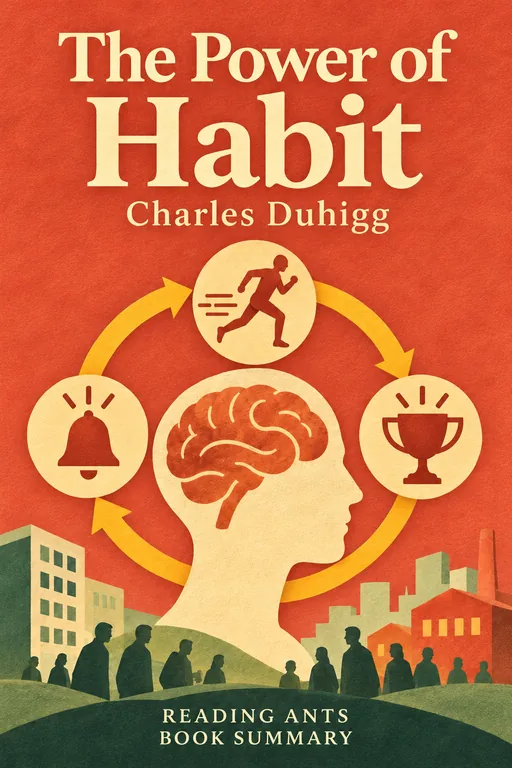
The Power of Habit
Charles Duhigg
Charles Duhigg shows that habits follow a loop of cue, routine and reward, and that by understanding the loop we can change our own habits, as well as those of companies and societies.
🌱 Self-Improvement
Atomic Habits
James Clear
Big changes in life come not from huge leaps but from tiny habits repeated every day, and you can build good habits (and break bad ones) by designing your life so the right choices are obvious, attractive, easy and satisfying.
🌱 Self-ImprovementWant something different?
Pick another topic and we will show you three books to start with.