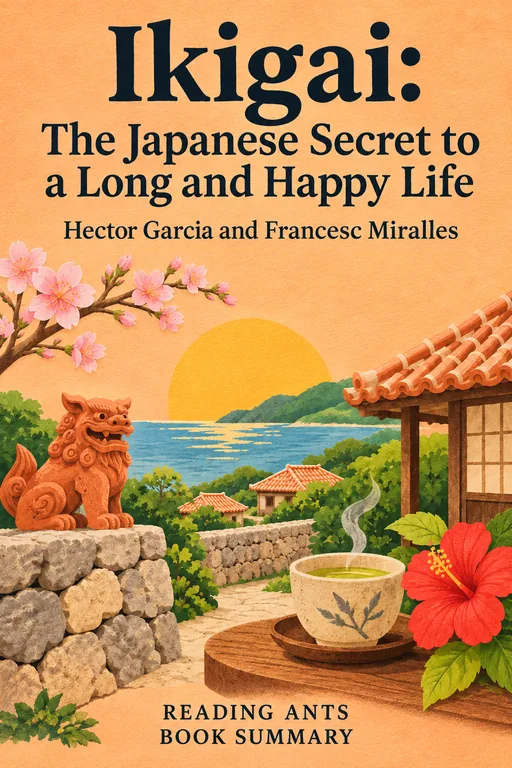
Ikigai: The Japanese Secret to a Long and Happy Life
Original title: Ikigai
Hector Garcia and Francesc Miralles explore the Japanese idea of ikigai, a reason for getting up in the morning, and share habits from long-lived people in Okinawa that can bring purpose and happiness.
Overview
Ikigai: The Japanese Secret to a Long and Happy Life was written by Hector Garcia, a Spanish engineer who has lived in Japan, and Francesc Miralles, a Spanish writer, and was first published in Spanish in 2016. Ikigai is a Japanese word that is often translated as “a reason for being,” or what makes life worth living. The authors traveled to Ogimi, a village in Okinawa known for the longevity of its residents, and interviewed elderly people about their lives and habits. They combined these stories with ideas from psychology, such as Viktor Frankl’s logotherapy, and from research on diet, exercise and stress. The book is short, easy to read and became an international bestseller.
Full Summary
1. What is ikigai?
The idea: The authors explain that ikigai is the idea that each person has a purpose that gives life meaning and joy, often found at the point where what you love, what you are good at, what the world needs and what you can be paid for overlap. They present this with a well-known diagram of four overlapping circles. They add that ikigai does not have to be something grand; it can be small, such as tending a garden, caring for grandchildren or making a craft. Having one is linked to well-being.
In real life: A person who looks forward to teaching a class, cooking for family or helping neighbors each day has found a form of ikigai.
2. The secrets of Okinawa
The idea: Okinawa has one of the highest numbers of people aged one hundred or more. The authors describe the community of Ogimi, where elderly people stay active, keep working in gardens, take part in social groups and have a positive outlook. They report that people there rarely retire in the Western sense, but continue doing what they love. Their lifestyle includes a diet rich in vegetables, tofu and fish, and the habit of stopping eating when about eighty percent full, known as hara hachi bu.
In real life: Eating slowly and stopping before feeling stuffed can be a simple way to follow this habit.
3. Staying active, social and connected
The idea: The book highlights the importance of social ties, such as moai, small groups of friends who support each other, in Okinawan tradition. These groups meet regularly for activities and mutual aid. The authors say that having friends, laughing and sharing meals contribute to long life. They also emphasize gentle daily movement, such as walking, gardening and stretching, instead of intense exercise.
In real life: Joining a club, walking group or regular family meal provides the kind of connection the book recommends.
4. Flow and doing what you love
The idea: The authors draw on Mihaly Csikszentmihalyi’s concept of flow, the state of being fully absorbed in an activity, which they say is often connected to ikigai. They encourage readers to find activities that challenge them just enough and give a sense of progress. They also discuss Frankl’s logotherapy, the idea that finding meaning helps people endure suffering, and quote examples of people who overcame hardship by focusing on a purpose.
In real life: Spending time on a hobby that absorbs you completely can be a clue to your own ikigai.
5. Resilience, mindset and handling stress
The idea: In the later chapters, the authors discuss ways to cope with setbacks, drawing on ideas of resilience and the Japanese concept of wabi-sabi, appreciating imperfection. They suggest seeing difficulties as opportunities to grow, practicing mindfulness and not worrying excessively. They recommend a calm, flexible attitude, so that stress is a challenge to manage, not a threat. They point out that many of the elderly people they met were serene, optimistic and ready to laugh.
In real life: Reframing a problem as something you can learn from can lessen anxiety.
6. Finding your own ikigai
The idea: The final chapters guide readers in finding their own ikigai. The authors suggest asking questions such as what you love doing, what you are good at, what gives you energy and what you would do even if no one paid you. They encourage experimenting with different activities, and being patient. They summarize ten “rules of ikigai,” such as staying active, not worrying, being optimistic, surrounding yourself with good friends and living in the present.
In real life: Trying a new activity each month, such as a class or volunteering, is a practical way of exploring what excites you.
Why It Matters
Ikigai became a worldwide bestseller, selling millions of copies in dozens of languages, and helped popularize the concept of ikigai outside Japan. It contributed to growing interest in purpose and well-being, and encouraged many readers to think about what gives their lives meaning and how to build healthier habits.
The idea of ikigai is now widely discussed in business, education and wellness circles, though often in forms that differ from the Japanese original.
For many readers, the book’s greatest value lies in its portraits of elderly Okinawans who stay active and cheerful, which present a positive picture of aging that is rarely seen in popular media.
Key Takeaways
- Purpose gives life meaning. Having a reason to get up each day matters.
- Stay active and engaged. Gentle movement and meaningful activity help.
- Connection is vital. Friends and community support longevity.
- Eat in moderation. Stopping before full is a healthy habit.
- Embrace imperfection. Resilience and acceptance reduce stress.
What We Can Learn
The book invites us to ask what we look forward to and what we would miss if it disappeared. Even a small answer can be a starting point for building a more purposeful life.
It also shows the value of balance: gentle activity, good food, friendships and calm are more important than any single “secret.”
Finally, it encourages us to respect older people and learn from them. Their stories show that a life of purpose, community and moderation can bring happiness at any age.
Criticism and Counterpoints
Many critics, including Japanese commentators, have pointed out that the popular four-circle diagram is not a traditional Japanese concept but one created outside Japan, adapted from an earlier diagram about finding purpose, and that in Japan ikigai is often much more modest and simple, like the pleasure of small daily things. Some also say that the book generalizes about Okinawa from a small number of interviews.
Others note that claims about longevity and diet are not rigorously supported, and that some of the data on very old people in Okinawa have been questioned because of record-keeping problems. The advice is generic, and some of the research citations are loose. Still, many readers enjoy its gentle message.
Who Should Read It
This book suits readers from about age ten up to adults. It is short and light, with simple language. Readers who want rigorous evidence about longevity will need other sources.
Want the whole book?
A summary is a taste, not the meal. Here is where to find the full book.
You reached the end 🎉
Nicely done. Mark this one as read, and we will suggest what to read next.
Read this next

Man's Search for Meaning
Viktor E. Frankl
A psychiatrist who survived the Nazi concentration camps explains that even in the worst suffering, people can choose their attitude, and that finding a reason to live is what gives us the strength to endure.
👤 Real Lives
Flow
Mihaly Csikszentmihalyi
Psychologist Mihaly Csikszentmihalyi shows that people feel happiest not when relaxing but when fully absorbed in a challenging activity that matches their skills, a state he calls flow.
🧩 Mind & Psychology
The Power of Now
Eckhart Tolle
Eckhart Tolle teaches that much of our suffering comes from living in thoughts about the past and future, and that peace is found by paying full attention to the present moment.
🌱 Self-Improvement
The Miracle of Mindfulness
Thich Nhat Hanh
Thich Nhat Hanh shows, through simple practices like washing dishes, breathing and walking, how paying full attention to the present moment can bring calm, joy and a deeper connection to life.
🕊️ Philosophy & Religion
Outlive
Peter Attia with Bill Gifford
To live longer and better, we should work early to prevent the chronic diseases that kill most people, by training the body with exercise, paying attention to nutrition and sleep, and caring for our mental health.
🍎 Health
Atomic Habits
James Clear
Big changes in life come not from huge leaps but from tiny habits repeated every day, and you can build good habits (and break bad ones) by designing your life so the right choices are obvious, attractive, easy and satisfying.
🌱 Self-ImprovementWant something different?
Pick another topic and we will show you three books to start with.