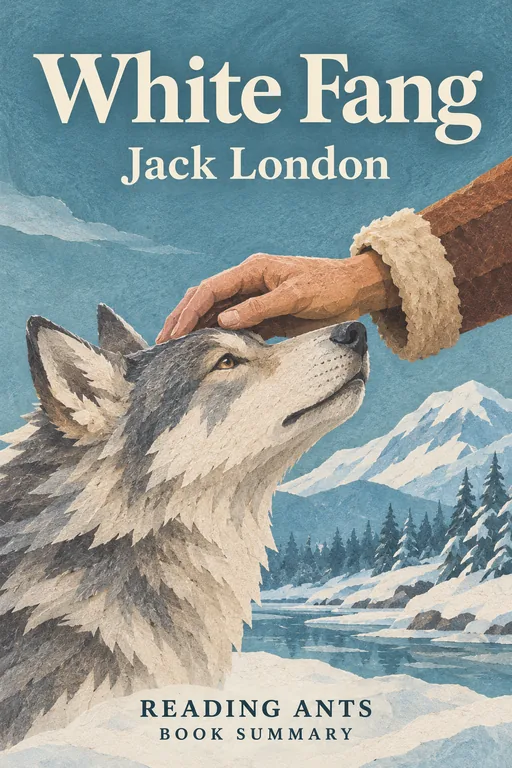
White Fang
A wolf-dog born in the Yukon wilderness is hardened by cruelty and survival, and then, through the patient kindness of one man, learns to trust and love, and becomes a loyal family dog in California.
Overview
White Fang is an adventure novel by the American writer Jack London, published in 1906. It is a companion to his earlier book The Call of the Wild, which tells of a tame dog that goes wild, while this one tells of a wild animal that becomes tame. Set in the Canadian North during the Klondike gold rush, the story is told from the point of view of the animal, though not in human language. London was interested in how heredity and environment shape character, and the book is a vivid and sometimes brutal study of that question.
Main Characters
- White Fang: a wolf-dog, strong, clever and fierce, who becomes fiercely loyal.
- Kiche: his mother, a half-wolf, half-dog, who has lived with humans.
- One Eye: his wolf father, who dies in a fight with a lynx.
- Gray Beaver: a Native American man who becomes White Fang’s first master.
- Beauty Smith: a cruel, cowardly man, who makes White Fang fight for money.
- Weedon Scott: a mining engineer, who rescues White Fang and wins his trust.
- Lip-lip: a bullying puppy who torments White Fang in the Indian camp.
Full Summary
The wild
The story begins with two men, Bill and Henry, who are hauling a coffin by dog sled through the frozen wilderness, and who are stalked by a pack of starving wolves. A bold she-wolf lures the sled dogs away one by one, and the pack eats them. Then the wolves take Bill himself, and only Henry, who keeps them off with a ring of fire, survives until a party of men arrives and rescues him. The story then follows the she-wolf, who is half dog, and her mate, the one-eyed wolf One Eye. She gives birth to a litter, and only one cub survives the famine that follows, a gray one who takes after his father. He grows up in a cave, learning the law of the wild, that one must eat or be eaten. When One Eye is killed by a lynx, the she-wolf and the cub are left alone.
Gray Beaver’s camp
When the cub is still small, he and his mother come to the camp of a group of Indians, led by Gray Beaver. One of the men calls out her name, Kiche, and she submits, for she is the dog who ran away from Gray Beaver a year earlier. The cub, who comes to be called White Fang, learns to obey the men. He is bullied by the other dogs, especially a puppy named Lip-lip, and learns to fight, becoming harder and meaner. Gray Beaver trades Kiche away to pay a debt, and White Fang is left without her. He is later harnessed as a sled dog, and, once he has beaten Lip-lip, he becomes the leader of the team of Gray Beaver’s son, Mit-sah, though he is feared and disliked by the other dogs.
Sale to Beauty Smith
When Gray Beaver travels to Fort Yukon to trade, White Fang sees white men for the first time. A man called Beauty Smith, who is cowardly, weak and cruel, wants the dog, and he gets Gray Beaver addicted to whisky until the Indian sells White Fang for bottles. Smith beats and torments White Fang, and makes him fight other dogs, for money. White Fang wins many fights, and, as the Fighting Wolf, is exhibited in a cage and in fights in Dawson. His hatred of people and dogs grows, and he lives in a world of pain and rage.
The bulldog and the rescue
At last, Smith matches White Fang against a bulldog, called Cherokee, who belongs to Tim Keenan, a faro dealer, and who has a deadly grip. The fight goes badly for White Fang, as the bulldog holds on to his throat and will not let go. A man in the crowd, Weedon Scott, a mining expert, forces the dogs apart with his revolver and rescues White Fang, taking him from Smith. Scott takes him to his cabin, where his dog-musher, Matt, doubts that the animal can be tamed. With great patience and gentleness, Scott tries to win his trust. At first, White Fang snaps and snarls, expecting to be hurt, and he kills one of the sled dogs and slashes both men.
Learning to love
Slowly, White Fang begins to respond. He is not used to kindness, and he is both puzzled and moved by it. Scott feeds him, speaks to him gently and never beats him. In time, White Fang becomes devoted to his new master. When Scott goes away for a time, the dog falls ill with grief, and he recovers only when Scott returns. When Beauty Smith comes to steal him one night, White Fang attacks him and drives him off. Later, when Scott is ready to return to California, White Fang senses it and howls in despair at being left behind. He breaks through a window, and Scott, seeing this, decides to take him along. The dog’s loyalty is no longer a matter of fear, but of love.
A new life in California
In California, at Sierra Vista, the home of Scott’s father, Judge Scott, White Fang finds a gentle life with a family and with other dogs, though he has to learn to behave. A sheepdog named Collie torments him at first, and he must learn not to kill the chickens, and to be gentle with the children. When an escaped convict, Jim Hall, whom the judge once sent to prison, breaks into the house to take revenge, White Fang attacks him, and saves the household, although he is badly wounded. He recovers, with the family’s care, and the book ends with him lying in the sun, while Collie’s puppies crawl over him, at peace.
Why It Matters
White Fang is a classic of animal fiction, and it was widely popular in its time. It is notable for its attempt to see the world through a dog’s eyes, and for the way that it shows how experience, cruelty and kindness shape character. London’s ideas, influenced by Darwin, about the struggle to survive, and by the belief that an animal, or a person, can change when treated differently, are central. The book has been adapted for the screen many times. Its setting, the Yukon during the gold rush of the late 1890s, gives it a vivid sense of place, and its contrast between the harsh North and the comfortable South of California lets London show how the same animal can be shaped by very different worlds. Readers still turn to it as a gripping adventure and as a way of thinking about how cruelty and kindness make us who we are.
Key Takeaways
- Environment shapes character. White Fang becomes fierce through cruelty.
- Kindness can heal. Scott’s patience wins his trust.
- Survival is a law of the wild. Strength and cunning decide who lives.
- Cruelty breeds cruelty. Beauty Smith’s treatment turns a wolf into a monster.
- Loyalty can be earned. Trust, once given, is deep.
What We Can Learn
You can learn from White Fang that a being who has been hurt can learn to trust again, if given patience, gentleness and time. The book is a reminder that how we treat animals, and each other, makes a difference to what they become. It also shows the importance of protecting those who are vulnerable. If you love animals, this story may deepen your understanding of how they think and feel, and make you think about caring for them. It also suggests that change is possible for people, too.
Criticism and Counterpoints
Some readers find the descriptions of cruelty and fighting disturbing, particularly for young children, and some think that the scenes of dog fighting are too graphic. Others say that London’s attribution of thoughts and reasoning to animals is unrealistic, and that the novel’s belief in heredity is simplistic. A few critics find the later chapters, set in California, to be sentimental, and feel that the contrast between the harsh North and the soft South is too neat. Some modern readers also find the portrayal of the Native Americans dated. However, many remain gripped by the story.
Who Should Read It
This book is for readers from about ten or twelve who love animals and adventure, and for those who read The Call of the Wild and want its companion. It contains violence, and sensitive readers should be prepared. It is a good read-aloud for older children.
Want the whole book?
A summary is a taste, not the meal. Here is where to find the full book.
You reached the end 🎉
Nicely done. Mark this one as read, and we will suggest what to read next.
Read this next
The Call of the Wild
Jack London
Buck, a big, pampered dog stolen from his comfortable California home, is sold into the freezing Yukon gold rush as a sled dog, where he learns to survive and eventually answers the call of the wild.
📜 Classics
Black Beauty
Anna Sewell
A gentle black horse tells the story of his life, from a happy childhood to hard years pulling cabs, and shows how kindness or cruelty can change an animal's whole life.
🧸 Children's Books
The Jungle Book
Rudyard Kipling
A human boy raised by wolves in the Indian jungle learns the Law of the Jungle from a wise bear and a panther, and must outwit a man-eating tiger, in a collection of classic animal stories.
🧸 Children's Books
Treasure Island
Robert Louis Stevenson
A boy who finds a pirate's treasure map sails to a distant island, only to discover that the ship's charming one-legged cook is the leader of a band of pirates who want the gold for themselves.
🧸 Children's Books
Pride and Prejudice
Jane Austen
Quick-witted Elizabeth Bennet and the proud, wealthy Mr. Darcy badly misjudge each other, and only by facing their own faults do they find their way to love.
📜 Classics
Nineteen Eighty-Four
George Orwell
In a future Britain ruled by an all-seeing Party, one man secretly rebels by keeping a diary and falling in love, and discovers just how completely a totalitarian state can crush the human mind.
📜 ClassicsWant something different?
Pick another topic and we will show you three books to start with.