AI Superpowers
Technology investor Kai-Fu Lee argues that China and the United States will dominate artificial intelligence, explains why China is catching up fast, and warns that AI will transform jobs, calling for a more humane response grounded in compassion and love.
Overview
AI Superpowers: China, Silicon Valley, and the New World Order was published in 2018 by Kai-Fu Lee, a Taiwanese-born computer scientist who worked at Apple, Microsoft and Google, headed Google China, and then became a venture capitalist in Beijing with Sinovation Ventures. He has a rare view of both Chinese and American technology. The book moves from a comparison of the Chinese and American AI ecosystems and the race between them to a discussion of the social effects of AI, especially on jobs, which includes a personal reflection. It was a bestseller.
Full Summary
1. A “Sputnik moment”
The idea: Lee begins with a moment in 2016 when Google’s AlphaGo program defeated Lee Sedol, a champion Go player, which was watched by more than 280 million Chinese viewers. He says that AlphaGo’s victories, including a later match against the Chinese player Ke Jie in 2017, were a “Sputnik moment” for China, which spurred its government and companies to invest in AI. He explains that the Chinese response was swift: less than two months after the Ke Jie match, the government issued a national plan to lead the world in AI by 2030, and entrepreneurs and investors joined in.
In real life: A single dramatic event can change what a country thinks is possible.
2. The age of implementation
The idea: Lee argues that AI has moved from an age of discovery, in which a few elite researchers made breakthroughs, mainly in the West, to an age of implementation, in which the key is to apply known techniques to real problems, with large amounts of data and many engineers. In that stage, China has advantages: large numbers of users, a hardworking and competitive entrepreneurial culture and strong government support. He says that data, not just algorithms, is the fuel, and China has more of it.
In real life: A method that works in the lab only matters when it is built into useful products.
3. China’s copycat to innovator story
The idea: The author tells how Chinese internet companies at first copied American ones, but, in a brutal competitive environment, which he calls a “gladiator” market, they developed their own models, adapted to local conditions, such as mobile payments, super apps and food delivery. He points to the success of companies such as Alibaba, Tencent and Baidu, and the rise of new ones such as Didi and Meituan. These firms became innovators, and collected rich data on how people live, shop and travel.
In real life: Learning by copying, and then improving, is how many industries begin.
4. Four waves of AI
The idea: Lee describes four waves of AI application. The first is internet AI, which recommends content and ads. The second is business AI, which uses data in banks, hospitals and other firms. The third is perception AI, which digitizes the physical world, with cameras and sensors, as in smart cities and retail. The fourth is autonomous AI, such as self-driving cars and drones. He says that China is already strong in the first and third, and that the US leads in research and in some areas of business AI.
In real life: A shopping app that suggests what to buy is a simple example of internet AI.
5. The coming job disruption
The idea: In the second part, Lee turns to the effects on work. He predicts that AI will displace many routine jobs, in both white-collar and blue-collar work, such as in customer service, driving and translation, perhaps as much as forty to fifty percent of jobs in the US being open to automation within about fifteen years, though he says that the timing is uncertain. He warns of growing inequality, as the gains go to a few firms and countries, and says that this could cause social unrest. This is a major concern of the book.
In real life: A call center may be replaced by a chatbot.
6. A human response: compassion and love
The idea: The last chapters are personal. After Lee was diagnosed with lymphoma, he reconsidered his priorities, and came to see that, in an age of AI, what is uniquely human, empathy, compassion and creativity, is what matters most. He proposes that we should invest in jobs that emphasize human connection, such as caregiving and education, and suggests a “social investment stipend” paid for caring work. He argues that, rather than fear AI, we should use it to free people to do what machines cannot, to love and to serve others.
In real life: A caregiver who offers warmth does something that a machine cannot truly replace.
Why It Matters
AI Superpowers was a bestseller, and influenced the way that many in the West and in China thought about the global AI competition. It gave a rare insider’s account of the Chinese tech scene, and challenged the assumption that the US would always lead. It also contributed to the debate about the future of work. The notion of a race between two AI superpowers was often cited by policymakers and journalists. At the same time, the book had a human message about love and meaning in a technological age, which stood out from other works on AI.
Key Takeaways
- AI is now about implementation. Data and execution matter more than discovery.
- China is a major contender. Its market, talent and support make it strong.
- Data is fuel. Countries and companies with more data have an advantage.
- Jobs will be disrupted. Routine work is most at risk.
- Human qualities matter. Compassion and care will remain valuable.
What We Can Learn
You can use the book to understand how technology competition shapes the world, and to learn about the Chinese tech industry. Think about which kinds of work are likely to be changed by AI, and which human skills, such as empathy and creativity, will remain valuable. Consider how societies might support those who do caring work. Reflect on your priorities, as Lee did, and whether you are spending time on what matters. And read other perspectives on AI and China, including critical ones, to get a fuller picture.
Criticism and Counterpoints
Some critics say that Lee promotes zero-sum thinking about a race between two countries, and that he hypes Chinese state investment in technology, which often underperforms. Others say that his job predictions, such as the forty to fifty percent figure, are speculative, and that many forecasts of automation have been overstated. Some reviewers argue that he focuses on deep learning to the exclusion of other kinds of AI, and that he overgeneralizes about how useful Chinese data sets are. A few say that the policy ideas, such as the stipend, are vague. Still, it is a useful picture.
Who Should Read It
This book is for readers who are interested in technology, China and the future of work, including students and professionals. It is clear and personal. Those who want a critical view of Chinese technology policy may supplement it with other works.
Want the whole book?
A summary is a taste, not the meal. Here is where to find the full book.
You reached the end 🎉
Nicely done. Mark this one as read, and we will suggest what to read next.
Read this next
The Second Machine Age
Erik Brynjolfsson and Andrew McAfee
MIT economists Erik Brynjolfsson and Andrew McAfee argue that digital technologies such as computers, robots and artificial intelligence are bringing a second machine age, which will bring enormous benefits but also growing inequality, and they say that we must adapt our skills and institutions.
💡 TechnologyLife 3.0
Max Tegmark
Physicist Max Tegmark explores what happens when artificial intelligence matches and then surpasses human intelligence, lays out a range of possible futures, and argues that we should think carefully, now, about which one we want.
🔬 ScienceChip War
Chris Miller
Chris Miller tells the story of how tiny computer chips became the foundation of modern life and military power, and why their supply, concentrated in a few places and companies, has become a major issue between the United States and China.
💰 Money & EconomicsSuperintelligence
Nick Bostrom
Philosopher Nick Bostrom argues that if machines become far more intelligent than humans, they could become very powerful, and that, unless we solve the problem of giving them goals that are safe for humanity, the result could be catastrophic.
💡 Technology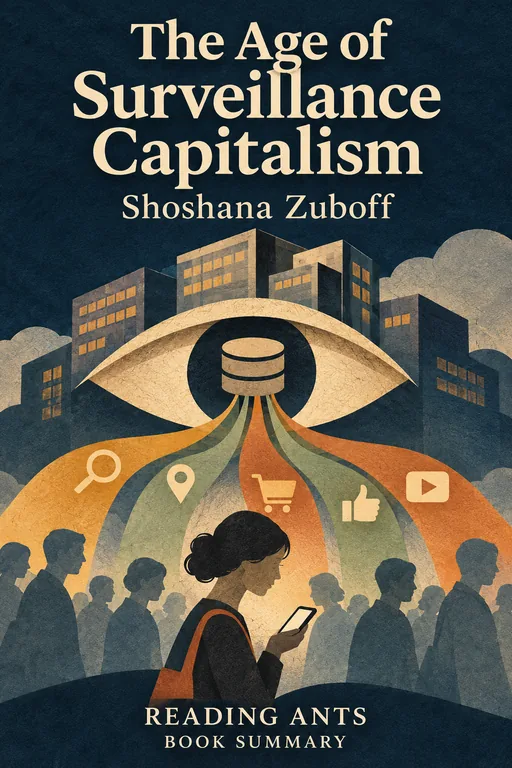
The Age of Surveillance Capitalism
Shoshana Zuboff
Harvard professor Shoshana Zuboff argues that large technology companies have created a new kind of capitalism that gathers vast amounts of personal data, turns it into predictions of our behavior and sells them, threatening privacy, autonomy and democracy.
⚖️ Politics & SocietyThe Innovators
Walter Isaacson
Walter Isaacson tells the history of the digital revolution through the people who invented the computer, the internet and the web, and argues that innovation is mostly the product of collaboration, not the work of lone geniuses.
💡 TechnologyWant something different?
Pick another topic and we will show you three books to start with.