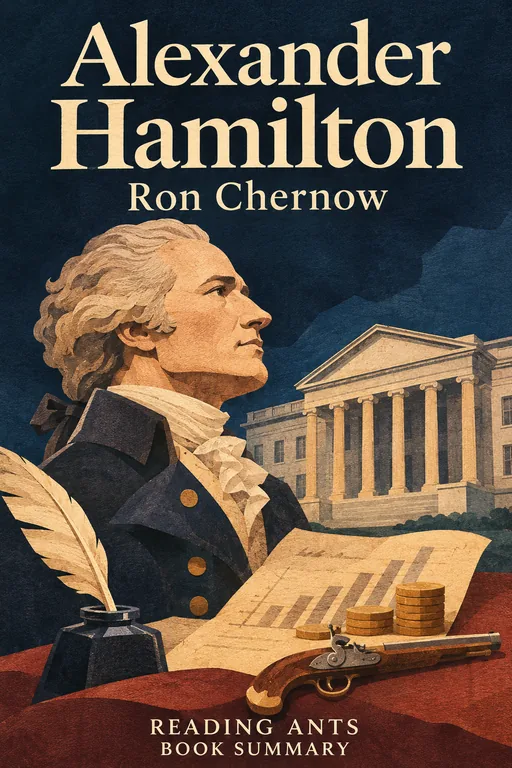
Alexander Hamilton
Ron Chernow tells the life of Alexander Hamilton, the brilliant immigrant orphan who became George Washington's right hand, shaped the American financial system and died in a duel with Aaron Burr.
Overview
Alexander Hamilton is a biography by Ron Chernow, published in 2004. It was the basis for the hit stage musical Hamilton, created by Lin-Manuel Miranda, who read the book on a vacation. The biography is about eight hundred pages, and draws on letters, papers and earlier studies. Chernow portrays Hamilton as a man of astonishing energy and talent, but also of pride and a sharp temper, who made many enemies. The book also gives a broad picture of the early United States and of the rivalries among its founders.
Full Summary
A Boy in the Caribbean
Hamilton was born on the island of Nevis, in the Caribbean, probably in 1755 or 1757, born out of wedlock to a mother who was still legally married to another man. His father left, and his mother died when he was a boy, leaving him an orphan. He went to work as a young clerk in a trading firm on the island of St. Croix, where he learned about commerce, shipping and accounts. His talent was recognized by local people. When a hurricane struck St. Croix, he wrote a powerful description, and a group of local citizens raised money to send him to North America for an education.
New York and the Revolution
Hamilton arrived in New York and enrolled at King’s College, now Columbia University. As the American colonies moved toward independence, he wrote pamphlets in support of the patriot cause, and joined the army. His courage and skill caught the eye of George Washington, who made him his aide. For several years, Hamilton served as Washington’s secretary, handling correspondence and advising. He longed for a battlefield command, and finally led an attack at Yorktown in 1781, which helped to bring the war to an end.
Marriage, the Constitution and the Federalist
In 1780, Hamilton married Elizabeth Schuyler, from a prominent New York family, and they had many children. After the war, he practiced law, and argued for a stronger national government, since the loose union was not working. He took part in the convention that wrote the Constitution, and after it was finished, he worked to win its ratification. He wrote the majority of the Federalist Papers, a series of essays, with James Madison and John Jay, that explained and defended the new system.
Secretary of the Treasury
When Washington became president, he chose Hamilton as the first Secretary of the Treasury. The nation was heavily in debt after the war, and its credit was weak. Hamilton proposed that the federal government take on the debts of the states, create a national bank and encourage manufacturing. His plans were opposed by Thomas Jefferson and James Madison, who feared that they would favor wealthy interests and give too much power to the central government. Out of this conflict, the first political parties emerged.
Scandal and Rivalry
In 1791, Hamilton began an affair with a woman named Maria Reynolds, whose husband blackmailed him. When he was accused of misusing public funds, Hamilton eventually chose, in 1797, to publish the details of the affair to prove that his payments were private blackmail and not corruption, which harmed his reputation and caused pain to his wife. He also feuded with Jefferson, with President John Adams, and with Aaron Burr, a New York politician. In the tied presidential election of 1800, he backed Jefferson over Burr, whom he distrusted more. Chernow shows him as a gifted writer who was often too outspoken for his own good.
The Duel
In 1801, Hamilton’s eldest son, Philip, then nineteen, was killed in a duel, which devastated him. In 1804, after Hamilton had criticized Burr during a campaign for the governorship of New York, Burr challenged him. On July 11, the two men met on the New Jersey side of the Hudson River, and Burr shot Hamilton, who died the next day. Chernow describes the mourning, and the legacy of the financial and political institutions that Hamilton helped to create, including a strong central government. His widow, Eliza, spent the rest of her long life working to preserve his legacy.
Why It Matters
Chernow’s biography revived interest in a Founding Father who had often been less celebrated than Washington, Jefferson or Adams, and showed how much of the shape of the modern American economy comes from Hamilton’s ideas. The book won the first George Washington Book Prize, and, through the stage musical, reached millions who might not otherwise have read a long biography. It also shows the role of immigrants and the importance of institutions in the early republic. It is a vivid account of the struggles over the nation’s direction, and a reminder that the founders were human beings with strengths and flaws.
Key Takeaways
- Talent and effort can overcome a hard start. Hamilton rose from an orphan to a national leader.
- Institutions matter. His work on finance and government shaped the country.
- Ideas create conflict. Debates over central power produced the first parties.
- Pride and impulse can destroy. His temper and public quarrels harmed him.
- Writing is power. His essays and reports persuaded and organized.
What We Can Learn
Hamilton’s life shows what a person can accomplish through reading, hard work and clear writing. It also shows the cost of a quick temper and of seeking to win every argument. Think about how you handle criticism: could you respond more calmly? Notice how public decisions, such as how a government borrows and spends, affect everyday life. And consider the many people, immigrants and those from poor backgrounds, who have contributed to your country. The story also invites you to read the documents of the founding era for yourself.
Criticism and Counterpoints
Some reviewers say that Chernow presents Hamilton in a very favorable light, and treats Jefferson harshly, though the concerns of Jefferson and Madison about concentrated power were serious. Others note that the book portrays Hamilton as firmly opposed to slavery on thin evidence, and that his connections to slaveholding were more complicated than portrayed. The musical, which popularized the story, has been criticized for its portrayal of the period. A few scholars also question some of the details of Hamilton’s early life in the Caribbean, which are poorly documented. The book remains a standard modern biography.
Who Should Read It
This book is for readers of history and biography, and fans of the musical who want to learn more. It is long and detailed, but the story is dramatic and the writing is lively. Those who want a shorter introduction might begin with a short life of Hamilton, and then come back to this for the full story.
Want the whole book?
A summary is a taste, not the meal. Here is where to find the full book.
You reached the end 🎉
Nicely done. Mark this one as read, and we will suggest what to read next.
Read this next
Team of Rivals
Doris Kearns Goodwin
Historian Doris Kearns Goodwin shows how Abraham Lincoln won the Republican nomination in 1860 against more famous rivals, and then brought those same rivals into his cabinet and used their talents to lead the nation through the Civil War.
🏛️ History
1776
David McCullough
David McCullough tells the story of the pivotal year of the American Revolution, when George Washington's poorly equipped army nearly lost everything and then, in a few winter weeks, won two surprising victories.
🏛️ History
The Federalist Papers
Alexander Hamilton, James Madison and John Jay
A series of eighty-five essays written in 1787 and 1788 by three of the founders of the United States to persuade the people of New York to approve the new Constitution, explaining how its system of government would work and why it was needed.
⚖️ Politics & Society
The Autobiography of Benjamin Franklin
Benjamin Franklin
Benjamin Franklin tells the story of his rise from a poor Boston boy to a successful printer, inventor and public leader in Philadelphia, and shares his methods of self-improvement.
👤 Real Lives
Common Sense
Thomas Paine
In a short, fiery pamphlet written in plain language, Thomas Paine argued in early 1776 that the American colonies should declare independence from Britain, and that monarchy itself was an unreasonable form of government.
⚖️ Politics & Society
Man's Search for Meaning
Viktor E. Frankl
A psychiatrist who survived the Nazi concentration camps explains that even in the worst suffering, people can choose their attitude, and that finding a reason to live is what gives us the strength to endure.
👤 Real LivesWant something different?
Pick another topic and we will show you three books to start with.