 Reading Ants
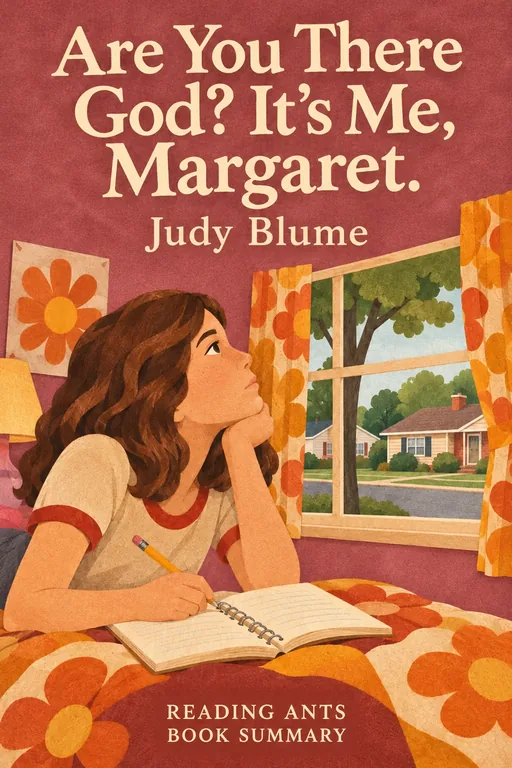
Are You There God? It's Me, Margaret.
An eleven-year-old girl moves to a new town, makes friends, worries about growing up and wonders about faith, and talks to God about it all.
Overview
Are You There God? It’s Me, Margaret. is a novel for young readers by Judy Blume, published in 1970. It is set in the early 1970s, when Margaret Simon, who is eleven, moves from New York City to a suburb in New Jersey. The story is told by Margaret herself, in a chatty, honest voice, and includes her private talks with God. It deals frankly with the changes of puberty, and with questions about religion. It was groundbreaking for its time, and it is still loved by readers.
Main Characters
- Margaret Simon: the narrator, an eleven-year-old girl, funny and curious.
- Mr. and Mrs. Simon: her parents, one Jewish, one Christian, who raise her without a religion.
- Nancy Wheeler: a confident neighbor, and Margaret’s first friend in New Jersey, who is a member of a secret club.
- Gretchen Potter and Janie Loomis: the other girls in Margaret’s club, called the Pre-Teen Sensations.
- Grandma Sylvia: her Jewish grandmother, her father’s mother, who dotes on her.
- Laura Danker: a tall girl in her class, who is the subject of cruel gossip.
- Mr. Benedict: her sixth-grade teacher.
Full Summary
Moving Day
Margaret’s family moves from their New York apartment to a house in the suburbs of New Jersey. Margaret suspects that one reason for the move is to put some distance between her and her grandmother, who spoils her. In the new neighborhood, she meets Nancy Wheeler, a neighbor of her own age, who seems confident and knowledgeable, and who is eager to include her.
Margaret often talks to God, in private. Her talks are casual, as if she was talking to a friend. She tells him about her day and asks him questions, and she hopes that he is listening.
The Club
Nancy invites Margaret to join a secret club with two other girls, Gretchen Potter and Janie Loomis. The club is called the Pre-Teen Sensations, and the girls talk about boys, bras and periods. They anxiously wait for their first periods, and they do exercises that they hope will help them to grow, such as chanting that they must increase their bust.
When Gretchen gets her first period, Margaret worries that she is not normal because hers has not started. She talks to God about her worries. Nancy claims that she has already gotten hers, on a vacation, which makes Margaret feel even further behind. Later, at a restaurant, Nancy gets her first period, and Margaret realizes that Nancy had lied. Margaret also gets her first bra, and she has her first kiss with Philip Leroy, a popular boy in her class, during a party game.
Religion
In school, Margaret’s teacher, Mr. Benedict, gives each student a year-long project. Margaret chooses religion. Her parents, who come from different faiths, have chosen not to raise her in any one religion, and they have told her that she can choose one for herself when she is older. She decides to learn about different faiths. She goes to temple with her grandmother, who hopes that her granddaughter will embrace Judaism, and she goes to church with two of her friends.
She finds that she cannot feel her connection to God in any formal religion. She feels it only when she is alone, talking to God in her own way.
Rumors
The girls start to gossip about Laura Danker, a tall classmate who has already developed. Nancy claims that Laura goes out with an older boy, and the club spreads untrue rumors about her. Margaret, who is troubled, goes along with it. Later, she feels guilty when she learns that Laura is a devout Catholic, and that she was hurt by the rumors.
Margaret begins to see how cruel it is to spread stories about others, and she feels ashamed of her part in it.
Grandma and the Truth
Late in the school year, Margaret’s mother’s parents, who are devout Christians, visit for the first time. They had stopped speaking to Margaret’s mother after she married a Jewish man. Their visit ruins the family’s plan to spend the spring vacation with Margaret’s grandmother Sylvia in Florida, and Margaret is determined not to like them.
When her grandparents mention religion, and try to insist that Margaret was born a Christian girl, a heated argument follows. Margaret angrily declares that she does not need religion or God, and she stops talking to God. Nothing is settled neatly.
At Last
By the end of her school project, Margaret has not chosen a religion, but she has learned about herself, and she is more comfortable with her lack of a religious label. On the last day of school, Margaret finally gets her first period. She is relieved and happy, she starts talking to God again, and she thanks him. She realizes that, when she is patient, the things that she wants come in time, and the story ends on that note of warm, honest hope.
Why It Matters
Judy Blume’s book is one of the best-known and most loved novels about growing up. It was among the first books for young readers to talk openly about periods, bras and the questions that girls have about their bodies and about God. Blume’s books have sold more than eighty million copies, and have been translated into dozens of languages. It was also banned or challenged in many libraries and schools, because of its frank treatment of these subjects, and Blume became an advocate for young readers’ freedom to read. A film adaptation was released in 2023.
Key Takeaways
- Growing up is a shared experience. Many girls worry about the same things.
- Honest talk matters. Margaret’s open questions help her to understand herself.
- Faith is personal. She must find her own answers.
- Gossip hurts. The treatment of Laura teaches a lesson about kindness.
- Families can disagree about faith. Margaret’s parents and grandparents hold very different views.
What We Can Learn
The book reassures young readers that their feelings about growing up are normal, and that everybody changes at a different pace. It encourages us to ask questions about the big topics, including religion, and to take our time to find answers.
It also reminds us to treat others with respect, and not to spread rumors or judge people on how they look. And it shows that talking openly with family and friends, even about awkward subjects, can help. Parents and teachers can also learn from Margaret’s parents, who let their daughter find her own answers about religion.
Criticism and Counterpoints
Some parents and community groups have objected to the book, because they feel that it discusses puberty too openly for young readers, or that it treats religion in a way they disagree with. Other critics say that the book is dated, since it shows a world with no cell phones and with views of girls’ bodies and religion that have changed. The characters are not very diverse, and Margaret’s world is mainly white and middle class.
Who Should Read It
This book is for readers from about ten or eleven years old, especially girls, but also anyone who wants to understand what growing up feels like. It is an easy and funny read. Parents may want to read it with their children, and to use it as a way to start conversations.
Want the whole book?
A summary is a taste, not the meal. Here is where to find the full book.
You reached the end 🎉
Nicely done. Mark this one as read, and we will suggest what to read next.
Read this next
Tales of a Fourth Grade Nothing
Judy Blume
Nine-year-old Peter Hatcher tells a funny and heartfelt story about the troubles of living with his destructive toddler brother Fudge, who gets all the attention, until Fudge's latest stunt is the last straw.
🧸 Children's Books
Anne of Green Gables
L. M. Montgomery
A talkative, imaginative red-haired orphan is sent by mistake to an elderly brother and sister who wanted a boy, and she wins their hearts and fills their quiet farm with life.
🧸 Children's Books
Little Women
Louisa May Alcott
Four very different sisters grow up together in a loving but poor family in New England during and after the American Civil War, learning about love, ambition, loss and finding their own paths in life.
📜 Classics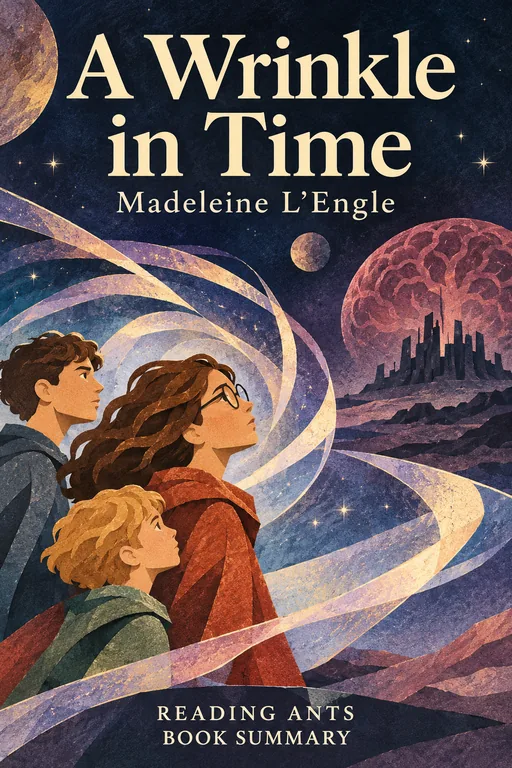
A Wrinkle in Time
Madeleine L'Engle
An awkward girl travels across the universe with her genius little brother and a new friend to rescue her scientist father from a dark planet ruled by a giant evil brain, and discovers that love is her greatest power.
🧸 Children's Books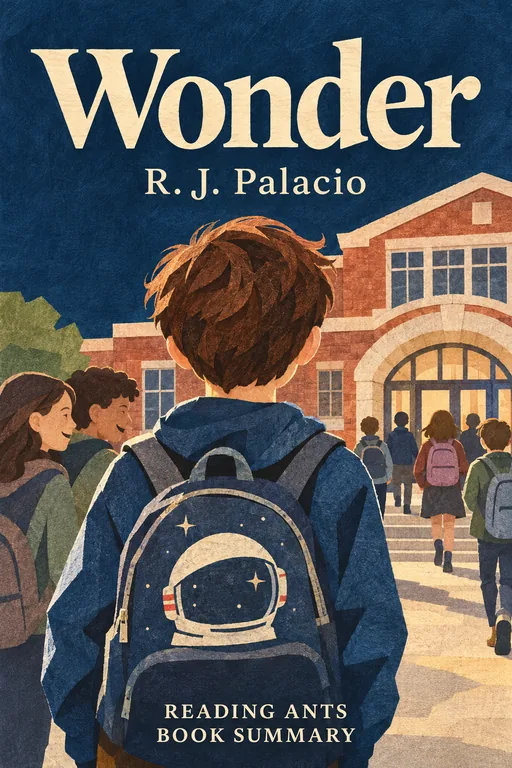
Wonder
R. J. Palacio
A ten-year-old boy born with a rare facial difference goes to school for the first time, and through bullying, friendship and courage he helps everyone around him learn to choose kindness.
🧸 Children's Books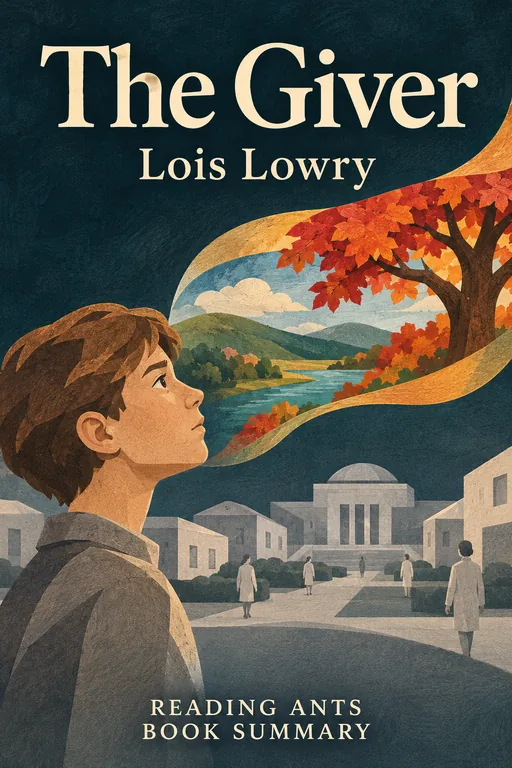
The Giver
Lois Lowry
In a perfectly controlled community with no pain, choice or color, a boy about to turn twelve is chosen to hold the memories of the past, and discovers the terrible price his people pay for their safety.
🎒 Young AdultWant something different?
Pick another topic and we will show you three books to start with.