 Reading Ants
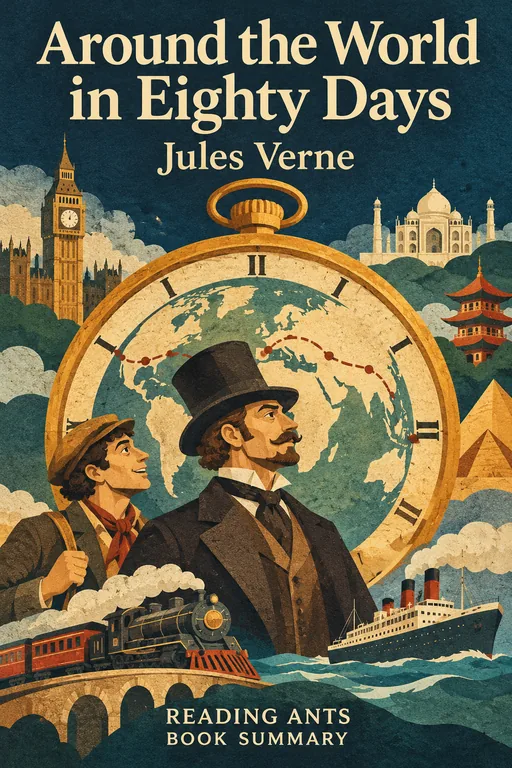
Around the World in Eighty Days
Original title: Le Tour du monde en quatre-vingts jours
A precise English gentleman wagers that new railways and steamships can carry him around the world in eighty days, while delays, rescues and a mistaken detective threaten his schedule.
Overview
Jules Verne’s 1872 adventure follows Phileas Fogg, a wealthy and extremely punctual London gentleman who lives by the clock. When fellow members of the Reform Club doubt a newspaper’s claim that modern transport has made an eighty-day trip around the world possible, Fogg wagers half his fortune, twenty thousand pounds, that he can prove it. He leaves that night with his newly hired French servant, Passepartout. Their route takes them by rail and steamship through Europe, India, East Asia and North America. Unknown to Fogg, Detective Fix believes he is a bank robber and follows him, waiting for permission to arrest him. The novel celebrates global travel and technology while turning timetables into suspense. It also reflects the colonial attitudes of nineteenth-century Europe, which modern readers should approach critically.
Main Characters
- Phileas Fogg: a calm, wealthy Englishman whose exact routine hides courage and generosity.
- Jean Passepartout: Fogg’s energetic French servant, who expected a quiet job and gets an adventure.
- Aouda: an Indian woman rescued by the travelers who becomes their loyal companion.
- Detective Fix: a British detective who wrongly believes Fogg robbed the Bank of England.
- Sir Francis Cromarty: a British officer who travels with Fogg across India.
- Colonel Stamp Proctor: an American traveler whose quarrel with Fogg leads to a later duel.
Full Summary
The Wager
Phileas Fogg follows the same schedule every day and reveals almost nothing about his past. On the day he hires Passepartout, a discussion at the Reform Club turns to a recent bank robbery and a new railway section in India. A newspaper calculates that a person can now circle the globe in eighty days. Other members point out that schedules ignore bad weather and accidents. Fogg wagers twenty thousand pounds, half of his fortune, that he can do it and leaves immediately.
Passepartout is astonished. He had chosen Fogg because he wanted a peaceful life after years of varied jobs. Instead, the two rush to a train with one small bag. Their itinerary runs east through Suez, Bombay, Calcutta, Hong Kong, Yokohama, San Francisco and New York before returning to London.
Across India
At Suez, Fix notices Fogg and decides his appearance matches the suspected bank robber. Fogg’s sudden departure and large supply of cash deepen the detective’s suspicion. Because an arrest warrant has not arrived, Fix follows and befriends Passepartout without revealing his purpose.
In Bombay, Passepartout enters a temple without understanding local rules and escapes after angering priests. Fogg’s party later discovers that the railway across India is unfinished despite the timetable. Fogg calmly buys an elephant and hires a guide. Traveling with Sir Francis Cromarty, they learn that a young widow named Aouda is being forced to die on her husband’s funeral fire. Fogg risks his schedule to save her. Passepartout takes the dead husband’s place beneath the coverings, suddenly rises and carries Aouda away. In Calcutta, Fogg and Passepartout are briefly arrested over the temple incident, but Fogg pays bail and catches the ship east.
Missed Connections
The travelers intend to leave Aouda with a relative in Hong Kong, but discover that he has moved to Europe. She continues with them. Fix still lacks authority to arrest Fogg. When a ship’s departure is moved earlier, Fix tells Passepartout but tries to stop him from warning his employer. He reveals that he is a detective and drugs Passepartout in an opium den.
Fogg and Aouda miss their ship to Yokohama. Fogg hires a smaller vessel to take them toward Shanghai, where they can meet another steamer. Passepartout wakes, boards the original ship alone and reaches Japan without money. He joins an acrobatic troupe to earn food. Fogg finds him during a performance, and the party reunites in Yokohama before crossing the Pacific. Fix now knows he cannot arrest Fogg outside British territory, so he decides to help him return quickly to Britain.
Across America
In San Francisco, the group boards a transcontinental train. They encounter a loud political meeting and Colonel Proctor, who insults Fogg. The rail journey offers spectacular landscapes but constant danger. The train races over a weak bridge before it collapses. A herd blocks the tracks. During an attack by Sioux warriors, Passepartout bravely moves beneath the carriages to separate the engine, helping the passengers survive, but he is captured.
Fogg gives up precious time to rescue his servant with soldiers. Afterward, they use a wind-powered sledge across the snow to reach Omaha and continue east. They arrive in New York just after their ship has sailed. Fogg hires a trading vessel whose captain refuses to go to Liverpool. Through determination and money, Fogg effectively takes command and redirects it. When coal runs short, he buys the ship and burns its wooden upper parts for fuel, reaching British waters.
The Missing Day
As soon as they arrive in Liverpool, Fix arrests Fogg. Hours later, the detective learns that the real bank robber has already been caught and releases him. Fogg races to London but reaches the London station, by his calculation, five minutes too late. Believing himself ruined, he returns home. Aouda, grateful for his kindness and worried about his loneliness, asks to marry him. Fogg discovers that he loves her and sends Passepartout to arrange the wedding.
The clergyman tells Passepartout that the next day is not Monday but Sunday. By traveling east around the globe, the party crossed time zones and gained one calendar day without noticing. Passepartout races home, and Fogg reaches the Reform Club with seconds to spare. He wins the wager. Travel costs have consumed almost all the financial profit, but Fogg has gained Aouda’s love and a life beyond his timetable.
Why It Matters
Around the World in Eighty Days turned the expanding transport networks of the nineteenth century into a new kind of adventure. Steamships, railways and telegraph lines had made distant places seem connected by a single clock. Verne recognized that a timetable could create as much suspense as a battlefield: every rescue, missed ship and mechanical delay costs measurable hours.
The book helped shape popular ideas about global travel and inspired real attempts to beat Fogg’s fictional record, most famously by journalists and adventurers. Its appeal also comes from the contrast between Fogg’s appearance and actions. He seems mechanical and unemotional, yet repeatedly risks time and money to help Aouda and Passepartout. The journey proves that efficiency alone is not a meaningful life. Fogg succeeds because precise planning is joined by loyalty, improvisation and generosity.
Key Takeaways
- Plans need flexibility. Fogg respects schedules, but unfinished tracks, missed ships and danger require creative alternatives rather than panic.
- Time is shaped by perspective. The final twist turns a scientific fact about eastward travel into the difference between defeat and victory.
- Character appears in costly choices. Fogg’s rescue of Aouda and Passepartout shows that people matter more to him than the wager.
- Different strengths support a team. Fogg’s calm, Passepartout’s daring and Aouda’s good sense repeatedly compensate for one another.
- Technology connects and divides. Transport makes the trip possible, but the route also follows networks built through empire and unequal power.
What We Can Learn
The adventure encourages careful preparation without pretending that plans control everything. A useful schedule includes spare time, backup routes and a clear sense of which goals can be sacrificed. When a surprise comes, Fogg rarely wastes energy complaining; he identifies the next workable step.
At the same time, the book shows why efficiency should serve human values. Fogg loses time whenever he chooses to help someone, yet those choices create the relationships that make his journey worthwhile. In school or work, finishing fastest is not always success if teammates are abandoned along the way. The date-line twist also offers a practical lesson: before concluding that a project has failed, check basic assumptions. A mistaken calendar, unit or time zone can matter as much as a dramatic obstacle.
Criticism and Counterpoints
The novel often views the world through a nineteenth-century European colonial lens. Countries can appear as colorful obstacles on a British travel route, and descriptions of Indian, Chinese, Japanese, Indigenous American and other peoples include stereotypes. Its rescue scenes sometimes deny local characters complexity while presenting European travelers as natural problem-solvers.
The geography and technology are partly realistic but arranged for entertainment, and coincidences repeatedly save the schedule. Aouda is brave and intelligent, yet much of her role is to be rescued and then become Fogg’s romantic reward. Some readers also find Fogg too emotionally distant to be convincing. These limitations do not erase the book’s ingenuity, but modern editions with notes can help distinguish historical context from reliable cultural representation.
Who Should Read It
This lively classic suits readers ages ten and up who enjoy races, travel, clever escapes and short episodic chapters. Families and classrooms can use it to discuss time zones, transportation and empire. Readers should be prepared for dated language, cultural stereotypes and brief scenes of danger that reflect its period.
Want the whole book?
A summary is a taste, not the meal. Here is where to find the full book.
You reached the end 🎉
Nicely done. Mark this one as read, and we will suggest what to read next.
Read this next

Journey to the Center of the Earth
Jules Verne
A stubborn professor, his nervous nephew and a calm guide climb down into an Icelandic volcano and find an enormous hidden world beneath the surface of the Earth.
🌍 World Literature
Treasure Island
Robert Louis Stevenson
A boy who finds a pirate's treasure map sails to a distant island, only to discover that the ship's charming one-legged cook is the leader of a band of pirates who want the gold for themselves.
🧸 Children's Books
The Three Musketeers
Alexandre Dumas
A young Gascon swordsman travels to Paris in the 1620s to join the King's Musketeers, befriends three legendary soldiers, and together they fight to protect the Queen's honor against the scheming Cardinal Richelieu and the dangerous Milady.
🌍 World Literature
Gulliver's Travels
Jonathan Swift
A ship's surgeon named Lemuel Gulliver visits four strange lands, from a country of tiny people to one ruled by rational horses, and Swift uses these voyages to mock human pride, politics and folly.
📜 Classics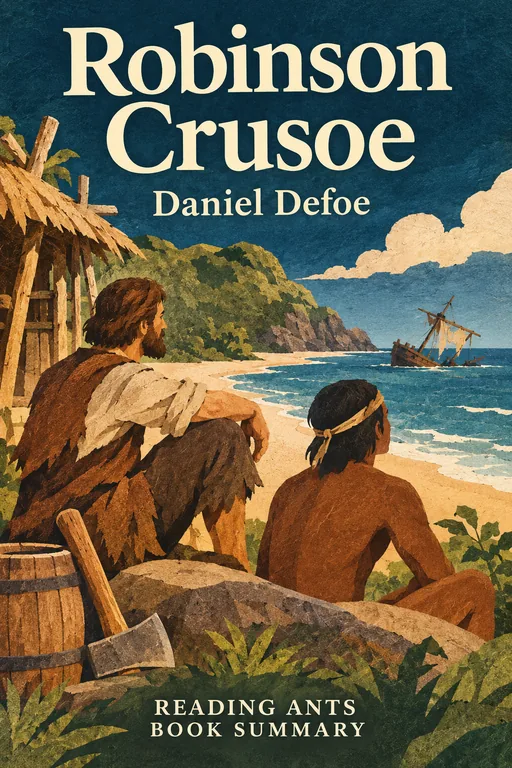
Robinson Crusoe
Daniel Defoe
After a shipwreck, an English sailor named Robinson Crusoe survives for twenty-eight years on a remote island, building a life with his own skill and faith, and eventually befriending a man he calls Friday.
📜 Classics
The Little Prince
Antoine de Saint-Exupery
A pilot stranded in the desert meets a small boy from a tiny planet, who teaches him that the most important things in life, like love and friendship, can only be seen with the heart.
🌍 World LiteratureWant something different?
Pick another topic and we will show you three books to start with.