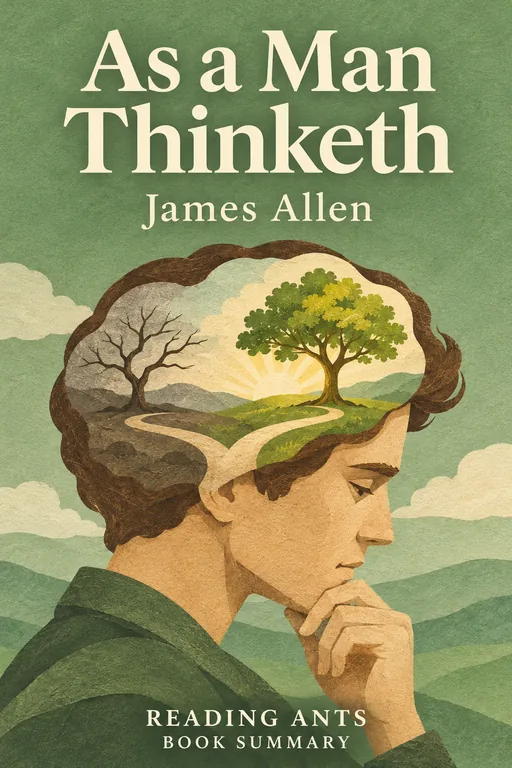
In a short essay, James Allen argues that a person's character and circumstances are the result of their thoughts, so that by controlling and purifying thinking, anyone can shape their life, health and success.
Overview
As a Man Thinketh was published in 1903 by James Allen, an English writer who worked as a private secretary and then retired to a quiet life in a seaside town to write. The title is influenced by a verse in the Book of Proverbs in the Bible, about a person being what he thinks in his heart. The book is very short, only a few dozen pages in most editions, and has seven brief chapters. It reached only a small audience at first, but over time it became a classic of the self-help tradition, and a source of inspiration for later writers. It is written in a calm, formal, almost sermon-like style.
Full Summary
1. Thought and character
The idea: Allen opens with the claim that a man is literally what he thinks, and that his character is the sum of his thoughts. Just as a plant grows from a seed, every act grows from a hidden seed of thought, even acts that seem spontaneous. Cause and effect work as surely in the world of thought as in the physical world, so a noble character is the natural result of long effort in right thinking, and a base one comes from harboring low thoughts. He says that a person is made or unmade by himself, and that anyone who learns to watch, control and alter his thoughts can become the master of his character, his life and his destiny.
In real life: A habit of kind thoughts tends to show up in kind actions.
2. The effect of thought on circumstances
The idea: Allen compares the mind to a garden, which can be cultivated or left to run wild: if no useful seeds are planted, weed seeds will fall in and grow anyway. He says that our circumstances are not random but are closely tied to our inner state, and that circumstance does not make the person but reveals him to himself. A person may think that outside events cause his troubles, but Allen says that, in the long run, a life is the outcome of its thoughts, and that to change one’s situation, one must change one’s mind. He gives three examples of people who blame their circumstances: a poor man who shirks his work and cheats his employer, a rich man who suffers from overeating but will not give up his appetite, and an employer who cuts his workers’ pay unfairly and then blames circumstances when he goes bankrupt. He also says that we cannot directly choose our circumstances, but we can choose our thoughts, and so shape our circumstances indirectly.
In real life: A person who always looks for faults may find that others avoid them.
3. Effect of thought on health and the body
The idea: Allen claims that thought affects the body. Fear, anxiety and ill will, he says, can damage health, and calm and cheerful thoughts support it. He goes so far as to suggest that a person who purifies his thoughts will no longer want unhealthy food, and that changing one’s diet will not help someone who will not change his thoughts. He calls the body the servant of the mind, and says that a mind that is clean and serene will have a healthy body. This is the most extreme of his claims, and not supported by modern medicine.
In real life: Stress can cause headaches or stomach problems, though thoughts alone do not cause every illness.
4. Thought and purpose
The idea: In a chapter on purpose, Allen says that until a person fixes a purpose in his life, his thoughts drift and he is prone to worry and failure. He advises setting a worthy aim and making it the center of one’s thoughts, and giving all one’s energy to it. Even repeated failure, he says, builds strength of character for the one who keeps a purpose. Those who are not ready for a great purpose should at least aim to do their present duty perfectly, however small it seems. He also warns that doubt and fear break up the straight line of effort, and that someone who conquers them has conquered failure.
In real life: A student with a clear goal is less likely to be distracted by passing fads.
5. The thought-factor in achievement
The idea: The essay claims that all achievements, and all failures, are the result of a person’s own thoughts, so individual responsibility is complete: nobody else can make a person strong or weak, and no one but himself can change his condition. Allen applies this even to oppressors and the oppressed, whom he describes as partners in ignorance. A person can rise only by lifting up his thoughts, and achievement of any kind requires sacrifice: the more he wants to achieve, the more he must give up. He adds that victories won by right thought can be kept only by watchfulness, since many people fall back into failure once success feels assured.
In real life: Picturing the kind of person you want to become can guide your daily choices.
6. Visions, ideals and serenity
The idea: In the closing chapters, Allen speaks of the importance of visions and ideals, which he sees as previews of what we can become. He calls dreamers the saviors of the world, names Columbus, Copernicus and Buddha as people who cherished a vision and then realized it, and describes a poor youth who dreams of a better life, uses his spare time to develop his abilities, and eventually leaves his workshop behind. People who talk of luck and chance, he says, do not see the long effort behind another person’s success. The last chapter, on serenity, praises calmness of mind as a sign of wisdom. A calm person, he says, has learned to govern himself, and is loved and respected. The book ends with a call to keep one’s hand on the helm of thought and to find inner peace.
In real life: A calm friend in a crisis helps everyone else to think clearly.
Why It Matters
As a Man Thinketh has been printed and reprinted many times since its publication, and is one of the best-known early self-help works. Because it is in the public domain, it is easy to find in many editions. James Allen is regarded as a pioneer of the self-help movement, and the book has been a source of inspiration to many later motivational and self-help authors. Its message that thoughts shape life has been influential in motivational writing. It remains popular as a short and inspiring read. Though its claims are far from scientific, it has encouraged many people to take responsibility for their thoughts and habits.
Key Takeaways
- Thoughts shape character. Our inner habits become our outer selves.
- We choose thoughts, not events. We cannot directly pick our circumstances, but we can choose our thoughts.
- A clear purpose gives direction. Focus brings energy and persistence.
- Dreams need effort. Visions become real through work.
- Calm is strength. Serenity comes from self-control.
What We Can Learn
You can use the book as a reminder to notice your own thoughts, and to try to replace harmful ones, such as resentment, with constructive ones. Set a goal that matters to you, and think about it daily. Practice staying calm in a difficult moment, perhaps by taking a few deep breaths. At the same time, do not take the claims literally: not all misfortune is caused by one’s thinking, and illness and poverty have many causes. Combine the book’s encouragement with practical action and good advice.
Criticism and Counterpoints
Critics say that Allen’s claim that circumstances are entirely the result of thought is false and unkind, since it ignores social, economic and biological factors, and may lead people to blame themselves for hardship. His statements on health are not supported by medical evidence. Others note that the book is vague and moralistic, with little practical guidance on how to change thinking. The style, formal and old-fashioned, may not appeal to modern readers. Some also say that it paved the way for the exaggerations of the law-of-attraction movement. Still, many value its calm message.
Who Should Read It
This book is for readers who want a brief, old-fashioned dose of inspiration, and who are interested in the history of self-help. It can be read in less than an hour, and is in the public domain. Those who prefer an evidence-based approach to thinking and mood might read modern books on cognitive therapy.
Want the whole book?
A summary is a taste, not the meal. Here is where to find the full book.
You reached the end 🎉
Nicely done. Mark this one as read, and we will suggest what to read next.
Read this next

The Secret
Rhonda Byrne
Rhonda Byrne presents the "law of attraction," the claim that thoughts and feelings attract matching events, so that by focusing on what you want and believing you will receive it, you can gain wealth, health and happiness.
🌱 Self-Improvement
The Power of Positive Thinking
Norman Vincent Peale
Minister Norman Vincent Peale teaches that faith, a hopeful attitude and the practice of positive thinking and prayer can help people to overcome fear, worry and failure, and to live more confident and effective lives.
🌱 Self-Improvement
Think and Grow Rich
Napoleon Hill
Napoleon Hill claims that wealth and success begin with a burning desire, firm belief and persistent action, and presents thirteen principles he says were distilled from the habits of successful people.
🌱 Self-Improvement
Meditations
Marcus Aurelius
The private notebook of a Roman emperor, reminding himself daily to accept what he cannot control, to act with justice and kindness, and to remember that life is short.
🕊️ Philosophy & Religion
The Untethered Soul
Michael A. Singer
Michael Singer teaches that we are not the constant chatter in our heads but the awareness that watches it, and that by stepping back and letting go of stored emotional blocks, we can find a freedom and inner peace that do not depend on circumstances.
🌱 Self-Improvement
Atomic Habits
James Clear
Big changes in life come not from huge leaps but from tiny habits repeated every day, and you can build good habits (and break bad ones) by designing your life so the right choices are obvious, attractive, easy and satisfying.
🌱 Self-ImprovementWant something different?
Pick another topic and we will show you three books to start with.