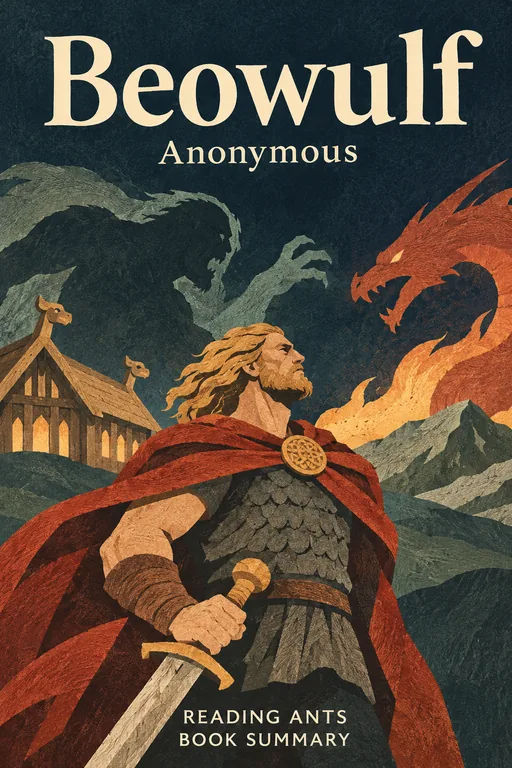
Beowulf
A mighty young warrior sails to Denmark to defeat a monster terrorizing a king's great hall, then battles the monster's vengeful mother, and decades later, as an old king, gives his life fighting a dragon.
Overview
Beowulf is the oldest surviving long poem in English, written in Old English, an early form of the language that looks almost foreign to modern readers. It survives in a single manuscript from around the year 1000, though the story may be older. Set in Scandinavia in the sixth century, it tells of Beowulf, a hero of the Geats, a people from what is now southern Sweden. He comes to the aid of Hrothgar, king of the Danes, whose great mead-hall, Heorot, has been attacked night after night by a terrifying monster named Grendel. The poem celebrates courage, loyalty and generosity, while reflecting on the passing of time and the certainty of death.
Main Characters
- Beowulf: a strong, courageous young warrior of the Geats.
- Hrothgar: the aging king of the Danes, builder of Heorot.
- Grendel: a monstrous descendant of Cain who attacks Heorot.
- Grendel’s mother: a fierce monster who seeks revenge for her son.
- Unferth: a Danish warrior who doubts Beowulf.
- Wealhtheow: Hrothgar’s gracious queen.
- Wiglaf: a loyal young warrior who stands by Beowulf at the end.
- The dragon: a fire-breathing creature guarding a treasure hoard.
Full Summary
Heorot and Grendel
King Hrothgar of the Danes builds a magnificent mead-hall called Heorot, where his warriors feast, drink and listen to poets singing. But the noise of celebration angers Grendel, a monstrous creature who lives in the dark marshes and is descended from Cain, the first murderer in the Bible. One night, Grendel bursts into Heorot and carries off thirty warriors to eat them. For twelve years, he attacks the hall, and no one can stop him.
Beowulf Arrives
News of Hrothgar’s suffering reaches Beowulf, a young warrior of the Geats with the strength of thirty men. He sails to Denmark with fourteen companions to help. At a feast, a jealous Danish warrior, Unferth, mocks Beowulf, claiming he once lost a swimming contest. Beowulf replies calmly that he won, having fought sea monsters along the way, and points out that if Unferth were as brave as he claims, Grendel would not be terrorizing Heorot.
The Fight with Grendel
That night, Beowulf and his men sleep in Heorot. Beowulf has decided to fight Grendel without weapons, since the monster uses none. Grendel arrives and devours one of the Geats. Then he grabs Beowulf, and finds himself caught in the strongest grip he has ever felt. They wrestle violently, shaking the hall. At last, Beowulf tears Grendel’s arm off at the shoulder. The monster flees into the marshes to die. Beowulf hangs the arm high in the hall as a trophy, and Hrothgar rewards him with rich treasures.
Grendel’s Mother
The next night, Grendel’s mother attacks Heorot to avenge her son. She kills Æschere, Hrothgar’s most trusted adviser, and carries his body away. Beowulf follows her trail to a dark, eerie lake surrounded by monsters. Armed with a famous sword lent to him by Unferth, he dives into the water and swims down for a long time until he reaches her underwater cave.
They fight fiercely. Unferth’s sword cannot pierce her skin, and she nearly kills Beowulf. Then he sees a giant’s ancient sword on the wall of the cave, grabs it and cuts off her head. He also finds Grendel’s body and beheads it. The magic blade melts in the monster’s poisonous blood, leaving only the hilt. Beowulf returns to Heorot with Grendel’s head and the hilt. Hrothgar thanks him and gives wise advice, warning him against pride and reminding him that strength and life do not last forever.
King of the Geats
Beowulf returns home and is welcomed with honor. After the deaths of the Geat king and his son, Beowulf becomes king himself and rules wisely for fifty years.
The Dragon
When Beowulf is old, a thief steals a jeweled cup from a dragon’s treasure hoard, hidden in an ancient burial mound. The furious dragon begins burning the land, including Beowulf’s own hall. Though aged, Beowulf decides to fight it, accompanied by eleven warriors. When the battle begins and the dragon’s flames engulf him, all his men flee except one: a young warrior named Wiglaf, who stands by his king.
Together they fight the dragon. Beowulf’s sword breaks, and the dragon bites him in the neck. Wiglaf strikes the dragon, and Beowulf, with his last strength, kills it with a knife. But the dragon’s poison spreads through Beowulf’s body. Dying, he asks Wiglaf to bring him some of the treasure so he can see what he has won for his people, and gives Wiglaf his gold collar and armor, telling him that he is the last of their family.
The Funeral
Wiglaf angrily scolds the warriors who fled, warning that the Geats will now be attacked by their enemies. The Geats build a great funeral fire for Beowulf and bury his ashes with the dragon’s treasure in a tall mound on a cliff by the sea, so that sailors will see it from afar. A woman sings a lament, fearing hard times ahead. The warriors ride around the mound, praising Beowulf as the kindest and most generous of kings, and the most eager for fame.
Why It Matters
Beowulf is one of the most important works of early English literature and a key source for understanding Anglo-Saxon culture, language and values. The only surviving manuscript was damaged in a fire in 1731 and is now kept at the British Library.
The poem has had an enormous influence on modern fantasy. J. R. R. Tolkien, a scholar of Old English, gave a famous lecture in 1936 arguing that the monsters were central to the poem’s meaning, and the dragon guarding a hoard in The Hobbit owes much to Beowulf. The poet Seamus Heaney’s 1999 translation became a bestseller, and the story has inspired novels, films and graphic novels.
Key Takeaways
- Courage defines a hero. Beowulf faces every danger without fear.
- Loyalty matters most. Wiglaf’s faithfulness contrasts with the warriors who flee.
- Fame can outlive us. Heroes seek glory that will be remembered after death.
- Pride is dangerous. Hrothgar warns that strength fades.
- Life is fleeting. Even the greatest heroes grow old and die.
What We Can Learn
Beowulf teaches us about courage and responsibility. Beowulf helps people who are suffering, even when the danger is great, and later fights to protect his own people.
It also shows the importance of loyalty. When things get frightening, most of Beowulf’s companions run away, but Wiglaf stays. Being someone who stands by friends in hard times is one of the most admirable qualities a person can have.
Finally, the poem reminds us that strength and success don’t last forever, so we should use our gifts wisely and be generous while we can.
Criticism and Counterpoints
Many readers find Beowulf hard to approach because the original is in Old English, and translations vary greatly in style. The poem’s structure can feel uneven, with long digressions into other stories and family histories that interrupt the main action.
Critics have also debated the poem’s mixture of pagan heroic values and Christian ideas, since the poet seems to be a Christian writing about pre-Christian warriors. Modern readers may find its focus on male warriors, revenge and treasure distant from their own values, and some retellings, such as John Gardner’s novel Grendel, tell the story from the monster’s side.
Who Should Read It
This poem suits older teens and adults interested in mythology, history and fantasy. A modern translation, such as Seamus Heaney’s or Maria Dahvana Headley’s, makes it much more accessible. Fans of Tolkien will enjoy seeing where many fantasy traditions began.
Want the whole book?
A summary is a taste, not the meal. Here is where to find the full book.
You reached the end 🎉
Nicely done. Mark this one as read, and we will suggest what to read next.
Read this next
The Hobbit
J. R. R. Tolkien
A comfortable, home-loving hobbit is swept into a dangerous quest with thirteen dwarves to win back their treasure from a dragon, and discovers along the way that he is far braver and cleverer than he ever imagined.
🧸 Children's Books
The Odyssey
Homer
After the Trojan War, the clever hero Odysseus struggles for ten years against monsters, gods and temptations to return home to his faithful wife and son, then must win back his house from the men trying to steal it.
🎭 Epics, Drama & Poetry
The Epic of Gilgamesh
Anonymous
A proud, powerful king of ancient Mesopotamia gains a true friend, loses him to death, and journeys to the edge of the world in search of eternal life, only to learn that what lasts is the life and legacy we leave behind.
🎭 Epics, Drama & PoetrySir Gawain and the Green Knight
Anonymous
When a mysterious green giant challenges King Arthur's court to a beheading game, the young knight Gawain accepts, and a year later must keep his word, in a test of courage, honesty and temptation.
🎭 Epics, Drama & Poetry
The Iliad
Homer
During the final year of the Trojan War, the great Greek warrior Achilles withdraws from battle in anger, and only the death of his dearest friend drives him back to fight, leading to terrible loss and a moment of shared human grief with his enemy.
🎭 Epics, Drama & Poetry
Hamlet
William Shakespeare
A grieving prince of Denmark learns from his father's ghost that his uncle murdered the king to take the throne, and his struggle to decide whether and how to take revenge leads to madness and death.
🎭 Epics, Drama & PoetryWant something different?
Pick another topic and we will show you three books to start with.