 Reading Ants
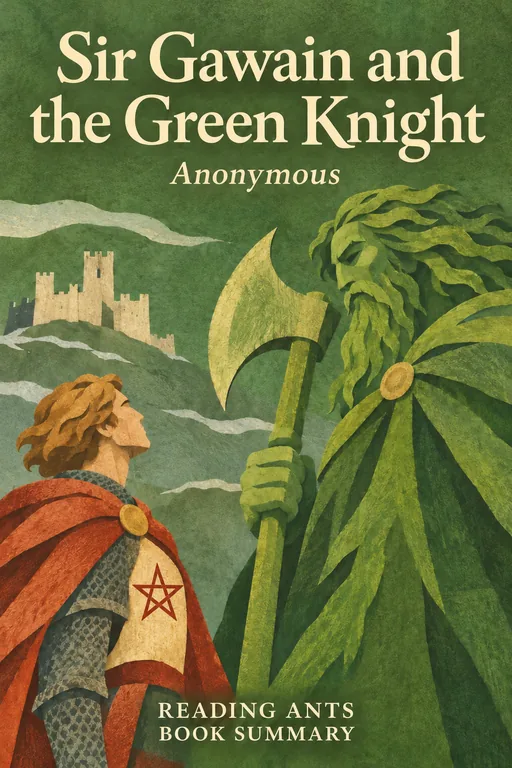
Sir Gawain and the Green Knight
When a mysterious green giant challenges King Arthur's court to a beheading game, the young knight Gawain accepts, and a year later must keep his word, in a test of courage, honesty and temptation.
Overview
Sir Gawain and the Green Knight is an anonymous poem in Middle English, written in the late fourteenth century, in a northwest Midlands dialect of Middle English. It survives in a single manuscript, which also contains three other poems, and its author, often called the Gawain poet or the Pearl poet, is unknown. It is one of the finest of the Arthurian romances, a story of chivalry and testing, written in rhymed, alliterative verse. It has been translated by writers such as J. R. R. Tolkien and the poet Simon Armitage, and adapted for film, and still fascinates modern readers.
Main Characters
- Sir Gawain: King Arthur’s nephew, a young knight, known for his courtesy and courage.
- The Green Knight: a huge, green-skinned stranger, who is both menacing and mysterious.
- King Arthur: the king of Camelot, who presides over the festival.
- Queen Guinevere: Arthur’s queen, who watches the challenge.
- Lord Bertilak: a cheerful lord, who hosts Gawain in his castle.
- The Lady: Bertilak’s beautiful wife, who tempts Gawain.
- The old lady: an elderly woman in the castle, who is revealed to be a powerful sorceress.
Full Summary
The challenge at Christmas
At a New Year’s feast at Camelot, King Arthur says that he will not eat until he has seen or heard a marvel. Suddenly, a huge knight, entirely green, even to his skin and his horse, rides into the hall, carrying a great axe and a holly branch. He says that he has come for a game: he will let anyone strike him with the axe, on condition that the same person will receive a blow in return a year later. The court is silent, afraid.
The beheading
Arthur himself stands up to accept, but Gawain, the youngest of the knights, asks to take the king’s place, saying that it would be better that he, the weakest, should be lost. The Green Knight kneels, and Gawain strikes off his head with a single blow. The head rolls across the floor, and the Green Knight picks it up, and the head speaks, reminding Gawain to seek him at the Green Chapel in a year, and rides away. The court tries to laugh it off, but Gawain knows that he has made a serious promise.
The journey
A year passes, and, as winter nears, just after the feast of All Hallows’ Day, Gawain sets out in his armor, with his shield showing a pentangle, a five-pointed star that symbolizes his virtues. He rides through winter and wilderness, fighting monsters and enduring cold, and prays for a place to hear Christmas Mass. At last he comes upon a splendid castle, where the lord, Bertilak, welcomes him warmly. After the Christmas feast, Gawain asks about the Green Chapel, and Bertilak laughs and says that it is only a couple of miles away and that Gawain may rest at the castle until the day he must go.
The exchange of winnings
Bertilak proposes a game: for three days, he will go hunting, and Gawain will remain in the castle, resting, and at the end of each day they will exchange whatever they have won. Gawain agrees. Each day, while the lord hunts a deer, a boar and a fox, the lady of the castle visits Gawain in his bedroom and tries to seduce him. Gawain, torn between politeness and his sense of honor, gently resists, accepting from her only kisses, which, as agreed, he gives to the lord.
The girdle
On the third day, the lady offers Gawain a green silk girdle, which she says has magic that will protect him from any blow. Tempted, since he expects to face death, Gawain accepts it, and promises to keep it secret. That evening, he gives the lord the kisses, but he hides the girdle, breaking the terms of the game. The next morning, he sets out for the Green Chapel, wearing the girdle around his waist, and ignoring a guide who warns him to run away.
The Green Chapel
At the chapel, which is a grassy mound, Gawain finds the Green Knight sharpening his axe. He bows his head. The Knight swings, and stops short when Gawain flinches, and mocks him for it. Gawain steadies himself, and the Knight feints a second time, and Gawain does not move. The third time, he nicks Gawain’s neck, drawing a little blood. Then he reveals himself as Lord Bertilak, who has been testing Gawain on the orders of Morgan le Fay, the sorceress, who wanted to test the Round Table and frighten Queen Guinevere. He explains that the nick was for the hidden girdle, and praises Gawain for his honesty in all else.
Return to Camelot
Gawain is ashamed, and he returns to Camelot, wearing the green girdle as a sign of his failure. The court, instead of mocking him, laughs and adopts the green band as an emblem, a badge of honor for all. But Gawain remains troubled by his lapse, a reminder that even the best knights are not perfect. The poem ends with a prayer, and the sense that all have been tested, and that humility is needed.
Why It Matters
Sir Gawain and the Green Knight is considered a masterpiece of Middle English poetry, and one of the greatest Arthurian stories. It combines adventure, humor and a serious meditation on honor, fear and human frailty. The poet’s use of nature, the seasons, and a vivid sense of place give it great beauty. It has been influential in modern fantasy, and was translated by J. R. R. Tolkien, who admired its craftsmanship. The poem raises enduring questions about integrity, truth and courage, and has been adapted for stage, film and many new translations.
Key Takeaways
- Keep your word. Gawain honors a rash promise.
- Courage is tested. Fear of death leads him to accept the girdle.
- Honor is not perfect. Even the best knight makes a mistake.
- Temptation takes many forms. The lady’s attempts test his courtesy and loyalty.
- Humility follows failure. Gawain’s shame teaches him about himself.
What We Can Learn
You can learn from Gawain that making a promise, even in a heroic moment, can carry a heavy cost, and that honesty is tested when we are afraid. The poem also shows that being human means failing sometimes, and that the right response is honesty and humility, not denial. If you read it in a good modern translation, notice how the poet uses the changing seasons to reflect Gawain’s journey, and how humor and danger go together. It may lead you to reflect on your own values.
Criticism and Counterpoints
Some readers find the poem’s language hard, even in translation, and its alliterative form unfamiliar. Others think that the ending is puzzling, since Gawain’s guilt seems out of proportion to his small fault, and the Green Knight’s explanation, that Morgan le Fay was behind it all, seems tacked on. Scholars debate whether the poem is a celebration of chivalry or a critique of it, and whether the green girdle is a mark of shame or of wisdom. Others point out that the female characters are used mainly as tools of testing.
Who Should Read It
This book is for readers from about thirteen who enjoy legends, fantasy and poetry, and who are prepared for an older style. A good modern translation, such as Tolkien’s or Simon Armitage’s, makes it accessible. Readers who like it may enjoy Beowulf or Le Morte d’Arthur.
Want the whole book?
A summary is a taste, not the meal. Here is where to find the full book.
You reached the end 🎉
Nicely done. Mark this one as read, and we will suggest what to read next.
Read this next
The Canterbury Tales
Geoffrey Chaucer
A group of about thirty pilgrims on the road from London to Canterbury pass the time by telling stories, in a poem that paints a lively picture of English society in the late fourteenth century.
🎭 Epics, Drama & Poetry
Beowulf
Anonymous
A mighty young warrior sails to Denmark to defeat a monster terrorizing a king's great hall, then battles the monster's vengeful mother, and decades later, as an old king, gives his life fighting a dragon.
🎭 Epics, Drama & Poetry
The Odyssey
Homer
After the Trojan War, the clever hero Odysseus struggles for ten years against monsters, gods and temptations to return home to his faithful wife and son, then must win back his house from the men trying to steal it.
🎭 Epics, Drama & Poetry
The Iliad
Homer
During the final year of the Trojan War, the great Greek warrior Achilles withdraws from battle in anger, and only the death of his dearest friend drives him back to fight, leading to terrible loss and a moment of shared human grief with his enemy.
🎭 Epics, Drama & Poetry
Hamlet
William Shakespeare
A grieving prince of Denmark learns from his father's ghost that his uncle murdered the king to take the throne, and his struggle to decide whether and how to take revenge leads to madness and death.
🎭 Epics, Drama & Poetry
The Epic of Gilgamesh
Anonymous
A proud, powerful king of ancient Mesopotamia gains a true friend, loses him to death, and journeys to the edge of the world in search of eternal life, only to learn that what lasts is the life and legacy we leave behind.
🎭 Epics, Drama & PoetryWant something different?
Pick another topic and we will show you three books to start with.