 Reading Ants
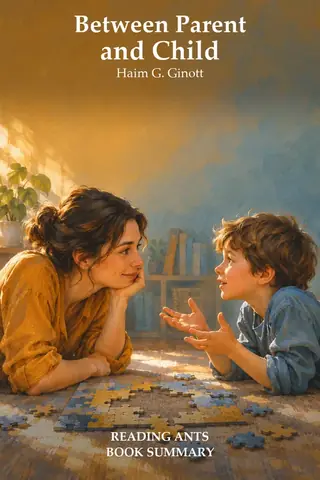
Between Parent and Child
A child psychologist argues that the words parents use shape how children see themselves, and he teaches parents to respond to feelings with empathy, to praise effort instead of character, and to set limits without insult.
Overview
Between Parent and Child was first published in 1965 by Haim Ginott, a child psychologist and parent educator who began his career as a teacher. It stayed on the bestseller list for more than a year and remained popular for decades. A revised and updated edition appeared in 2003, edited by his widow Alice Ginott and by H. Wallace Goddard. Ginott’s central idea is that how parents speak to children matters as much as what they decide. The book is full of short dialogues that set a poor reply next to a better one, which made the ideas easy to copy at home. Adele Faber and Elaine Mazlish, authors of How to Talk So Kids Will Listen, credit his parenting classes as the inspiration for their own books.
Full Summary
1. Feelings first
The idea: Ginott starts from the view that an upset child needs to be understood before anything else can happen. When a child is angry or sad, parents often deny the feeling, give advice or argue. He suggests naming the feeling in a few plain words, so the child sees that the parent understands. Naming an emotion tends to calm a child and makes a real conversation possible. Accepting a feeling is not the same as approving of every action that comes from it.
In real life: A boy says that school is awful, and his mother answers that it sounds like a hard day, instead of telling him it is not so bad.
2. Praise that describes
The idea: Ginott argues that praise and criticism which judge the child can leave children anxious and defensive. Praise works better when it describes what the child did and what the parent sees, and it should be realistic, since inflated praise makes children doubt the adult. Calling a child a great artist or a great kid teaches little. Saying what is good about the work lets the child reach the conclusion alone. In the same spirit, criticism should deal with the behavior at hand and never attack the child’s character.
In real life: A parent says, “I can see how long you worked on that puzzle,” instead of telling the child he is a genius.
3. Limits on acts, not on wishes
The idea: The book separates what a child feels or wants from what a child may do. All feelings and wishes can be accepted, while some actions cannot. One classroom summary of his method gives a sequence: recognize the wish, state the limit, show a way to meet the wish at least in part, and let the child voice resentment about the rule. Reviewers describe his advice on discipline as correcting without demeaning and avoiding threats, bribes, sarcasm and punishment, so the child’s dignity stays intact.
In real life: A parent says that cars are not for throwing and hands the child a ball to throw outside.
4. Responsibility and values
The idea: Ginott treats responsibility as something children grow into, not something that can be forced on them. Catalog entries for the book describe a chapter on teaching values and valuable behavior instead of demanding compliance. The thread is that children learn more from the example and respect of adults than from orders, and that obedience gained through pressure does not build inner standards of their own.
In real life: A mother lets her ten-year-old plan a family dinner, and accepts that the menu is not what she would have chosen.
5. Anger without insult
The idea: Ginott is honest that parents get angry. He says anger is normal and that parents need not feel guilty for having it, as long as they do not attack the child’s character. The advice is to say what you see, what you feel and what you expect, speaking about yourself instead of calling the child names. In this way anger can bring some relief to the parent and some understanding to the child.
In real life: A father says that he is angry about the broken window and that it needs fixing, and does not call his son careless.
6. Jealousy and anxiety
The idea: The book also gives chapters to two common troubles of childhood. Jealousy between children is treated as natural and expected, with roots in a young child’s wish to be the one most loved, and parents are urged to acknowledge it instead of denying it. On anxiety, the book speaks of giving children emotional safety. Parents cannot remove every worry, but the way they respond can lessen it.
In real life: A girl who is afraid of the dark is listened to and given a night light, and is not told there is nothing to fear.
Why It Matters
Between Parent and Child helped establish the idea that how parents talk to children is a skill that can be learned. Its publisher says the book has helped millions of parents and that its methods influenced a generation of parenting experts. Ginott’s emphasis on empathy and on respect for children’s feelings, together with his warnings about judging praise and criticism, shaped later parenting writing, including the books of Faber and Mazlish, who learned from his classes. The book also made the point that parents set the emotional climate of a home, and that a few well-chosen words can turn a bad moment into a better one. The 2003 revision shows that readers still wanted his advice decades after it first appeared.
Key Takeaways
- Accept feelings. Name what the child feels before trying to fix or correct anything.
- Describe, do not judge. Praise effort and criticize specific events, not the child’s character.
- Limit acts, not wishes. A child may feel anything, but not do anything.
- Teach values. Responsibility grows from respect and example more than from demanded obedience.
- Express anger carefully. Say what you feel and see, without insults or name-calling.
What We Can Learn
Pick one conversation this week where you would normally argue or give advice, and try a different first reply. Instead of saying that it is not that bad, say what you hear: “That sounds really frustrating.” Wait, and listen to the answer.
Watch your praise as well. When your child does something well, describe the effort or the result in plain words and leave out the labels. And when you are angry, say what you feel and what needs to change, without attacking your child. If you set a limit, offer something the child may do instead. Small changes in words add up over time.
Criticism and Counterpoints
The book reflects the era of its first edition, and the 2003 revision was meant to refresh it for a new century. Some readers may find the sample dialogues too neat, since real children do not always answer as calmly as the examples suggest. Ginott’s advice grew out of his work as a clinician and teacher, and its claims about praise were not tested in the experiments that came later.
Those later debates are mixed. Carol Dweck’s research found that praising intelligence can hurt motivation while praising effort helps, which fits Ginott’s view, but she did not conclude that parents should stop praising. Critics such as Alfie Kohn go further and warn against praise in general, while others argue that children need encouragement. The advice also takes patience and presence that busy parents may find hard to give in the heat of a moment.
Who Should Read It
This book is for parents, teachers and counselors who want to improve how they talk with children. It is clear, practical and full of examples, and it is a classic of the field. Readers who prefer research-heavy or modern treatments may find it dated, but it remains a good starting point for communication skills.
Want the whole book?
A summary is a taste, not the meal. Here is where to find the full book.
You reached the end 🎉
Nicely done. Mark this one as read, and we will suggest what to read next.
Read this next

How to Talk So Kids Will Listen and Listen So Kids Will Talk
Adele Faber and Elaine Mazlish
Parents can get better cooperation and closer relationships by acknowledging children's feelings, describing problems instead of blaming, and using simple, respectful communication skills.
🎓 Parenting & Education
Siblings Without Rivalry
Adele Faber and Elaine Mazlish
Two parent-group leaders argue that sibling fights are normal but not hopeless, and show how listening to feelings, refusing to compare, and teaching children to settle their own disputes can make home calmer.
🎓 Parenting & Education
Peaceful Parent, Happy Kids
Laura Markham
A parenting writer and clinical psychologist argues that peaceful, cooperative children grow best when parents first regulate themselves, then build connection, and then coach their children's feelings and behavior without punishment.
🎓 Parenting & Education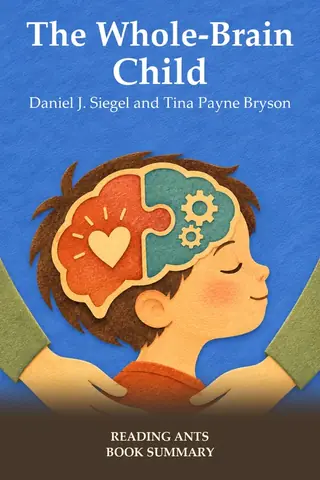
The Whole-Brain Child
Daniel J. Siegel and Tina Payne Bryson
Understanding how a child's brain develops helps parents respond to tantrums, fears and conflicts in ways that connect, calm and teach, so that different parts of the brain work together.
🎓 Parenting & Education
Positive Discipline
Jane Nelsen
Jane Nelsen argues that children behave better when they are treated with both kindness and firmness, and she offers practical tools, such as family meetings and logical consequences, to teach them responsibility without punishment or pampering.
🎓 Parenting & Education
No-Drama Discipline
Daniel J. Siegel and Tina Payne Bryson
Two brain-science authors argue that discipline means teaching rather than punishing, and that a parent who first calms and connects with an upset child can then guide the child toward better choices without screaming, threats or drama.
🎓 Parenting & EducationWant something different?
Pick another topic and we will show you three books to start with.