 Reading Ants
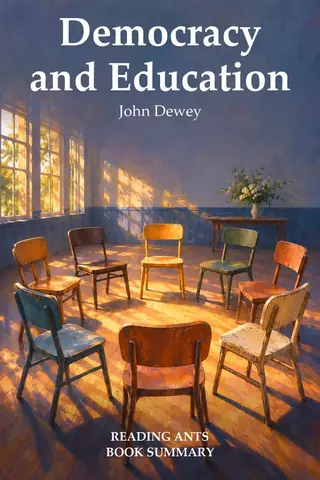
Democracy and Education
John Dewey argues that education is how a society renews itself, that real learning comes from active, shared experience and thoughtful problem solving, and that a democracy needs schools that give everyone a chance to take part and keep growing.
Overview
Democracy and Education: An Introduction to the Philosophy of Education is a book by the American philosopher John Dewey, published in 1916. It is a long work in twenty-six chapters, and it ends each chapter with a short summary, which this summary draws on heavily. Dewey starts from a simple fact: every society must pass its knowledge, habits and hopes to its young, who arrive knowing nothing of them. From this he builds a full theory of what education is, how children learn, what schools should do and why a democratic society needs a particular kind of education. The book is serious and abstract, and it is one of the best-known works on the philosophy of education.
Full Summary
1. Education is how a society renews itself
The idea: Dewey begins with the observation that living things keep going by renewing themselves. A society, he says, does this through education. Individuals are born and die, so the group’s beliefs, ideals and skills can continue only if they are passed on to the young. This happens mainly through communication, which is the sharing of experience until it becomes common property. Education is therefore not a luxury added to life, but a necessary part of it, in the same way that eating and reproduction are necessary for the body.
From the book: Dewey points out that when we say life, we usually mean more than biology. A biography of a person describes their family, work, struggles and hopes, and we speak of the life of a people in the same way.
In real life: A new member of a sports team learns what the team cares about by playing with them, not only by hearing rules. A society works the same way on a larger scale.
2. The school as a special kind of environment
The idea: Children are not educated by having beliefs poured into them, but through the surroundings that call out their activity. The social surroundings teach most when a child takes part in shared activity and sees how his own part fits the whole. Dewey says the school has three jobs as an environment. It should simplify, by choosing basic features of life that young people can understand and then moving gradually to more complicated ones. It should purify, by leaving out the trivial and harmful parts of the existing world. And it should balance, by giving each child a chance to escape the limits of the group they were born into and meet a wider world.
In real life: A good science class, a school play or a garden project gives students a clear, well-chosen piece of real life to work in. It is neither a copy of the whole messy world nor a list of facts to memorize.
3. Guiding, not forcing
The idea: Dewey says that the natural impulses of the young do not fit the customs of their group, so they have to be guided. But guidance is not the same as physical compulsion or commands. It means centering a child’s energy on some definite aim and giving it order and continuity. Dewey warns that when we are most aware of controlling others, through orders and praise or blame, we exaggerate how important this is. Much of what shapes children comes from the setting and from what everyone around them is doing.
In real life: A teacher who sets up an interesting problem and lets students work toward the solution may direct them more effectively than one who barks instructions.
4. Education is growth, and growth has no goal beyond more growth
The idea: Dewey says that children have two features that make growth possible: they depend on others, and they are plastic, meaning they can learn from experience. Growth, he says, is the real mark of life, and it should not be measured against a fixed picture of the adult. He argues that there is nothing outside education to which it should be subordinate except more education. A school has done its work well when students keep wanting to learn and have the habits to do so. He also gives a technical definition: education is the reorganizing of experience so that it adds to its meaning and increases our ability to steer later experience.
In real life: A student who finishes school hungry to learn more has been educated in Dewey’s sense, even if he forgot some facts. One who knows many facts but has lost curiosity has not.
5. Not mere preparation for later
The idea: Dewey criticizes the idea that school is just getting ready for some future duty. This makes teachers and students look away from what is available now, and it defeats its own purpose. He also questions the idea that education is simply an unfolding of what is already inside a child. Instead, he says, education should use the past as a resource for building a developing future and should treat each stage of life as having value of its own. Habits have an important place, but active habits that involve thought and invention are different from routine, which stops growth.
In real life: Telling a ten-year-old that fractions will matter when they grow up is not as helpful as letting them use fractions to double a recipe today.
6. Democracy as a way of living together
The idea: Because education is a social process, we need to ask what kind of society we want it to serve. Dewey offers two tests of a good society: how many interests its members share, and how freely it interacts with other groups. A society that sets up barriers inside or outside is poor. A society is democratic to the degree that everyone shares in its good on equal terms and that its institutions can be adjusted through free interaction. Such a society needs an education that gives people an interest in social relations and the habits of mind to change things without disorder.
From the book: Dewey compares three historical philosophies. Plato’s ideal was close to this one but treated a class, not the individual, as the unit. The Enlightenment looked to all humanity but fell back on Nature. And the nineteenth-century state-centered view used the nation as the agent but narrowed its concern to its own members.
In real life: A school where students from different backgrounds work together on common projects is practicing democracy more than one that only teaches the rules of government.
7. Aims, interest and discipline
The idea: Dewey explains that a real aim is the result of an activity brought to awareness and used to guide choices. It means foreseeing the consequences of different ways of acting and using that foresight to direct one’s observation and experiments. An aim forced on a student from outside, by contrast, is rigid and makes thinking pointless. He tests three popular aims, natural development, social efficiency and cultural enrichment, and finds that each is partial and can conflict with the others. Interest and discipline, he says, are not opposites but two sides of an activity with a purpose: to be interested is to identify with a goal, and discipline is the steady attention that reaching it requires.
In real life: A student building a model rocket sticks with a hard step because she wants the rocket to fly. The wish and the effort are one thing.
8. Thinking, method and the content of study
The idea: In his chapters on thinking, Dewey says that experience always combines doing something with undergoing the results. Thinking is the careful tracing of connections between what we do and what follows. It begins when a situation is puzzling, leads to a suggested solution, is worked out by reasoning and is finally tested by action. Good teaching therefore needs a genuine activity, a real problem within it, the information to deal with it, solutions the pupil develops, and a chance to try them out. For the content of study, he says the best starting points are simple active occupations that have a social origin and use, through which students gradually reach science and the other subjects. He warns against narrow job training for the many and a classical education for the few, and he argues that school subjects should be tied to action so that knowledge and character grow together.
In real life: A class that must plan and cost a garden uses arithmetic, biology and teamwork, and sees why each matters.
Why It Matters
Democracy and Education is among the most influential books about schooling ever written. Its central claim, that learning is active and social and that schools should prepare people to take part in a democracy, shaped the progressive education movement and still colors debates about project-based and inquiry-based learning. Education students still read it as a core text, and many of its phrases and ideas have become part of the language of teachers. According to one source, however, its ideas were never fully carried into American schools, which makes it a book more often admired than followed. It remains valuable because it connects classroom questions to larger ones about what a free society needs from its citizens.
Key Takeaways
- Education renews society. Each generation must learn the knowledge and values of the one before, and schools are a central way this happens.
- Learning is active and shared. People learn best by taking part in meaningful activities with others, not by being given facts.
- Growth is the aim. Education should leave people able and eager to keep learning, since there is nothing beyond growth that education serves.
- Democracy needs shared interests. A good society lets everyone take part on equal terms and keeps open contact between groups.
- Thinking is problem solving. Real thinking starts with a puzzle in a real activity and ends with testing ideas in action.
What We Can Learn
For students, Dewey offers a way to judge your own learning: ask whether you are working on a real problem and whether you see how the pieces connect. If you are, you are probably learning deeply. If not, try to turn the task into a question you care about, such as using a history project to answer something you wonder about.
For parents and teachers, the book suggests giving children real jobs, such as planning a meal, fixing something or organizing an event, and letting them struggle with the problem before offering the answer. It also suggests that praise and orders matter less than the world we arrange around a child.
For everyone, Dewey reminds us that democracy is not only voting. It is a way of living together in which we share interests, listen across groups, and remain open to change. We can practice it in a family, a club or a classroom by asking whether everyone gets to take part and whether we are willing to learn from people outside our circle.
Criticism and Counterpoints
The book’s style is one frequent complaint. It is dense and abstract, and many readers find that it gives few concrete classroom recipes, so teachers have often read their own ideas into it. Critics of progressive education have blamed Dewey for classrooms with too little structure or too little attention to basic skills and knowledge, though defenders reply that such schools misread him, since he insisted on guidance and on the careful organization of subject matter. Others say that his picture of a school that is simple, pure and balanced is idealistic, and that his faith in shared experience underrates differences of power and wealth. Dewey’s own chapter on vocational education argues against a split between narrow job training for many and a liberal education for a few, but this issue remains disputed. The book is also long and some of its examples, from 1916, are dated.
Who Should Read It
This book is for teachers, parents, students of education and anyone curious about what schools are for. It is dense, so most readers will do better with selected chapters, such as the first two, the chapters on growth, aims and the democratic idea, and the chapters on thinking and method, using Dewey’s own chapter summaries as a guide. A teenager who likes big ideas can try it in small pieces. Readers looking for a manual of teaching tips will want a different book.
Want the whole book?
A summary is a taste, not the meal. Here is where to find the full book.
You reached the end 🎉
Nicely done. Mark this one as read, and we will suggest what to read next.
Read this next
Summerhill
A. S. Neill
Headmaster A. S. Neill argues that children grow up happier, kinder and more capable when they are given real freedom and shared power at school, with no fear, no forced lessons and no moral lectures.
🎓 Parenting & Education
Pedagogy of the Oppressed
Paulo Freire
Brazilian educator Paulo Freire argues that traditional teaching treats students as empty containers to be filled, and proposes instead a dialogue-based education in which oppressed people learn to read both the word and the world, and to change it.
⚖️ Politics & Society
The Republic
Plato
Plato, through the character of Socrates, asks what justice is and imagines an ideal city, arguing that a just person and a just state are ruled by wisdom, with reason guiding the whole.
🕊️ Philosophy & Religion
How to Win Friends and Influence People
Dale Carnegie
People are driven by emotion and the desire to feel important, so the way to get along with them, and win them to your point of view, is to stop criticizing, show genuine interest and appreciation, and see things from their side.
🌱 Self-Improvement
How to Talk So Kids Will Listen and Listen So Kids Will Talk
Adele Faber and Elaine Mazlish
Parents can get better cooperation and closer relationships by acknowledging children's feelings, describing problems instead of blaming, and using simple, respectful communication skills.
🎓 Parenting & Education
Siblings Without Rivalry
Adele Faber and Elaine Mazlish
Two parent-group leaders argue that sibling fights are normal but not hopeless, and show how listening to feelings, refusing to compare, and teaching children to settle their own disputes can make home calmer.
🎓 Parenting & EducationWant something different?
Pick another topic and we will show you three books to start with.