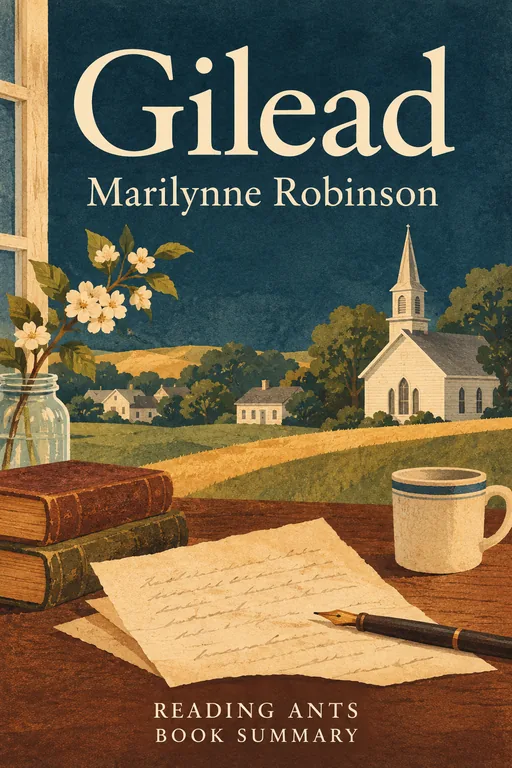
Gilead
In 1956, an elderly Iowa minister named John Ames, who knows that he is dying, writes a long letter to his young son, telling family stories, reflecting on faith and describing the ordinary beauty of life.
Overview
Gilead is a novel by Marilynne Robinson, published in 2004, which won the Pulitzer Prize for Fiction in 2005. It takes the form of a letter written by John Ames, a Congregationalist minister in the small town of Gilead, Iowa, who is seventy-six and has a weak heart. He has a son who is about seven, from a late marriage, and wants to leave him a record of his life and thoughts. The prose is slow, quiet and rich, with meditations on grace, forgiveness and the world’s beauty. The novel is followed by Home, Lila and Jack, which tell related stories from other points of view.
Main Characters
- John Ames: the narrator, an old minister, gentle, thoughtful and aware of his failings.
- Lila: his much younger wife, a quiet woman with a hard past.
- Robby: their young son, to whom the letter is addressed.
- Jack Boughton (John Ames Boughton): his godson and namesake, the prodigal son of his best friend.
- Reverend Robert Boughton: Ames’s old friend, a Presbyterian minister.
- Ames’s father and grandfather: preachers who held opposite views on violence and abolition.
Full Summary
A Letter to a Son
John Ames begins by explaining to his young son that he is writing because he may not be around to see him grow up. He says that his heart is failing, and that he wants the boy to know him. He starts to tell the story of his life, which has been quiet: he has lived in Gilead for almost all of his years, preaching to the same congregation. He recalls the boy’s mother, Lila, who came into the church one rainy day and whom he married, to the surprise of the town.
Fathers and Grandfathers
Ames tells the story of his grandfather, a fierce abolitionist who went to Kansas to fight against slavery and who preached with a pistol, and who lost an eye. His father, a pacifist, quarreled with the old man and the two did not speak for years. Ames reflects on the way that they disagreed about violence, faith and duty, and on how he has tried to understand both. The family history shapes his own sense of what it means to be a minister.
Boughton and Jack
Ames’s old friend Boughton, a minister who is also dying, has a prodigal son, Jack, who has been away for twenty years and who returns to Gilead. Jack’s namesake is Ames himself, which has always been difficult, since Ames has never been able to feel kindly toward the young man, who was a troublemaker and who got a girl pregnant and left. Ames feels a mixture of resentment and sorrow. He suspects that Jack’s visit is meant to hurt him, or to get close to his wife.
The Fire and the Baptism
Ames describes small events: a baptism of cats that he and a friend performed as boys, a fire at a church, the way that sunlight falls on a bush, and the pleasure of seeing his son blow bubbles. He believes that the world is full of holy moments, and says that he has often felt blessed. He also recalls the death of his first wife and child, and the lonely years that followed. His reflections are gentle, but marked by honest grief.
Jack’s Confession
Eventually, Jack speaks with Ames, asking in an oblique way about predestination, and whether some people are doomed. Ames, who has been uneasy, becomes aware that Jack is carrying a secret: that he has a Black wife and a child, who live in Tennessee, and that racial law and social prejudice keep them from living as an ordinary, openly recognized family; her family has also refused him. Ames is moved by the young man’s suffering, and feels the need to extend forgiveness. He blesses him.
Blessing
In his last pages, Ames thinks about death and about the world he will leave, and tells his son to take care of his mother and to live well. He says that he does not know what heaven is like, but believes that there is much beauty in this life, and that it is a gift. He ends with a blessing, and says that he will pray for the boy’s life, and he thanks him for being a joy. The letter closes with a sense of grace.
Why It Matters
Gilead is regarded as one of the finest American novels of the early twenty-first century. It won the Pulitzer Prize and the National Book Critics Circle Award, and helped bring Robinson, who had written only a few books, to international fame. President Barack Obama has said that it is one of his favorite novels, and he later interviewed Robinson.
It is also notable for its treatment of religion in fiction, in a thoughtful, non-dogmatic way, in a literary culture where faith is often treated with suspicion.
Its sequels, Home and Lila, retell parts of the story from other perspectives, and together the novels have been praised as an unusual and patient portrait of a small American town and its moral life.
Key Takeaways
- Grace appears in ordinary moments. Ames finds holiness in daily life.
- Forgiveness can be hard but powerful. He blesses Jack.
- Family history shapes us. Generations affect Ames’s views.
- Mortality sharpens attention. Facing death makes him notice beauty.
- Love is passed through words. The letter is a gift to a son.
What We Can Learn
The novel invites us to slow down and to notice the small beauties of life, like light, water and a child’s play. Ames’s attention to such moments is a model of gratitude.
It also shows how hard it can be to forgive, and what it costs, and invites us to consider those whom we struggle to forgive.
Finally, it suggests that writing to those we love can be a way of giving them our best selves.
It also suggests that attention to our own history, including the quarrels and mistakes of our parents, can help us to understand ourselves with more kindness.
Criticism and Counterpoints
Some readers find the novel too slow, with few events and a very meditative style, and the theological reflections hard to follow. Others point out that the narrator’s view of the world is limited, and that characters such as Lila, and Jack’s Black wife, are seen only from the outside. A few find its Christian outlook narrow, or its handling of racial matters light.
Others feel that the narrator is too saintly. Still, many readers find it deeply moving.
Who Should Read It
This book suits mature teenagers and adults. It is quiet and contemplative, and is best read slowly. Readers who enjoy reflective, language-rich novels will find it rewarding.
A little patience at the start is rewarded.
Want the whole book?
A summary is a taste, not the meal. Here is where to find the full book.
You reached the end 🎉
Nicely done. Mark this one as read, and we will suggest what to read next.
Read this next
The Brothers Karamazov
Fyodor Dostoevsky
When a vulgar, greedy landowner is murdered, his three very different sons, a passionate soldier, a rational intellectual and a gentle novice monk, are drawn into a mystery that is also a debate about faith, doubt, guilt and freedom.
🌍 World Literature
The Color Purple
Alice Walker
Told in letters, the story follows Celie, a poor Black woman in rural Georgia who survives abuse and loss, and through the love of other women finds her voice, her independence and joy.
✨ Modern Fiction
A Prayer for Owen Meany
John Irving
Looking back on his New Hampshire boyhood, John Wheelwright tells of his best friend, Owen Meany, a tiny boy with a strange voice who believes that he is God's instrument, and whose faith shapes both their lives.
✨ Modern Fiction
The Kite Runner
Khaled Hosseini
A wealthy boy in Kabul betrays his loyal best friend on the day of a kite tournament, and decades later, after fleeing to America, he returns to a Taliban-ruled Afghanistan to try to make things right.
✨ Modern Fiction
The Bluest Eye
Toni Morrison
In 1940s Ohio, a poor Black girl named Pecola Breedlove, who believes that she is ugly, prays for blue eyes, and the community's failure to protect her leads to tragedy.
✨ Modern Fiction
Song of Solomon
Toni Morrison
Macon "Milkman" Dead, a self-absorbed young man from Michigan, goes south in search of a family treasure and finds instead his family's history, and learns to take responsibility and to fly.
✨ Modern FictionWant something different?
Pick another topic and we will show you three books to start with.