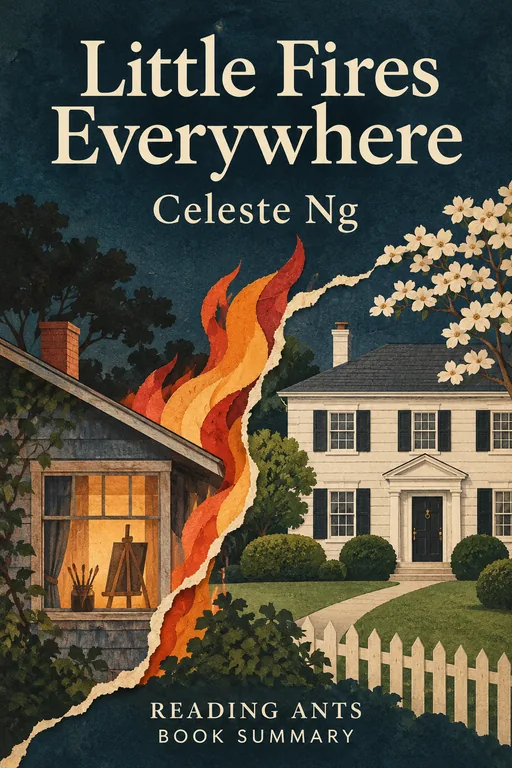
Little Fires Everywhere
In the carefully planned suburb of Shaker Heights, Ohio, the rigid Richardson family and the free-spirited artist Mia Warren and her daughter Pearl become entangled, and a custody battle over a baby exposes class, race and the meaning of motherhood.
Overview
Little Fires Everywhere is a novel by Celeste Ng, published in 2017, and a bestseller that was chosen as the Goodreads Choice Award winner for fiction. It was adapted into a 2020 miniseries starring Reese Witherspoon and Kerry Washington. The story takes place in Shaker Heights, Ohio, in the late 1990s, a community which prides itself on its rules, its progressive ideals and its orderly appearance. The novel opens with a house fire, which the reader later learns was started deliberately, and moves back to tell how it came about. It is a story about mothers and daughters, secrets and the limits of good intentions.
Main Characters
- Elena Richardson: a wealthy, controlling journalist and mother of four who believes in rules.
- Mia Warren: a mysterious, independent artist who moves from place to place with her daughter.
- Pearl Warren: Mia’s teenage daughter, intelligent and curious about the world.
- Izzy Richardson: Elena’s youngest, rebellious daughter.
- Lexie, Trip and Moody Richardson: Elena’s other children.
- Mark and Linda McCullough: a white couple who adopt a baby.
- Bebe Chow: a Chinese immigrant woman who is the baby’s birth mother.
Full Summary
The Fire
The novel opens with the Richardson house in flames, and the family standing outside, suspecting that Izzy, the youngest daughter, is the culprit. The detective finds that there were many small fires, set in each bedroom. The narrative then goes back to the summer before, when Mia Warren and her daughter Pearl arrive in Shaker Heights and rent a small apartment from Mrs. Richardson, who is happy to be a benefactor.
Mia and Pearl
Mia is a photographer who has led a nomadic life, moving whenever she feels she has stayed too long, with Pearl in tow. She makes ends meet by doing odd jobs, and agrees to work as a housekeeper for the Richardsons. Pearl, who has never had a stable home, is thrilled to be in the Richardsons’ orderly world, and befriends the children. Mia’s artwork, which uses unusual materials, is admired, but she keeps her past secret.
Mia’s art consists of photographs that she stages and then develops herself, using materials that she finds. Pearl watches her work, and sees that her mother can turn small things into something beautiful, even as she wonders why they never stay in one place for long.
The Richardsons
The Richardson household is ordered and comfortable, but each member is dissatisfied. Lexie, the eldest daughter, is popular and dates a boy. Trip, a boy, is charming, and Moody, who is sensitive, falls for Pearl. Izzy, who is rebellious, feels that her mother does not understand her, and she attaches herself to Mia, who encourages her creativity. Elena, who is jealous of Mia’s freedom, begins to look into her past.
Elena was born in Shaker Heights and has followed its rules all her life: she believes in being fair, in planning and in doing the right thing. This has made her blind to the ways in which her own life is shaped by advantages, and to the feelings of those she thinks she is helping.
The Baby
A Chinese immigrant woman, Bebe Chow, abandons her infant daughter, May Ling, at a fire station, in a moment of desperation. The baby is adopted by Mark and Linda McCullough, friends of the Richardsons, who have long wanted a child. Bebe, who regrets her choice, wants her baby back, and a bitter custody battle starts. The town divides: Elena sides with the McCulloughs, and Mia, who has met Bebe, supports the birth mother.
The adoption becomes a public issue, with neighbors, lawyers and journalists taking sides. In court, the lawyers argue about what is best for the child, and the question of who is a better mother, a wealthy couple or a poor immigrant, divides families and friends.
Revelations
Elena begins to dig into Mia’s past herself, with help from contacts, and finds that Mia’s story is not what she told. Pearl learns that her mother has hidden the truth about her birth: Mia had agreed to be a surrogate for a wealthy couple, the Ryans, but could not bear to give up the baby and fled with her. That baby was Pearl. Pearl is shocked. Other secrets also come out, including Lexie’s secret abortion, which she had arranged under Pearl’s name, and old loyalties are tested.
Little Fires
The court, while the adoption is still pending, rules in favor of the McCulloughs, and Bebe loses her daughter. Mia, who feels that the system is unjust, resolves to leave, and, with Pearl, leaves town. On her last night, Izzy sets the fires, in her family’s house, as an act of protest and liberation. She leaves separately, to look for Mia and Pearl. The novel ends with Elena, who has lost her house and her illusions, and with Mia and Pearl looking at the road ahead, as Izzy sets off to find her own way.
In the end, Elena realizes how little she knew her youngest daughter, and how her need for control may have pushed her away. The fires are a symbol of the many small acts of anger and rebellion that lead to the blaze.
Why It Matters
Little Fires Everywhere was a bestselling novel, and its television adaptation increased its audience. It was praised for its analysis of privilege, race and motherhood in a community that sees itself as enlightened. Ng’s earlier novel, Everything I Never Told You, was also a success, and she has become a leading voice in contemporary American fiction.
The novel contributes to debates about adoption, surrogacy and how class and race shape the law.
The novel is often discussed in classrooms and book clubs for its treatment of class, race and the question of who gets to decide what is best for a child, and the television series prompted new debate over how closely it follows the book.
Key Takeaways
- Good intentions can mask privilege. The Richardsons think they are generous.
- Motherhood takes many forms. Several women claim the right to a child.
- Rules cannot control life. The community’s order breaks down.
- Secrets can be damaging. Mia’s silence has consequences.
- Art and freedom matter. Mia lives by her own values.
What We Can Learn
The novel asks us to look at how fairness is applied differently to different people, and to question our assumptions about what is best for a child or a family.
It also shows how control can stifle those we love, and encourages us to listen.
Finally, it reminds us that those who seem to have everything may be hiding unhappiness.
It also shows that the people we think of as generous may still hold assumptions that harm others, and that honesty about our own privilege is a first step toward fairness. Listening, not judging, is the better way to help.
Criticism and Counterpoints
Some critics find the novel’s characters types, such as the controlling mother, the free-spirited artist and the rebellious daughter, and say that the plot, with its twists, is overly neat. Others feel that the book’s treatment of race in the custody case is simplified, and that the Chinese mother is less developed than the white characters.
Some also object that the setting of Shaker Heights is portrayed unfairly. Still, many readers find it gripping.
Who Should Read It
This book suits mature teenagers and adults. It is easy to read, with a few mature themes. It is a good book for discussion, especially on family and social class.
Want the whole book?
A summary is a taste, not the meal. Here is where to find the full book.
You reached the end 🎉
Nicely done. Mark this one as read, and we will suggest what to read next.
Read this next
The Help
Kathryn Stockett
In 1962 Jackson, Mississippi, a young white woman named Skeeter secretly collects the stories of Black maids who work in white homes, putting them all at risk in the heat of the civil rights movement.
✨ Modern Fiction
The Corrections
Jonathan Franzen
An aging Midwestern couple, Alfred and Enid Lambert, hope to bring their three grown children home for one last family Christmas, but each of the siblings is struggling with a crisis of their own.
✨ Modern Fiction
Normal People
Sally Rooney
Marianne and Connell, two teenagers from a small town in the west of Ireland, begin a secret relationship at school, and over the next four years, as they move to Trinity College in Dublin, they drift together and apart.
✨ Modern Fiction
The Kite Runner
Khaled Hosseini
A wealthy boy in Kabul betrays his loyal best friend on the day of a kite tournament, and decades later, after fleeing to America, he returns to a Taliban-ruled Afghanistan to try to make things right.
✨ Modern Fiction
The Bluest Eye
Toni Morrison
In 1940s Ohio, a poor Black girl named Pecola Breedlove, who believes that she is ugly, prays for blue eyes, and the community's failure to protect her leads to tragedy.
✨ Modern Fiction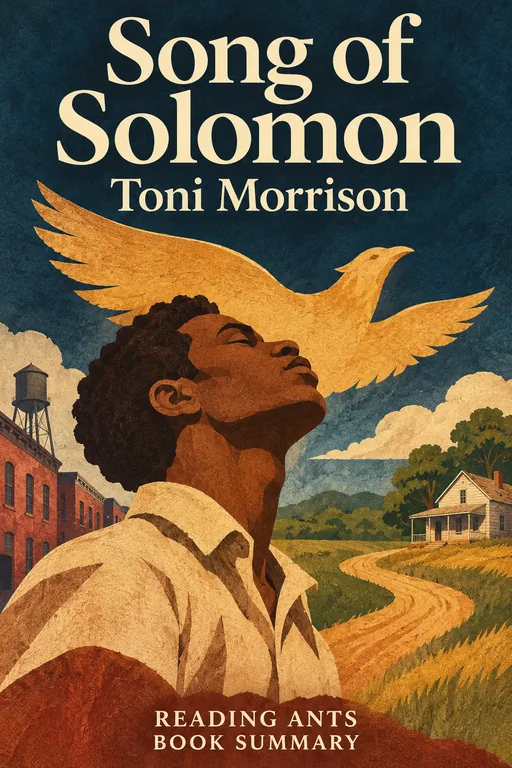
Song of Solomon
Toni Morrison
Macon "Milkman" Dead, a self-absorbed young man from Michigan, goes south in search of a family treasure and finds instead his family's history, and learns to take responsibility and to fly.
✨ Modern FictionWant something different?
Pick another topic and we will show you three books to start with.