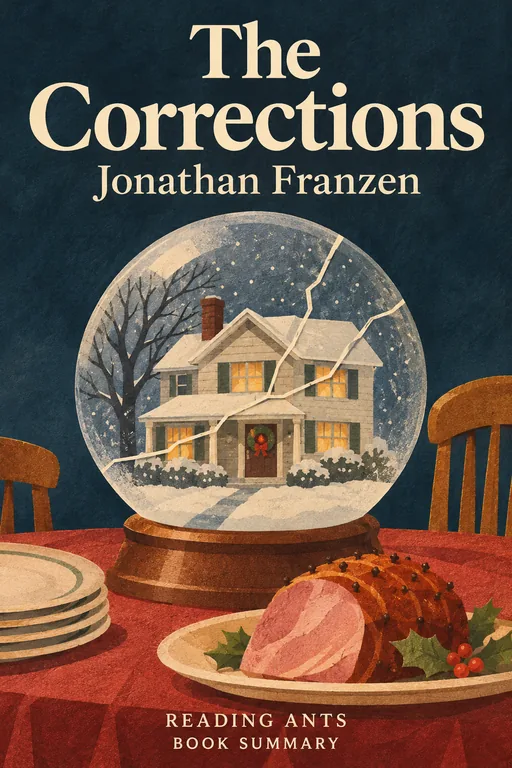
The Corrections
An aging Midwestern couple, Alfred and Enid Lambert, hope to bring their three grown children home for one last family Christmas, but each of the siblings is struggling with a crisis of their own.
Overview
The Corrections is a novel by Jonathan Franzen, published in 2001, which won the National Book Award and was a finalist for the Pulitzer Prize. It is a long, satirical family saga set in the late 1990s, mostly in the fictional town of St. Jude in the Midwest and on the East Coast. Alfred, a retired railroad engineer, suffers from Parkinson’s disease and dementia, and his wife Enid wants to gather the family. The children, Gary, Chip and Denise, have fled to the East Coast and to their own troubles. The title refers to market corrections, the adjustments in the economy, as well as to the personal corrections that the characters try to make.
Main Characters
- Alfred Lambert: the father, a stubborn, stoic man whose mind is failing.
- Enid Lambert: the mother, anxious, controlling and desperate for a family Christmas.
- Gary Lambert: the eldest son, a banker who is wealthy and depressed.
- Chip Lambert: the middle son, a former professor whose career has collapsed.
- Denise Lambert: the youngest, a talented chef with a complicated love life.
- Caroline Lambert: Gary’s wife.
- Brian Callahan and Robin Passafaro: Denise’s boss and his wife, both of whom she has affairs with.
Full Summary
The Parents in St. Jude
The novel begins with Alfred’s decline: his hand trembles, he sees hallucinations, such as a turd that talks, and he is increasingly unsteady. Enid, who has put up with a lifetime of her husband’s moods, wants to keep up appearances. She is eager for the whole family to gather for the last Christmas in the family home. Meanwhile, she is tempted by a drug that promises to cure Alfred, which she has seen advertised. The marriage is shown to be both comic and moving.
Gary
Gary, the eldest, lives in Philadelphia with his wife Caroline and three sons. He is a banker, and a successful man in the eyes of the family, but he is in fact depressed, which he denies, and feels that Caroline and the children conspire against him. His efforts to avoid his parents are comic. He invests in a company, while struggling to keep up his sense of control, and slips into a tangle of resentments.
He is also a father who worries that his young son is being turned against him, and his struggles are an uneasy mixture of real depression and comic self-pity. His wife Caroline, who is more aware than he thinks, tries to manage the family while resisting his control.
Chip
Chip, a former professor, lost his job after an affair with a student, and is writing a screenplay. He is in debt, and tries to pay off by taking a job helping a Lithuanian politician to defraud investors in an Eastern European scheme. In Vilnius, he is swept into a world of corruption, in which his own intelligence offers little help. His story is a mix of high comedy and farce, and he ends up fleeing, helped by his sister Denise.
Denise
Denise is a successful chef, who has become the star of a restaurant opened by her boss, Brian Callahan. Her love life is complicated: she has affairs with both her married boss, Brian, and his wife, Robin, and she is drawn to people she should not be. She loses her job in the fallout, and her father’s illness draws her back to the family.
The Cruise
Enid, hoping to unite the family, goes on a cruise with Alfred, arranged as a kind of last family outing. In a harrowing scene on the ship, Alfred, drugged and confused, suffers a frightening episode, and the cruise ends in disaster. The family finally has to confront the fact that he can no longer care for himself.
The Last Christmas
The siblings come home for the Christmas that Enid has dreamed of, and the occasion is only partly satisfactory. Gary is distant, Chip arrives late and chastened, and Denise is hurt. Alfred, by now very ill, speaks in fragments, and after a disastrous Christmas morning the family has to accept that he cannot stay at home. He is moved into a nursing home, where he later dies. The novel closes with Enid, who has become a widow and learned to enjoy a new freedom, and the children going on with their lives, all making small corrections.
Enid, in the final chapters, finds that after Alfred’s death, she is free to take trips, to spend her money and to make new friends, which she had not expected. The correction that she makes is to stop living for appearances, and her small joys are the novel’s most touching surprise.
Why It Matters
The Corrections was a major event in American fiction, and it made Franzen a celebrity, particularly after a controversy in which he expressed ambivalence about the novel’s selection for Oprah’s Book Club and his invitation to appear on her show was withdrawn. It is regarded as one of the best novels of the early twenty-first century, and has been compared to the great social novels of earlier eras. It is admired for its portrait of an American family and for the way it combines satire with sympathy.
The book is widely taught, and has led to many discussions of family, aging and consumer culture.
Key Takeaways
- Families are complicated. Love and resentment coexist.
- Aging is hard on everyone. Alfred’s decline affects the family.
- Success does not guarantee happiness. Gary is wealthy but unhappy.
- We often misjudge ourselves. The children are mistaken about their lives.
- Small corrections matter. Change can come slowly.
What We Can Learn
The novel invites us to look with compassion at our parents and at our own family patterns. Enid’s pushiness is also an expression of love and fear, and seeing that can help us respond with patience.
It also shows how our culture’s focus on achievement and self-image can cause suffering, and encourages us to look for what is truly valuable.
Finally, it reminds us that caring for an aging parent is difficult, and that families need honesty and support.
Criticism and Counterpoints
Some critics find the novel’s characters unlikable, and its tone sometimes sneering, particularly in its attitudes toward women and popular culture. Others find the plot lines uneven, and the Lithuanian adventure implausible. The book is long, and some find it self-indulgent.
Others have criticized Franzen’s public remarks, and the extent of the media attention. Still, many consider the book a major achievement.
Franzen has also been criticized for focusing mainly on white, middle-class characters.
Who Should Read It
This book suits mature readers. It is long and detailed, with sexual content, drug use and a depiction of dementia. It is a good choice for readers who enjoy family sagas with humor and insight.
Want the whole book?
A summary is a taste, not the meal. Here is where to find the full book.
You reached the end 🎉
Nicely done. Mark this one as read, and we will suggest what to read next.
Read this next

White Noise
Don DeLillo
Jack Gladney, a professor of "Hitler studies" at a small American college, tries to live a normal family life while an airborne toxic event, consumer culture and a terror of death crowd in on him.
✨ Modern Fiction
The Great Gatsby
F. Scott Fitzgerald
A mysterious millionaire throws lavish parties on Long Island in the hope of winning back the woman he loved years ago, but his dream collides with the careless cruelty of the rich.
📜 Classics
White Teeth
Zadie Smith
Two wartime friends, the Englishman Archie Jones and the Bangladeshi Samad Iqbal, and their families live and clash in multicultural North London over several decades, in a comic novel about identity, roots and chance.
✨ Modern Fiction
A Prayer for Owen Meany
John Irving
Looking back on his New Hampshire boyhood, John Wheelwright tells of his best friend, Owen Meany, a tiny boy with a strange voice who believes that he is God's instrument, and whose faith shapes both their lives.
✨ Modern Fiction
The Kite Runner
Khaled Hosseini
A wealthy boy in Kabul betrays his loyal best friend on the day of a kite tournament, and decades later, after fleeing to America, he returns to a Taliban-ruled Afghanistan to try to make things right.
✨ Modern Fiction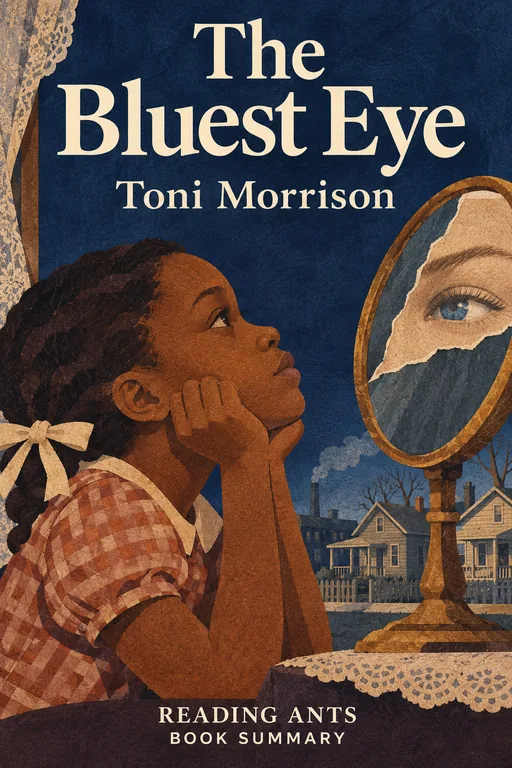
The Bluest Eye
Toni Morrison
In 1940s Ohio, a poor Black girl named Pecola Breedlove, who believes that she is ugly, prays for blue eyes, and the community's failure to protect her leads to tragedy.
✨ Modern FictionWant something different?
Pick another topic and we will show you three books to start with.